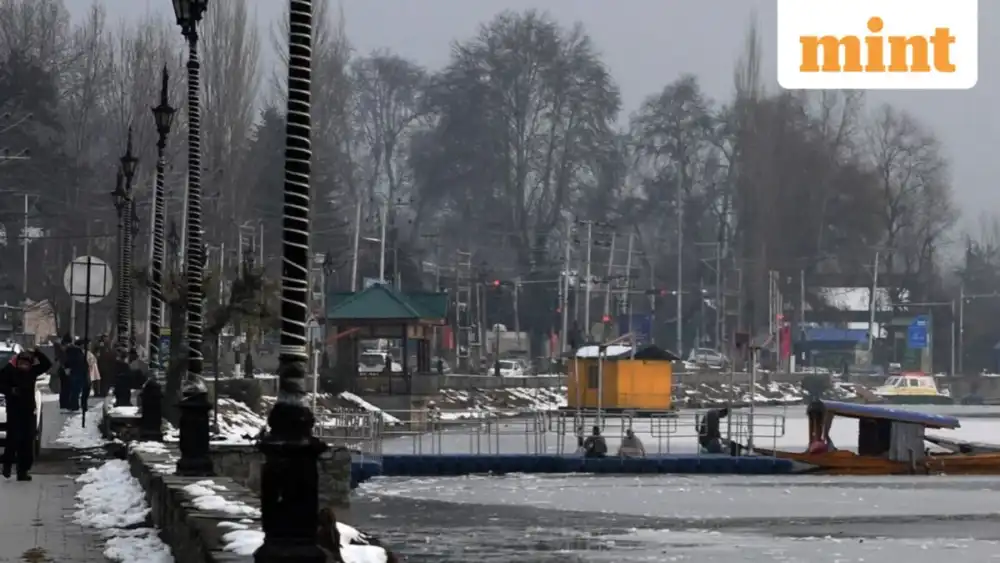
In Srinagar’s historic Safa Kadal district, Nazir Ahmad Parray, a 65-year-old artisan renowned for his intricate Kashmiri embroidery, recalls winters dramatically different from the present. He speaks of snow piling high on rooftops, blanketing the landscape until March, a ubiquitous feature of his youth. This year, however, February unfolded with an unseasonal warmth, the sun shining brightly on parched ground. "We grew up playing in the snow," Parray laments, "Now, we don’t wait for snow to play; we wait for electricity. When snowfall is less, the canals run low, and the hydropower plants slow down. That means more power cuts for us." This poignant shift from abundant snow to prolonged periods of aridity underscores a profound and accelerating crisis for Jammu and Kashmir (J&K), a region whose energy economy has historically been inextricably linked to its majestic, snow-fed rivers.
This disappearing snow, a critical source for centuries, is triggering a cascading effect across the Union Territory. Rivers are experiencing reduced flows, leaving a region heavily reliant on hydropower grappling with severe energy deficits. The very foundation of J&K’s energy security, built upon the pristine glacial melt and winter precipitation of the Himalayas, is now under unprecedented strain, exposing acute vulnerabilities in its economic infrastructure and daily life.
The empirical evidence of this climatic upheaval is starkly reflected in recent meteorological data. The India Meteorological Department (IMD) reported an alarming overall rainfall and snowfall deficit of 39% across the Union Territory during the current winter season. This shortfall was not uniform; many districts witnessed significantly below-normal precipitation, with the period between October 1 and December 31, 2025, recording just 77.5mm of rainfall against a normal average of 127.7mm. The situation deteriorated further in January, with the first three weeks alone witnessing an extraordinary 96% shortfall. These deficits are more than mere statistics; they are critical indicators, as winter precipitation directly determines the volume of water available to sustain river systems and subsequent hydropower generation throughout the spring and summer months.
The current crisis, while immediate, is also symptomatic of a longer, more disturbing trend. Weather analysts confirm that dry winters and erratic snowfall patterns have become increasingly frequent over the past six years. In 2024, J&K experienced its driest year in nearly five decades, receiving only 870.9mm of rainfall against a normal annual average of 1,232.3mm, representing a significant deficit of 29%. This follows a consistent pattern of below-normal rainfall for five consecutive years, with deficits of 7% in 2023, 16% in 2022, 28% in 2021, and 20% in 2020. This prolonged period of aridity is systematically destabilizing the snow-fed river systems crucial for the region’s electricity generation, drastically reducing the discharge required to operate hydropower plants at optimal capacity.
Even prior to the intensified impacts of climate change, J&K’s hydropower sector faced chronic challenges during winter. Freezing temperatures historically locked river water in snow and ice, naturally reducing flows and forcing many run-of-the-river projects to curtail generation precisely when electricity demand peaked due to heating requirements. Experts highlight that current winter shortages are a complex interplay of both structural and climatic factors. Dry winter weather exacerbates sub-zero conditions, causing surface runoff to freeze and disrupting the steady water flow essential for generation. Unlike much of the country, J&K’s hydropower infrastructure relies heavily on real-time runoff from rivers and canals, snowmelt, glaciers, and direct catchment contributions. When these sources diminish or freeze, generation plummets, necessitating costly power imports.
Iftikhar A. Drabu, a veteran consulting civil engineer with extensive experience in the hydropower sector, articulates the gravity of the situation, noting that the entire Himalayan region, including J&K, is already designated as one of the most water-stressed zones globally. He asserts that prolonged dry spells are compounding this existing vulnerability. "Dry winters will adversely affect hydropower generation," Drabu warns. "Most of our major plants were built over decades by the National Hydroelectric Power Corporation (NHPC), and we have failed to add new capacity of our own to strengthen local generation." This dependency on central projects, coupled with insufficient local investment in capacity expansion, leaves the region highly susceptible to climatic shocks.
The immediate fallout on local power availability this season has been severe, highlighting the precariousness of J&K’s energy matrix. Officials report that generation from J&K’s own powerhouses has plummeted to approximately 105MW, a stark contrast to their installed capacity of 1,140MW. This dramatic reduction is primarily attributed to significantly reduced water discharge in rivers and canals. This collapse in indigenous supply has coincided with a sharp surge in winter electricity demand, particularly within the Kashmir Valley, where heating requirements drive consumption peaks. The widening chasm between supply and demand has compelled the J&K government into deeper fiscal dependence on imported electricity. In the last financial year alone, the administration reported spending a staggering ₹9,250 crore to purchase power from the national grid. As dry spells lengthen and the reliability of hydropower diminishes, profound concerns are mounting over the region’s energy security and the efficacy of its long-term strategic planning.
Mudasir Nabi, an engineer with the J&K Power Development Corporation Ltd, points to a concerning trend: the contraction of the hydropower generation cycle itself. "Our peak generation period, which usually runs from late April to the end of September, has begun to shrink," Nabi explains. "We have studied this closely, and the energy shortfall is becoming more visible now." He warns that if snowless winters and intensifying summer heatwaves continue to accelerate glacier melt, power generation will decline further. In such a scenario, J&K faces a difficult predicament. "We will be forced to look for alternatives, but we do not have wind or coal resources, nor do we yet have a strong solar base. In that scenario, we have little option but to rely on power imports." Nabi emphasizes that a wetter winter remains critical for rebuilding the water base essential for hydropower, stressing that glaciers are the region’s "water banks" upon which all projects depend.
Beyond the climatic and economic pressures, the energy landscape in J&K is intricately woven with socio-political dynamics. Power remains one of the most discussed subjects in Kashmir, shaped as much by economic realities as by long-running political narratives. Of the erstwhile state’s total installed capacity of around 3,500MW, only about 1,140MW originates from J&K-owned plants, including Baglihar (900MW), Lower Jhelum (110MW), and Upper Sindh (110MW). The remaining 2,300MW, representing a substantial 64% of J&K’s hydropower capacity, is contributed by central projects operated by NHPC, such as Salal, Dul-Hasti, Uri, and Kishanganga. The Union Territory receives only a 13% free supply from these central projects, necessitating the purchase of additional power as per the power purchase agreements signed for each NHPC installation.
This structural imbalance has historically fueled a political narrative in Kashmir, reinforced by regional political parties and separatist outfits, that local resources are being exploited for external benefit while the region itself grapples with chronic power shortages. Officials contend that this deeply ingrained belief has generated resistance to crucial reforms, including the installation of smart meters and low transmission cabling. These measures, championed by the power development department, are deemed vital for curbing power pilferage, illegal hooking, and electricity theft, which contribute significantly to high aggregate technical and commercial (AT&C) losses—a pervasive issue across India’s power sector, but particularly pronounced in regions with complex socio-political dynamics.

Even policy interventions, such as the Centre’s decision last year to place aspects of the Indus Waters Treaty in abeyance following geopolitical tensions, are deemed unlikely to fundamentally alter hydropower generation capabilities in J&K. Drabu clarifies that hydropower projects in the region are predominantly run-of-the-river based. This design means that simply storing more water, while beneficial for irrigation or other uses, does not automatically translate into higher electricity production, as generation is tied to immediate river flow rather than large-scale reservoir capacity.
Underlying these immediate challenges is a deeper, structural disruption within the region’s climate system, as elucidated by Kashmir-based independent weather analyst Faizan Arif. He highlights that hydropower generation in J&K is being critically affected by declining winter snowfall and persistently rising temperatures. "Reduced snow accumulation and accelerated glacier loss are weakening the meltwater buffer that sustains river flows during lean months, lowering inflows for run-of-the-river projects and cutting firm power availability," Arif explains. Himalayan glaciers act as vital natural reservoirs, gradually releasing meltwater through spring and summer to maintain river flows that feed major hydropower projects on critical rivers like the Chenab, Jhelum, and Kishanganga, powering several NHPC plants.
Scientific investigations corroborate this alarming narrative. Studies, notably those led by Anil V. Kulkarni, former scientist at the Indian Institute of Science, Bengaluru, leveraging satellite data from the Indian Space Research Organisation (ISRO)’s National Remote Sensing Centre, have revealed that J&K has already witnessed a nearly 30% reduction in its glacial mass over the past six decades. Climate scientists issue stark warnings that up to 70% of these glaciers could vanish by the end of this century if current warming trends persist. With 18,000 glaciers across J&K and Ladakh steadily thinning and retreating at rates of 15-20 meters per year, the hydropower that once underpinned the region’s energy security is proving to be inherently unsustainable as a standalone solution.
Mohammad Muslim, Assistant Professor in the Department of Environmental Science at the University of Kashmir, further elaborates on the operational challenges stemming from climate change, including erratic generation patterns, elevated operational costs, and significant silt loads during spring. These factors not only diminish the overall efficiency of hydropower projects but also reduce their effective storage capacity and increase maintenance requirements, thereby escalating the cost of electricity production.
In the face of ‘blue gold’ losing its lustre, J&K is strategically reorienting its energy policy towards a solar-led future. To bridge the widening winter energy gap and build long-term resilience, the government is aggressively pushing for the solarization of both government buildings and residential homes through rapid rollout schemes such as the PM Surya Ghar Muft Bijli Yojana. The overarching goal is to transform rooftops into distributed power plants, thereby insulating the grid from the inherent volatility of hydropower and turning to solar energy for the stability that melting mountains can no longer guarantee.
Shahid Choudhary, former Secretary to the Government in the Department of Science and Technology, underscores that the administration views solar energy as a crucial long-term complement to hydropower, rather than a complete substitute. "As we expand solar schemes, hydropower will increasingly work alongside solar and wind in hybrid models," Choudhary explains. "The focus is on building a sustainable and clean energy system that reduces seasonal vulnerabilities." Solar deployment is being prioritized across multiple sectors, particularly agriculture, which remains highly susceptible to erratic grid supply. Unstable electricity directly impacts irrigation systems and overall farming operations. Last year alone, approximately 4,000 solar pumps were installed, collectively generating about 14MW of power for agricultural and irrigation needs, significantly enhancing resilience for local farmers.
The strategic deployment extends to public infrastructure, with nearly 8,000 government buildings already solarized through the J&K Energy Development Agency (JAKEDA) out of a target of 12,900. These installations currently generate close to 78MW, with an ambitious target set for 120MW. Solar schemes are continually being revised and accelerated to expedite this critical energy transition. Collectively, the Union Territory has made demonstrable progress in solar integration, with Mehmood Shah, Managing Director of the Kashmir Power Development Corporation Ltd, reporting the installation of 33,975 grid-connected rooftop solar systems, aggregating approximately 177MW of capacity across the region.
Yasir Altaf, Assistant Professor in the Department of Environment Sustainability and Climate Change at the Islamic University of Science and Technology, advocates for integrating climate-resilient planning into energy strategy. He highlights solar generation’s relative reliability during prolonged dry spells and lean-season low river flows, emphasizing its potential to complement hydropower and significantly mitigate climate-related risks in the power sector. This synergy is key to achieving a more stable and robust energy infrastructure.
The economic incentives driving this transition are substantial, as exemplified by Drabu’s own experience with the government’s grid-connected solar rooftop scheme, which offers subsidies up to 65% of installation costs. "From mid-March to mid-November, I don’t pay any electricity bill because my solar plant generates more power than I consume," Drabu states. "The surplus energy is stored in a battery and drawn upon during winter, when usage rises sharply and generation drops." The J&K power development department’s latest tariff schedule illustrates these subsidies: a 3kW system, common for households, has a market price of ₹1.59 lakh, but combined central and Union Territory subsidies reduce the payable amount to ₹64,700. Larger installations, such as a 10kW rooftop solar system priced at ₹5.06 lakh, receive a subsidy of ₹94,800, leaving consumers to bear an expense of ₹4.11 lakh.
However, Drabu also offers a pragmatic caution, stressing that solar power cannot entirely supplant hydropower as the sole source of sustainable clean energy, particularly within Kashmir. He points to limitations such as restricted land availability, which constrains the development of large-scale solar parks, and a finite number of clear-sky days, especially during the crucial winter months. "A hybrid approach works better," he suggests. "Solar can meet daytime demand, while hydropower is utilized at night. Relying entirely on solar is not feasible here because of limited clear-sky days and the lack of land for large-scale projects." This nuanced perspective underscores the necessity of a diversified, multi-pronged strategy.
The unfolding energy narrative in Jammu and Kashmir serves as a microcosm of the broader global challenge posed by climate change, particularly in fragile ecosystems like the Himalayas. Given the immediate and future challenges emanating from climatic shifts, J&K’s imperative is clear: it must diversify its energy sources, develop resilient infrastructure, implement sustainable water management practices, and foster continued innovation in energy technologies. Only through a comprehensive, adaptive, and politically astute strategy can the Union Territory ensure its energy security, keep the lights on for its citizens, and pave the way for a sustainable economic future in the face of a rapidly changing climate.