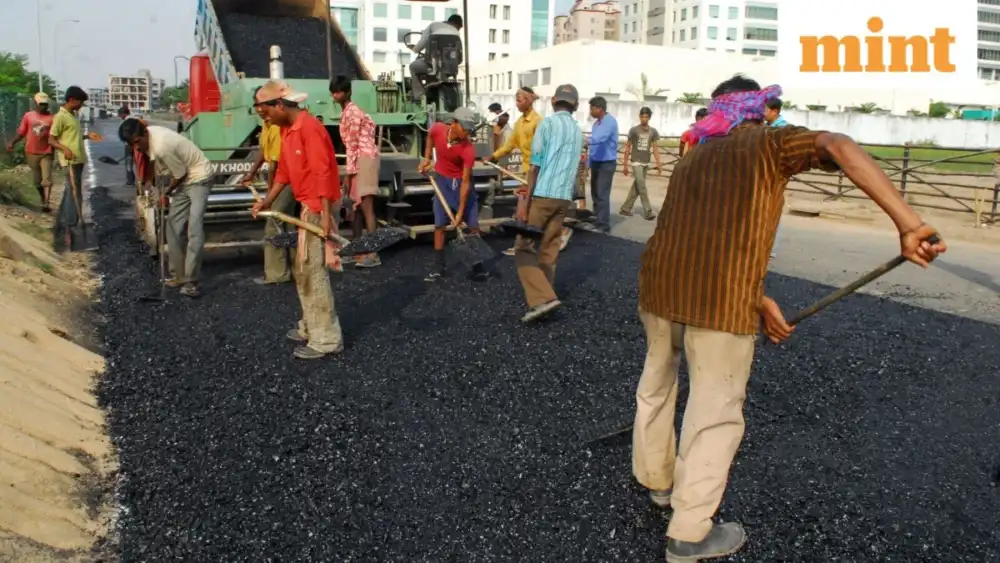
India’s ambitious drive to bolster its national highway network faces an anticipated slowdown over the next two fiscal years, a development that could have significant implications for the nation’s economic growth trajectory and the health of its construction sector. Projections indicate a moderation in road construction pace, primarily attributed to a sustained period of subdued project awards, which has consequently tightened the order books of developers and is expected to constrain execution capabilities. This deceleration comes at a critical juncture for India, where robust infrastructure development is seen as a cornerstone of its aspiration to become a developed economy.
The Ministry of Road Transport and Highways (MoRTH) is projected to complete between 9,500 and 10,000 kilometers of roads in Fiscal Year 2026 (FY26), followed by a further dip to 9,000-9,500 kilometers in FY27. These figures mark a notable decline from the 10,660 kilometers achieved in FY25, signaling a potential tempering of the rapid expansion witnessed in previous years. This moderation is not an isolated incident but rather a cumulative effect, reflecting three consecutive years of lower project awarding, which forms the lifeblood of the construction pipeline. For instance, project awards are estimated to remain largely flat at 7,250-7,750 kilometers in FY26, compared to 7,538 kilometers in FY25. While seemingly stable year-on-year, these numbers fall significantly short of the robust awarding levels observed between FY21 and FY23, periods characterized by accelerated government spending on infrastructure.
The impact of this awarding drought is already manifesting in current execution figures. In the initial eight months of FY26, project awards plummeted by 24% year-on-year, reaching just 1,951 kilometers. Although numerous projects are reportedly in various stages of bidding, the finalization and award process has been protracted, leading to expectations of a concentrated surge in the fourth quarter. Similarly, execution under the MoRTH saw a 3% decline, with 4,612 kilometers constructed between April and November of FY26, down from 4,761 kilometers in the corresponding period a year earlier. This dip is directly linked to the shrinking backlog of orders for developers and was exacerbated by disruptions stemming from an early onset and prolonged monsoon season across various parts of the country. Suprio Banerjee, a co-group head of corporate ratings at a leading ratings agency, underscored this trend, noting that "owing to the shrinking order book of road developers amid continued slowdown in project awarding and disruptions caused by the early onset and elongated monsoon across the country, road construction under the ministry is expected to decline."
The financial health and operational stability of road developers are now under considerable scrutiny. Revenue growth for these companies is anticipated to remain subdued over the next 12 to 15 months, largely due to the typical lag of six to nine months between a project award and the commencement of billing. This creates a challenging environment where competition for new projects is expected to intensify, compelling companies to bid aggressively to replenish their dwindling order books and sustain operational momentum. This aggressive bidding behavior has been a persistent feature in projects tendered by both MoRTH and the National Highways Authority of India (NHAI), despite the reintroduction of earnest money deposits and additional performance security requirements, measures usually designed to deter frivolous bids and ensure serious participation.

Market data reveals the extent of this cutthroat competition. Approximately 71% of Engineering, Procurement, and Construction (EPC) projects awarded by NHAI and MoRTH over the past three years were secured at significant discounts, often exceeding 20% of the base prices. This phenomenon is a direct consequence of limited project awards juxtaposed with a high number of bidders vying for each opportunity. A similar trend is evident in Hybrid Annuity Model (HAM) projects, where bidding discounts have steadily widened over the past four years. Discounts in HAM projects stood at around 16% in FY25, escalating further to approximately 21% in the first ten months of FY26. Such aggressive pricing strategies, while potentially beneficial for the awarding authorities in the short term, raise concerns about the long-term profitability and financial viability of the developers, potentially impacting project quality or future investment capacity.
Paradoxically, despite the slowdown in new project awards and execution, toll collections on existing highway networks have remained remarkably robust. This divergence highlights the strong underlying demand for functional infrastructure, driven by sustained economic activity. Toll revenue is projected to grow by a healthy 7-9% in FY26. While this growth may ease slightly to 6-8% in FY27, primarily due to muted toll rate hikes linked to softer wholesale price inflation, traffic growth is expected to remain strong, bolstered by India’s robust overall economic performance. For instance, inflation-linked toll increases are estimated at about 3.3% for newer projects, tied to December’s wholesale price index readings, and 2.5-3.0% for older assets, linked to March inflation data in FY27. Furthermore, the nationwide rollout of the FASTag electronic toll collection system, initially facing operational challenges, has largely stabilized, with most developers now receiving weekly payouts from authorities, indicating improved efficiency and collection mechanisms on existing assets.
The broader economic ramifications of a sustained slowdown in highway construction are substantial. Infrastructure development, particularly roads, serves as a critical engine for economic growth, fostering connectivity, reducing logistics costs, and facilitating trade and commerce. A deceleration in this sector could ripple through various allied industries, including cement, steel, construction equipment, and aggregates, potentially impacting their demand outlook and capacity utilization. India’s ambitious goal of reducing its logistics costs as a percentage of GDP, currently higher than many developed nations, heavily relies on a modern and efficient road network. Any significant slowdown could impede progress towards this crucial competitiveness objective. Moreover, the infrastructure sector is a major employer, both directly in construction and indirectly through upstream and downstream industries. A contraction in project activity could lead to job losses and affect livelihoods, particularly for the vast workforce engaged in manual labor.
Looking ahead, the government’s continued emphasis on capital expenditure, as outlined in recent budgets, signals an unwavering commitment to infrastructure. However, the current bottleneck appears to be in the project awarding phase. Reasons for this slowdown could be multifaceted, ranging from more stringent land acquisition processes and environmental clearances to potential budgetary reprioritizations or a more cautious approach to project structuring and risk allocation. Historically, such periods of moderation have often been followed by renewed impetus, especially after major political cycles stabilize. The long-term necessity of a world-class road network for India’s growing economy, expanding urban centers, and strategic national development objectives remains undeniable. Therefore, while the immediate outlook suggests a moderation, policy interventions, including streamlining project clearances, de-risking investment, and exploring innovative financing models like asset monetization and greater private sector participation (BOT, HAM), will be crucial to reignite the pace and ensure India’s highway ambitions stay on track for its journey towards a developed economy. The coming months will be critical in determining whether this slowdown is a temporary speed bump or a more prolonged challenge to India’s infrastructure aspirations.