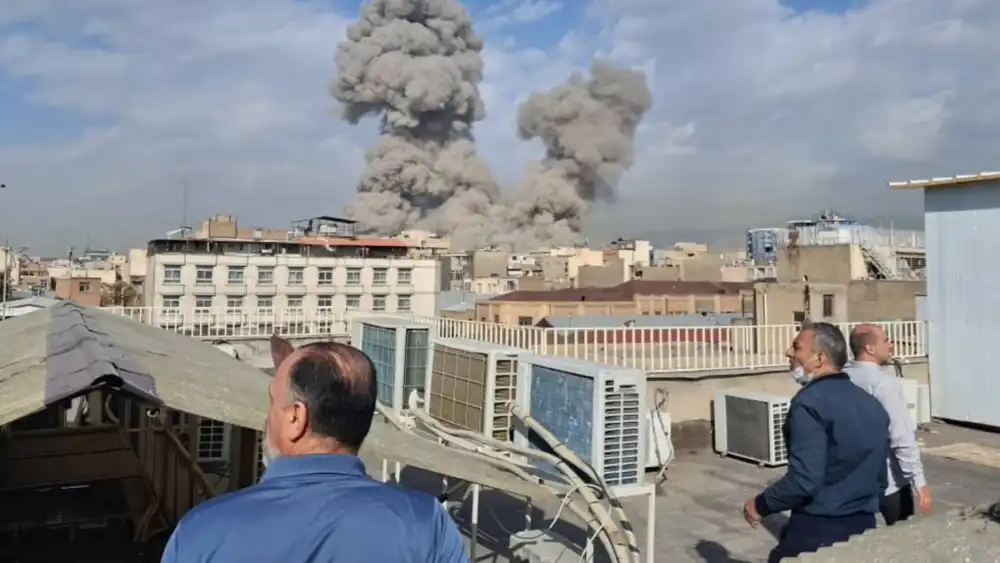
The rhythmic start of the Iranian working week was abruptly shattered by the thunderous echoes of precision strikes, marking a seismic shift in the long-standing "shadow war" between Israel and the Islamic Republic. As the sun rose over Tehran, the immediate physical damage to military installations was secondary to the profound psychological and economic tremors felt across the region. This direct confrontation, characterized by hundreds of aircraft targeting strategic air defense and missile production facilities, represents a departure from decades of proxy engagement, thrusting the Middle East into an era of high-stakes, direct military maneuvering. For global markets, the event served as a critical stress test, revealing both the fragility of regional stability and the complex calculus of modern energy security.
The immediate reaction in global financial markets was one of calibrated relief, followed by cautious reassessment. In the weeks leading up to the strikes, the "geopolitical risk premium" had added significant volatility to Brent crude futures, with prices fluctuating based on the perceived likelihood of an attack on Iran’s energy infrastructure. However, as news emerged that the strikes avoided the Kharg Island oil terminal and the country’s nuclear facilities, oil prices saw a surprising downward correction. Brent crude, which many analysts feared could spike toward the $100 mark in the event of a total regional war, instead settled lower as the market internalized the "measured" nature of the retaliation. This reaction highlights a peculiar paradox in contemporary economics: the mere avoidance of a worst-case scenario can often trigger a market rally, even as the underlying geopolitical foundations remain precarious.
Despite the relative calm in global oil benchmarks, the domestic Iranian economy faces a far more harrowing reality. Even before the latest escalation, Iran was grappling with systemic economic headwinds, including chronic inflation hovering above 40 percent and a currency, the rial, that has seen its value evaporate against the US dollar. The strikes coincided with a period of intense fiscal pressure for the Pezeshkian administration, which has been attempting to navigate a path toward sanctions relief while maintaining its regional "Axis of Resistance." The psychological blow of a direct strike on the capital has further weakened the rial on the informal market, as citizens scramble for hard currency and gold, viewing them as the only reliable hedges against a potential total collapse of domestic stability.
The economic impact of this escalation extends far beyond the borders of Iran, impacting the broader logistics and insurance landscapes of the Persian Gulf. The Strait of Hormuz, a maritime chokepoint through which approximately 20 percent of the world’s total oil consumption passes, remains the ultimate "red line" for global commerce. While the recent strikes did not directly target shipping, the increased threat level has forced maritime insurers to maintain elevated war-risk premiums for vessels navigating the region. For major shipping conglomerates, the cumulative cost of these premiums, combined with the potential for rerouting around the Cape of Good Hope, adds a persistent inflationary pressure to global supply chains that were already recovering from the disruptions of previous years.
From a strategic perspective, the nature of the targets chosen—specifically S-300 air defense batteries and facilities involved in the production of solid-fuel missiles—suggests a meticulous effort to degrade Iran’s defensive and offensive capabilities without triggering an immediate, existential response. This "deterrence by denial" strategy aims to leave the Iranian leadership feeling vulnerable, knowing that their most sensitive sites are within reach, while simultaneously offering an "off-ramp" by sparing the economic lifeblood of the nation: its oil refineries. This delicate balancing act was reportedly the result of intense diplomatic coordination between the Israeli government and the Biden administration, the latter of which remains focused on preventing a regional conflagration that could destabilize global energy markets ahead of critical political cycles.
Expert insights into the military-economic nexus suggest that we are witnessing a new form of "asymmetric economic warfare." By targeting the production lines for the very drones and missiles that Iran exports to its proxies and to Russia for use in Ukraine, the strikes serve to disrupt not just Iranian military power, but its growing role as a defense exporter. This "defense-industrial" impact is a critical component of the broader strategy to isolate Tehran economically. If Iran cannot fulfill its export obligations or maintain its own stockpiles due to the destruction of manufacturing equipment that is difficult to replace under current sanctions, the fiscal burden of rebuilding will drain an already depleted national treasury.
Global comparisons illustrate the unique danger of the current situation. Unlike the Cold War-era standoffs, which were often governed by clear "red lines" and established communication channels, the current Israel-Iran confrontation is characterized by a lack of direct dialogue and a reliance on signals sent through kinetic action. This increases the risk of miscalculation. Economists often point to the 1973 oil crisis as a cautionary tale of how Middle Eastern conflict can trigger global stagflation. While the world today is less dependent on Middle Eastern oil than it was in the 1970s—thanks to the rise of US shale production and the acceleration of the green energy transition—the region remains the marginal supplier that sets the global price. A sustained disruption could still derail the "soft landing" that central banks in Washington and Frankfurt have been painstakingly engineering.
Furthermore, the role of regional actors like Saudi Arabia and the United Arab Emirates has shifted significantly. Once seen as protagonists in the anti-Iran bloc, these Gulf monarchies have recently pursued a policy of "de-escalation and diversification." Their reaction to the strikes has been one of condemnation of the violation of sovereignty, reflecting a desire to protect their own ambitious economic transformation projects, such as Saudi Arabia’s Vision 2030. For Riyadh and Abu Dhabi, any regional war is an existential threat to their status as emerging global hubs for tourism, finance, and technology. The economic cost of regional instability is now measured not just in barrels of oil, but in lost foreign direct investment (FDI) and the potential flight of high-net-worth individuals and multinational corporations.
As the smoke clears over the Iranian capital, the long-term economic forecast remains clouded by uncertainty. The "new normal" is one where direct strikes are no longer unthinkable, and where the global economy must permanently price in the risk of a major energy producer being drawn into a hot war. The resilience of the global financial system is being tested by a transition from a world of "just-in-time" efficiency to one of "just-in-case" security. This shift requires a fundamental re-evaluation of sovereign risk, particularly for emerging markets that are sensitive to energy prices and dollar strength.
Ultimately, the events that unfolded at the start of Tehran’s working week serve as a stark reminder that the boundaries between military strategy and economic reality have effectively dissolved. The precision of the missiles was matched by the precision of the market’s response, but neither can guarantee future stability. As Iran weighs its response—balancing the need to save face with the necessity of preserving what remains of its economy—the rest of the world watches the ticker tapes and the satellite imagery with equal concern. The path forward is a narrow one, where a single misstep could transform a measured strike into a global economic catastrophe, proving that in the modern interconnected world, no explosion is truly local. The quiet that has returned to the streets of Tehran is not the quiet of peace, but the uneasy silence of a region holding its breath, waiting to see if the cycle of escalation has truly been broken or merely paused.