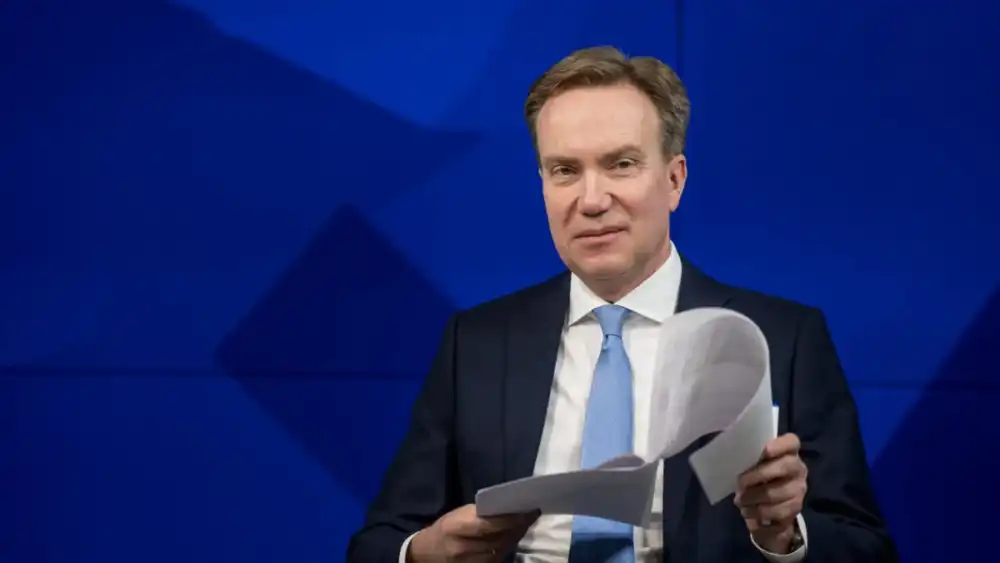
The departure of Børge Brende from the presidency of the World Economic Forum (WEF) marks a watershed moment for the Geneva-based organization, which has long served as the ultimate convening power for the world’s political and financial elite. Brende’s resignation, precipitated by intensifying scrutiny over his historical links to the late convicted sex offender Jeffrey Epstein, signals a period of profound institutional uncertainty. For an organization that prides itself on "improving the state of the world" through moral leadership and stakeholder capitalism, the departure of its most prominent operational executive under a cloud of controversy creates a vacuum that could resonate far beyond the snowy slopes of Davos.
Børge Brende, a former Norwegian Minister of Foreign Affairs and a seasoned diplomat, was widely seen as the pragmatic face of the WEF, balancing the visionary, often idiosyncratic, leadership of the forum’s founder, Klaus Schwab. Since taking the helm as president in 2017, Brende was instrumental in navigating the organization through the complexities of the COVID-19 pandemic and the subsequent geopolitical shifts caused by the war in Ukraine. However, the shadow of Jeffrey Epstein’s extensive social and professional network has proven to be an inescapable gravity well for many high-profile figures in the global establishment. The revelation of Brende’s associations, however peripheral or historical they may have been, eventually became untenable in an era where institutional transparency and ethical vetting have become paramount.
The crisis at the WEF is not an isolated incident but rather the latest chapter in a broader reckoning involving the Epstein network. From the halls of academia at MIT and Harvard to the upper echelons of finance at JPMorgan Chase and Barclays, the "Epstein effect" has decimated the careers of several high-ranking executives and public figures. Former Barclays CEO Jes Staley and Apollo Global Management co-founder Leon Black are among those who saw their tenures cut short due to their proximity to Epstein. In Brende’s case, the resignation underscores the heightened sensitivity of international NGOs to reputational risk. In the current socio-political climate, even the perception of proximity to figures associated with systemic abuse is enough to trigger a leadership transition.
The economic implications of Brende’s exit are significant, given the WEF’s role as a primary facilitator of public-private partnerships. The forum is responsible for coordinating initiatives that involve trillions of dollars in global capital, ranging from the transition to a green economy to the governance of artificial intelligence. Stability at the top of the WEF is often viewed by multinational corporations as a barometer for the stability of the globalist agenda itself. With Brende gone, questions are being raised about the forum’s ability to maintain its influence among sovereign wealth funds and G7 governments, many of whom look to the WEF president to bridge the gap between corporate interests and national policy.
Beyond the immediate personnel change, the resignation fuels a growing firestorm of skepticism directed at globalist institutions. In recent years, the WEF has become a lightning rod for populist movements across the ideological spectrum. Critics argue that the forum represents an unaccountable "superclass" that operates behind closed doors. By allowing a leader with even tenuous links to a figure as disgraced as Epstein to remain in power for as long as he did, the WEF has inadvertently provided ammunition to those who claim that the global elite operate under a different set of moral and legal standards than the general public. This "trust deficit" is perhaps the most significant challenge the organization faces as it prepares for its next annual meeting.
To understand the weight of this resignation, one must look at Brende’s career trajectory. Before joining the WEF, he served as Norway’s Minister of Trade and Industry and later as Minister of the Environment. His tenure as Foreign Minister from 2013 to 2017 was marked by a commitment to multilateralism and humanitarian aid. He was, in many ways, the quintessential "Davos Man"—highly educated, internationally mobile, and deeply embedded in the structures of global governance. His downfall suggests that the traditional safeguards of high-level diplomacy are no longer sufficient to protect individuals from the consequences of their social networks.
The internal dynamics of the World Economic Forum are also likely to shift. Klaus Schwab, now in his mid-80s, has long been the subject of succession rumors. Brende was frequently mentioned as a potential successor or, at the very least, the steady hand that would guide the organization through a post-Schwab transition. His departure leaves the WEF without a clear heir apparent at a time when the organization is attempting to redefine its mission for a "polycrisis" era. The search for a new president will likely involve a rigorous vetting process that prioritizes "reputational purity" over diplomatic experience, a shift that could change the very nature of the forum’s leadership.
Market analysts and geopolitical strategists are closely watching how the WEF’s corporate partners respond. The forum’s "Strategic Partners" include some of the world’s largest companies, such as BlackRock, Goldman Sachs, and Saudi Aramco. These entities pay significant annual fees for access to the WEF’s network and events. If the resignation of Brende leads to a perceived decline in the forum’s prestige or its ability to attract top-tier political leaders, these corporate giants may begin to reassess the value of their membership. In the world of high finance, access is the ultimate currency, and any devaluation of the Davos brand could have direct financial consequences for the organization.
The global context of this resignation cannot be ignored. We are currently witnessing a fragmentation of the post-Cold War international order. The rise of protectionism, the return of industrial policy, and the intensifying rivalry between the United States and China have already put the WEF’s vision of a frictionless, globalized world under strain. Brende’s exit adds a layer of personal and institutional scandal to these systemic challenges. It highlights a vulnerability in the "networking" model of global governance: when the networks themselves become toxic, the institutions built upon them begin to crumble.
In comparison to other international bodies, the WEF occupies a unique and somewhat precarious space. Unlike the United Nations or the World Bank, it has no formal mandate from voters or sovereign states. Its power is entirely derived from its reputation and its ability to convene the "right" people. When that reputation is compromised, the organization’s raison d’être is called into question. The Brende scandal forces the WEF to confront an uncomfortable truth: in a hyper-connected world, the private associations of its leaders are no longer private matters, but rather public liabilities that can undermine years of policy work and advocacy.
Looking forward, the WEF must navigate a path toward institutional renewal. This will likely involve more than just appointing a new president; it will require a fundamental reassessment of how the organization vets its leadership and manages its relationships. There is a growing demand for "radical transparency" in global governance, and the WEF may find that its survival depends on its willingness to open its doors and its books to greater scrutiny. The era of the "unaccountable elite" is facing a stiff challenge from a public that is increasingly wary of the hidden ties that bind the world’s most powerful people.
As the dust settles on Børge Brende’s resignation, the focus will turn to the 2025 Davos summit. The event will serve as a litmus test for the WEF’s resilience. Will world leaders continue to flock to the Swiss Alps, or will the Epstein shadow cast too long a pall over the proceedings? The departure of its president is a clear signal that the status quo is no longer sustainable. Whether the WEF can evolve into a more transparent and accountable version of itself remains to be seen, but one thing is certain: the era of Børge Brende has ended, and with it, perhaps, the era of unquestioned trust in the architects of the global order.