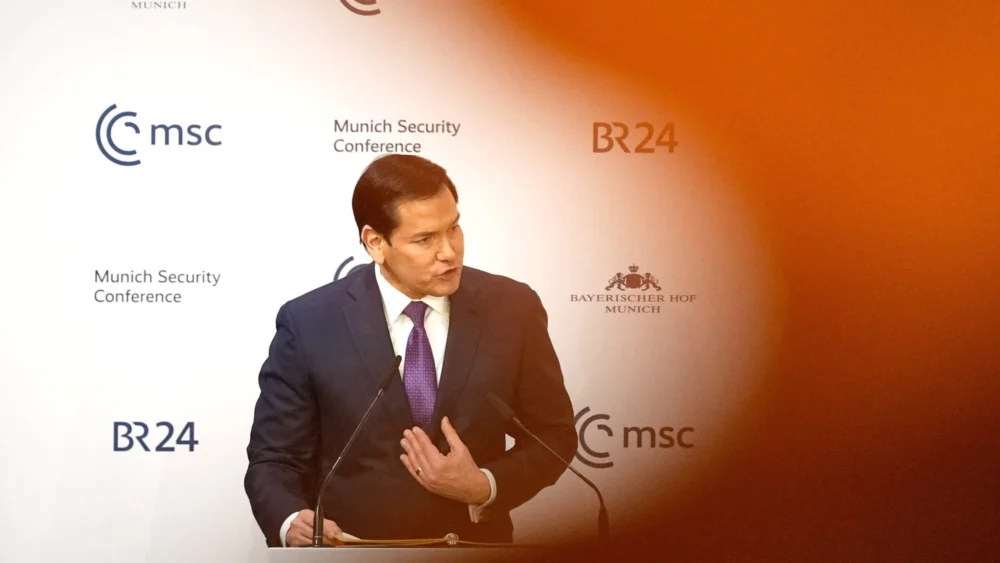
In a period of profound geopolitical flux and shifting domestic priorities within the United States, Senator Marco Rubio has moved to reassure European allies that the fundamental architecture of the transatlantic alliance remains a cornerstone of American foreign policy. Amidst concerns regarding a potential retreat into isolationism, Rubio’s recent diplomatic signals suggest a nuanced "America First" approach that prioritizes burden-sharing and strategic efficiency without dismantling the security umbrellas that have defined the post-World War II era. This outreach comes at a critical juncture for the North Atlantic Treaty Organization (NATO) and the broader economic partnership between the United States and the European Union, as both blocs navigate the dual challenges of a revanchist Russia and an increasingly assertive China.
The core of Rubio’s message hinges on the concept of a "sustainable alliance." For decades, the transatlantic relationship has been characterized by a perceived imbalance in defense contributions, a point of contention that has reached a boiling point in recent American political discourse. By signaling that the U.S. will not abandon its partners, Rubio is simultaneously signaling that the terms of engagement are evolving. The expectation is no longer just for symbolic unity, but for a tangible increase in European "strategic autonomy" that complements, rather than competes with, American interests. This shift is reflected in the growing pressure on European capitals to meet and exceed the 2% of GDP defense spending target—a benchmark that was once a suggestion but has now become a prerequisite for continued American political capital.
Economic data underscores the massive stakes involved in maintaining this stability. The U.S.-EU economic relationship is the largest and most integrated in the world, accounting for nearly one-third of global GDP in terms of purchasing power parity. According to recent trade figures, the bilateral trade in goods and services exceeds $1.3 trillion annually. Furthermore, the mutual investment position is even more significant; U.S. foreign direct investment (FDI) in Europe is roughly four times higher than in the entire Asia-Pacific region. Rubio’s assurances are, therefore, as much about protecting these economic arteries as they are about military cooperation. Investors and market analysts have long viewed the transatlantic corridor as a "safe haven," and any credible threat to the security guarantees underpinning this region could lead to significant capital flight and market volatility.
The energy sector provides a poignant example of this deepening interdependence. Following the invasion of Ukraine and the subsequent decoupling from Russian hydrocarbons, Europe has turned to the United States as its primary supplier of Liquefied Natural Gas (LNG). In 2023, the U.S. provided nearly half of Europe’s LNG imports, a shift that has transformed the American energy industry into a vital component of European national security. Rubio, a longtime advocate for American energy dominance, views this relationship through a geostrategic lens. By securing Europe’s energy needs, the U.S. not only bolsters its own domestic economy but also ensures that its allies are not susceptible to the "energy blackmail" that previously hampered a unified Western response to aggression.
However, the path forward is not without friction. While Rubio emphasizes continuity, he also represents a wing of the American political establishment that views the Indo-Pacific as the primary theater of the 21st century. This creates a "pivot within a pivot." The message to Europe is clear: the U.S. will remain committed to the Atlantic, but it expects Europe to take the lead on its own regional security so that American resources can be increasingly allocated to the competition with Beijing. This creates a complex dynamic for European leaders, who must now balance their domestic fiscal constraints with the need to build a credible defense industrial base that can operate independently of constant American oversight.
The defense industrial base itself is a point of significant economic interest. As European nations ramp up procurement, there is a burgeoning debate over whether those funds should go toward American-made systems, such as the F-35 Lightning II, or toward fostering homegrown European defense giants like Dassault or Rheinmetall. Rubio’s vision likely favors the former, viewing defense exports as a key driver of American high-tech manufacturing and a way to ensure interoperability across the alliance. Recent data suggests that European defense spending rose by 16% in real terms in 2023 alone, reaching an estimated $350 billion. The competition for these contracts will be a defining feature of the transatlantic economic relationship over the next decade.
Expert insights suggest that Rubio’s role is that of a "stabilizer" who speaks the language of the new American right while maintaining the institutional knowledge of a seasoned foreign policy hand. Analysts from the Atlantic Council and the Brookings Institution note that Rubio’s rhetoric is designed to move the conversation away from "whether" the U.S. stays in NATO to "how" the U.S. stays in NATO. This distinction is vital for diplomatic morale in Brussels, Paris, and Berlin. It replaces the existential dread of a total American withdrawal with a more manageable, albeit difficult, negotiation over costs and responsibilities.
The China factor remains the most significant variable in this diplomatic calculus. Rubio has been a vocal critic of the Chinese Communist Party’s influence, and his support for Europe is often framed through the necessity of a unified Western front against non-market economies and authoritarian digital standards. The U.S. is increasingly pushing for a "de-risking" strategy that limits European exposure to Chinese technology, particularly in critical infrastructure and telecommunications. For Rubio, the transatlantic alliance is the foundation of a "global network of democracies" that must set the standards for artificial intelligence, quantum computing, and green energy. If Europe is to keep the American security guarantee, it will likely be expected to align more closely with Washington’s restrictive trade policies regarding high-end semiconductors and dual-use technologies.
In terms of global comparisons, the transatlantic alliance remains an anomaly in its depth and duration. While the U.S. maintains treaty alliances with Japan, South Korea, and Australia, none possess the institutional complexity of NATO or the integrated regulatory frameworks of the U.S.-EU Trade and Technology Council (TTC). Rubio’s outreach serves to remind the world that despite internal political polarization, the structural incentives for the U.S. to remain a European power are overwhelming. The cost of a vacuum in Europe—which would likely be filled by Russian influence or Chinese investment—far outweighs the costs of maintaining a military presence on the continent.
Looking ahead, the economic impact of Rubio’s "reassurance campaign" will be measured in corporate boardrooms and central banks. Stability breeds investment. When the risk of a major geopolitical rupture is mitigated, companies are more likely to engage in long-term cross-border projects. For instance, the semiconductor industry, which is currently seeing a massive reorganization through the U.S. CHIPS Act and the European Chips Act, requires a high degree of policy synchronization to avoid a "subsidy war." Rubio’s commitment to the alliance provides the political cover necessary for such technical and economic cooperation to continue.
Ultimately, Marco Rubio’s message to Europe is one of evolution rather than abandonment. It is a recognition that the world of 1949, and even the world of 1991, has vanished. The new era demands a more muscular, self-reliant Europe and a more strategically focused United States. By bridging the gap between traditional internationalism and the demands of a skeptical American electorate, Rubio is attempting to forge a 21st-century version of the Atlantic Charter—one that is defined by shared economic resilience, technological alignment, and a more equitable distribution of the burdens of leadership. While the rhetoric may be sharper and the demands more explicit, the underlying reality remains: the bond between the two sides of the Atlantic is too big to fail and too vital to forsake.