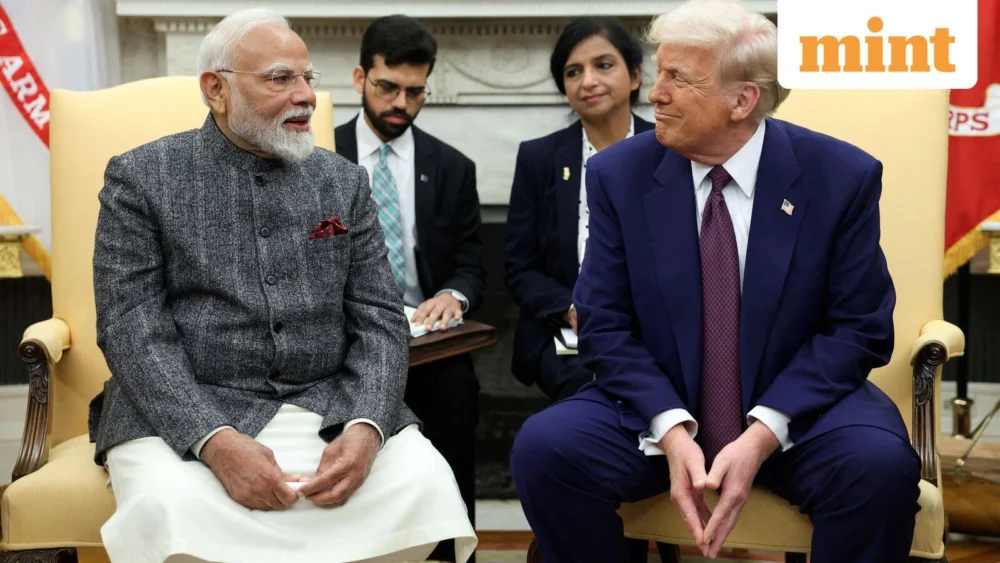
The United States has unveiled a significant policy move, rescinding a 25% additional ad valorem tariff on imports from India, a decision inextricably linked to New Delhi’s future energy procurement strategy. This tariff revocation, outlined in a recent executive order by former President Donald Trump, comes with a critical caveat: the establishment of a dedicated U.S. government panel tasked with rigorously monitoring India’s direct or indirect imports of Russian oil. Should this panel determine a resumption of such purchases, the tariffs stand liable for immediate reimposition, underscoring Washington’s potent use of trade leverage to influence geopolitical energy flows.
At the heart of this agreement lies a stated commitment from India to cease the importation of Russian crude and instead pivot towards acquiring energy products from the United States. The executive order meticulously details the multi-agency oversight, empowering the Secretary of Commerce, in close coordination with the Secretaries of State and the Treasury, alongside other relevant senior officials, to meticulously track India’s adherence to this understanding. This comprehensive monitoring framework highlights the seriousness with which the U.S. intends to enforce its sanctions regime and reshape global energy supply chains in the wake of geopolitical realignments. The potential consequences of non-compliance are equally stringent; if the panel identifies renewed Russian oil imports, a high-level interagency group – including the Secretaries of State, Treasury, Commerce, and Homeland Security, along with the United States Trade Representative and key presidential advisors – will convene to recommend further actions, including the potential reinstatement of the punitive 25% tariff. Such a move would undoubtedly send ripples through the Indo-U.S. trade relationship, which has seen substantial growth in recent years.
This development places India, the world’s third-largest crude oil importer and consumer, at a critical juncture in its energy policy and foreign relations. Historically, India has pursued a diversified energy procurement strategy, balancing relationships with various global suppliers to ensure energy security for its rapidly expanding economy. However, the geopolitical landscape shifted dramatically following the Russia-Ukraine conflict. Western sanctions against Moscow led to an unprecedented surge in discounted Russian crude oil available on the global market. India, prioritizing its economic stability and inflationary control, became a primary beneficiary of these lower prices. Since the fiscal year 2023, Russia has consistently emerged as India’s largest crude oil supplier, a dramatic shift from its negligible share pre-conflict. By fiscal year 2025, Russian crude accounted for approximately 35% of India’s total oil imports, a testament to the economic incentives driving New Delhi’s decisions. Data from trade intelligence firms like Kpler indicated that Russia supplied around 1.16 million barrels per day (bpd) of oil to India in January alone, demonstrating the scale of this reliance.
Despite recent declines in imports from Russia, partly attributed to high tariffs and specific U.S. sanctions targeting key Russian oil suppliers such like Rosneft and LUKOIL, Russia has maintained its position as the dominant crude source for Indian refineries. The financial mechanics of these transactions have also evolved, with India exploring alternative payment mechanisms, including non-dollar currencies, to navigate the complexities of international sanctions. This strategic engagement with Russia, while economically pragmatic for India, has drawn scrutiny from Western powers keen to limit Moscow’s energy revenues. The U.S. executive order effectively formalizes this scrutiny, transforming it into a direct condition for trade concessions.
The other side of this strategic bargain is India’s commitment to significantly increase its energy imports from the United States. This aligns with a broader interim trade agreement framework between the two nations, which envisages India purchasing a staggering $500 billion worth of products from the U.S. over the next five years, with energy products and coking coal forming a substantial component. While specific details on the exact energy products remain sparse, India has been actively working to augment its imports of crude oil, liquefied natural gas (LNG), and liquefied petroleum gas (LPG) from the U.S. in recent years. This ambition is further underscored by a bilateral commitment made last year to elevate the energy trade between the two economic giants to $20 billion.
The U.S., leveraging its shale revolution, has transformed into a major global energy exporter, offering an alternative to traditional suppliers. For India, diversifying its energy basket to include more U.S. crude offers multiple benefits beyond geopolitical alignment. In January, India’s imports of U.S. oil stood at approximately 297,000 bpd, a slight increase from 293,000 bpd a year prior, though monthly figures have seen peaks, reaching 568,000 bpd in November. Analysts suggest that U.S. oil is emerging as a primary beneficiary of India’s broader import diversification efforts, potentially accounting for up to 10% of India’s crude intake. Crucially, this influx of American crude appears to be primarily displacing lighter West African grades rather than directly replacing Russian supplies, indicating a complex rebalancing rather than a simple substitution. This dynamic suggests that India may be attempting to reconfigure its overall crude slate, absorbing U.S. volumes while carefully managing its existing relationships.
The economic impact of this U.S. directive on India is multifaceted. On one hand, the revocation of the 25% tariff offers immediate relief to Indian exporters, enhancing their competitiveness in the U.S. market. This can stimulate export growth, support domestic industries, and contribute to India’s overall economic expansion. On the other hand, the conditionality regarding Russian oil imports presents a significant economic dilemma. India’s refineries, having adapted to processing discounted Russian Urals crude, might face higher procurement costs if forced to source exclusively from other, potentially more expensive, suppliers. This could translate into increased input costs for various industries, potentially fueling inflation and impacting consumer prices in a rapidly growing economy. The challenge for India will be to secure competitive pricing and reliable supply from alternative sources, primarily the U.S., without jeopardizing its energy security or economic stability.
From Washington’s perspective, this move represents a sophisticated application of geoeconomic statecraft. By linking trade concessions to energy policy, the U.S. aims to achieve several strategic objectives: further isolate Russia from global energy markets, bolster its own energy exports, and deepen strategic partnerships with key Indo-Pacific nations like India. It signals a clear intent to use economic incentives and disincentives as tools to enforce its foreign policy agenda, particularly concerning the financing of the conflict in Ukraine. For the global energy market, such a shift in India’s purchasing patterns could lead to further re-routing of crude flows, potentially impacting benchmark prices and creating new trade corridors.
The long-term implications for the India-U.S. strategic partnership are substantial. While the immediate focus is on energy and trade, this agreement could pave the way for deeper collaboration across various sectors, including defense, technology, and critical minerals. However, it also highlights the inherent tensions in India’s foreign policy, which has historically sought strategic autonomy. Balancing its long-standing relationship with Russia, a key defense supplier, with its burgeoning partnership with the U.S., a vital economic and technological partner, remains a delicate act for New Delhi. The monitoring mechanism will serve as a constant reminder of this balancing act, influencing future decisions on energy procurement and broader foreign policy alignment. The coming months will reveal the extent to which India can successfully navigate these complex geopolitical currents while securing its vital energy needs and fostering its ambitious economic growth trajectory.