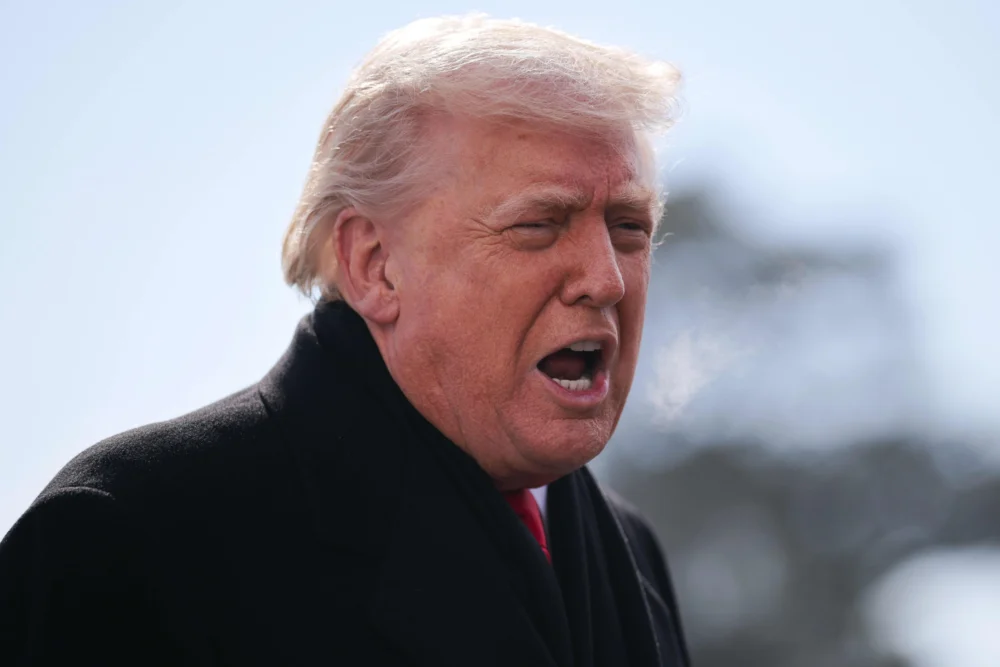
The international financial landscape experienced a significant tremor on Tuesday as the U.S. dollar endured its most precipitous single-day decline since April of last year. The catalyst for this sharp recalibration was a series of candid remarks from President Donald Trump, who signaled a distinct lack of concern regarding the currency’s recent downward trajectory. During a high-profile visit to Iowa intended to showcase the administration’s economic achievements, the President’s commentary effectively dismantled the long-standing "strong dollar" orthodoxy that has governed American fiscal rhetoric for decades.
The U.S. Dollar Index (DXY), a crucial metric that measures the greenback against a basket of six major global currencies, tumbled by 1.3% following the President’s statements. This contraction represents the most significant daily loss for the currency in over twelve months, pushing it to its lowest valuation since February 2022. The market reaction was swift and decisive, reflecting investor sensitivity to executive branch signaling on monetary value—a domain traditionally reserved for the technocrats at the Federal Reserve and the Treasury Department.
When questioned by reporters in Iowa about whether the dollar had fallen too far—given its cumulative 10% slide over the previous twelve months—President Trump offered a resounding endorsement of the current trend. "I think it’s great," the President remarked, referring to the softening of the exchange rate. He linked the weaker currency directly to the nation’s commercial success, stating, "I mean the value of the dollar, look at the business we’re doing. No, the dollar is doing great."
This pivot in rhetoric marks a stark departure from the era of the "Rubin Doctrine," named after former Treasury Secretary Robert Rubin, who famously asserted that a strong dollar was in the best interest of the United States. While that policy was designed to attract foreign capital and maintain low borrowing costs, the current administration’s "America First" economic framework prioritizes manufacturing output and the reduction of trade deficits. A weaker dollar is a potent tool in this regard, as it makes American-made goods more price-competitive in foreign markets while simultaneously increasing the cost of imported goods for domestic consumers.
The President’s comments also reignited long-standing grievances regarding the monetary policies of major Asian economies. In his address, he specifically targeted China and Japan, accusing them of historical currency manipulation to gain an unfair advantage in global trade. "You know it’s very interesting, if you look at China or Japan, I used to fight like hell with them because they always wanted to devalue their yen… the yen and yuan, and they’d always want to devalue it," Trump noted. He characterized these actions as "not fair," arguing that it is exceedingly difficult for American companies to compete when trading partners intentionally suppress their own currency values to boost exports.
The historical context for Tuesday’s slide is particularly telling. The last time the Dollar Index experienced a contraction of this magnitude was on April 10 of the previous year, a day defined by extreme volatility and escalating geopolitical tensions. At that time, the index fell nearly 2% amid a backdrop of aggressive trade posturing, including threats from the White House to impose a staggering 145% tariff on Chinese imports. That period of uncertainty saw the S&P 500 retreat by 3.5% and the Nasdaq Composite plunge by 4.3%, as investors grappled with the implications of a full-scale trade war.
In contrast, Tuesday’s market movement was more localized within the foreign exchange (FX) markets, though its ripples are expected to reach every corner of the global economy. For multinational corporations based in the United States, a weaker dollar is often viewed as a boon. Companies that derive a significant portion of their revenue from overseas—such as technology giants and industrial conglomerates—stand to benefit when they convert foreign earnings back into a depreciated greenback. This "repatriation effect" can provide a notable lift to quarterly earnings reports, potentially offsetting some of the broader macroeconomic headwinds.

However, the benefits of a weaker currency are not without significant risks. The primary concern for economists is the potential for imported inflation. As the dollar loses purchasing power, the cost of raw materials, energy, and finished goods imported from abroad rises. In an economy already sensitive to price fluctuations, a sustained decline in the dollar could force the Federal Reserve into a difficult corner, potentially necessitating higher interest rates to cool inflationary pressures, even if the broader economy requires a more accommodative stance.
Furthermore, the President’s comments have sparked a renewed debate over the concept of "currency wars." By publicly welcoming a weaker dollar, the U.S. risks being seen as engaging in a "race to the bottom," where nations compete to devalue their currencies to capture a larger share of global trade. Such a scenario often leads to increased protectionism and retaliatory measures, which can stifle global GDP growth. International observers are now closely watching the European Central Bank (ECB) and the Bank of Japan (BoJ) to see if they will respond with their own dovish signaling to prevent their currencies from becoming overvalued against the dollar.
The technical implications of the dollar hitting its lowest level since February 2022 cannot be understated. For currency traders, breaking through these multi-year support levels often signals a change in the long-term trend. The Dollar Index’s 10% decline over the past year suggests that the "King Dollar" era, characterized by safe-haven inflows and high relative interest rates, may be giving way to a more balanced or even bearish cycle. This shift is driven not only by political rhetoric but also by a narrowing gap between U.S. interest rates and those of other developed nations as global central banks begin to synchronize their monetary policies.
Market analysts suggest that the President’s comfort with a weaker dollar may also be a strategic move to pressure the Federal Reserve. By highlighting the benefits of a lower exchange rate, the administration subtly underscores its desire for a more dovish monetary policy. While the Federal Reserve remains an independent institution, the public discourse surrounding the currency’s value inevitably factors into the broader economic sentiment that the central bank must navigate.
From a global investment perspective, the weakening dollar is prompting a reallocation of capital. Emerging markets, which often carry significant debt denominated in U.S. dollars, stand to benefit from a softer greenback. As the dollar declines, the cost of servicing that debt becomes more manageable, potentially sparking a rally in emerging market equities and bonds. Conversely, European and Japanese exporters may find themselves under pressure as their goods become relatively more expensive for American buyers, potentially slowing the recovery in those regions.
As the dust settles from Tuesday’s trading session, the focus remains on whether this 1.3% drop is a momentary reaction to a headline or the beginning of a more profound structural shift in the global monetary order. The intersection of populist economic policy and traditional market mechanics has created a high-stakes environment where a single comment from the Oval Office can erase billions in valuation in a matter of hours.
In the coming weeks, the Treasury Department’s semi-annual report on international economic and exchange rate policies will be scrutinized for any formal shifts in language that mirror the President’s Iowa remarks. Until then, the foreign exchange markets will likely remain on high alert, balancing the administration’s desire for export-driven growth against the traditional mandates of currency stability and purchasing power. The era of the "strong dollar" may not be officially over, but its foundations have rarely looked more precarious. The global economy, tethered to the greenback as its primary reserve currency, must now prepare for a potentially more volatile and price-sensitive future.