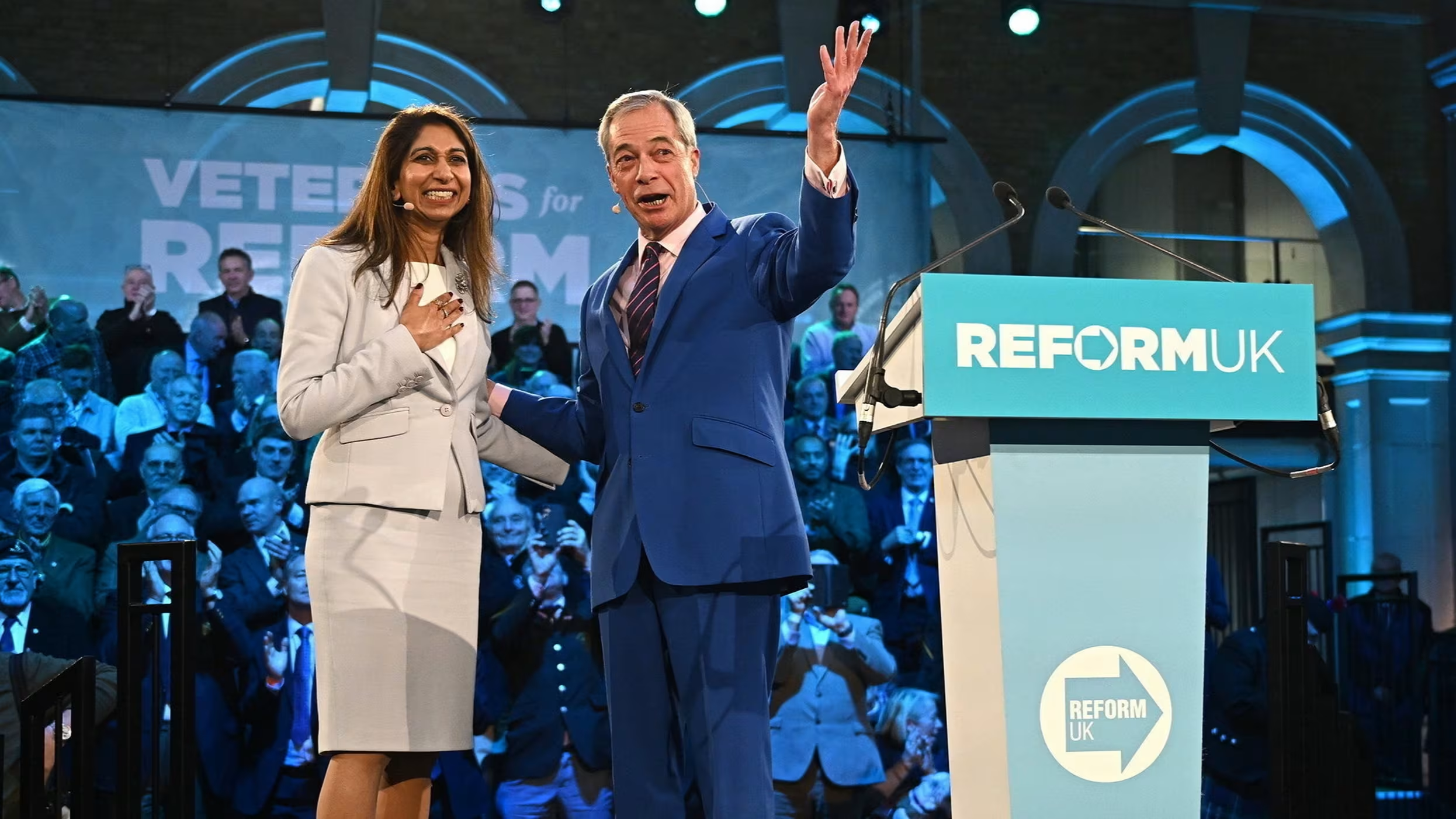
The landscape of British politics underwent a seismic realignment this week as Suella Braverman, the former Home Secretary and a standard-bearer for the Conservative Party’s right wing, officially defected to Reform UK. This move, while rumored for months following her increasingly vocal critiques of the government’s direction, represents a historic fracture in the Tory coalition that has dominated United Kingdom governance for over a decade. Braverman’s departure is not merely the loss of a high-profile Member of Parliament; it is a symbolic migration of the "hard-right" ideological core from the established center-right institution to a burgeoning populist challenger. For the Conservative Party, the defection raises existential questions regarding its future identity, its electoral viability, and its ability to maintain a "big tent" philosophy in an era of extreme political polarization.
Braverman’s decision to join Reform UK—the successor to the Brexit Party and the UK Independence Party (UKIP)—follows a pattern of increasing friction between the Conservative leadership and its more nationalist-leaning flank. As Home Secretary, Braverman was the primary architect and most vocal defender of the Rwanda asylum plan and aggressive rhetoric regarding "small boats" crossing the English Channel. Her exit statement cited a "fundamental betrayal of the British voter" by the Conservative frontbench, particularly regarding record-high net migration figures and the failure to decouple the UK from the European Convention on Human Rights (ECHR). By joining Reform UK, Braverman aligns herself with Nigel Farage’s populist movement, which has seen a meteoric rise in opinion polls, frequently threatening to overtake the Conservatives as the primary alternative to the Labour Party.
The economic implications of this political volatility are profound. Markets typically prize stability and predictability, yet the UK’s political environment has been characterized by churn since the 2016 Brexit referendum. Braverman’s defection introduces a new layer of uncertainty for domestic and international investors. Reform UK’s platform focuses on radical fiscal shifts, including the lifting of the VAT threshold for small businesses, the abolition of inheritance tax, and significant cuts to "net zero" spending. While these policies appeal to a specific segment of the electorate frustrated by the UK’s current tax burden—which has reached a post-war high—economists warn that such a drastic pivot could lead to further fluctuations in gilt yields and pressure on the British pound. The memory of the 2022 "mini-budget" crisis remains fresh in the minds of institutional investors, and any movement that threatens fiscal orthodoxy is viewed with a high degree of caution by the City of London.
Furthermore, the defection highlights a deepening divide in the UK’s labor market strategy. Braverman has consistently argued that the UK’s reliance on imported labor is a "crutch" that suppresses wages and disincentivizes investment in automation and domestic skills. Her move to Reform UK reinforces a protectionist economic stance that prioritizes social cohesion and reduced population growth over the GDP growth often fueled by migration. Conversely, many business leaders and industry bodies, including the Confederation of British Industry (CBI), have expressed concern that a sudden and drastic reduction in net migration would exacerbate labor shortages in critical sectors such as healthcare, hospitality, and agriculture. This tension between the "sovereignty-first" economics championed by Braverman and the "globalist-growth" model preferred by the Conservative mainstream is now the central fault line in British right-wing thought.
From a comparative global perspective, the rise of Reform UK and the absorption of mainstream conservative figures like Braverman mirrors trends seen across the Western world. In France, the traditional Republicans have been hollowed out by Marine Le Pen’s National Rally; in Germany, the Alternative for Germany (AfD) has forced the CDU to harden its stance on immigration; and in the United States, the Republican Party underwent a total transformation under the influence of the MAGA movement. Braverman’s defection suggests that the "cordon sanitaire" that once kept populist-nationalist ideologies at the periphery of British governance has finally dissolved. The Conservative Party now faces the "Canada scenario" of 1993, where a split on the right between the Progressive Conservatives and the Reform Party led to a near-total electoral wipeout, handing a decade of power to the opposition.
Data from recent polling highlights the gravity of the situation for the incumbent government. Reform UK has consistently polled between 15% and 18% nationally, with much of that support being cannibalized directly from the 2019 Conservative voter base. Analysts suggest that for every point Reform UK gains, the Conservatives lose a disproportionate number of seats due to the UK’s "first-past-the-post" electoral system. Braverman’s defection serves as a "permission structure" for other disgruntled Tory voters and MPs to follow suit. If the Conservatives cannot find a way to reconcile their moderate and radical wings, they risk becoming a minority party defined by internal strife rather than policy implementation.
The ideological shift also impacts the UK’s standing on the international stage. Braverman’s insistence on exiting the ECHR and her skepticism of international climate agreements are central tenets of the Reform UK platform. Should this faction gain significant influence, it could lead to a further distancing of the UK from its European neighbors and a potential reconsideration of various international treaties. For multinational corporations operating in the UK, this signals a potential shift toward a more deregulated but also more isolated economic environment. The "Singapore-on-Thames" vision, once a fringe aspiration of the hardest Brexiteers, is now the explicit goal of the movement Braverman has joined, promising a low-tax, low-regulation economy that seeks to compete aggressively with the European Union.
However, the path forward for Braverman and Reform UK is not without significant obstacles. The party lacks the grassroots infrastructure and historical brand loyalty of the Conservatives. Moreover, the British electorate is currently preoccupied with the cost-of-living crisis, the state of the National Health Service (NHS), and crumbling public infrastructure—issues for which Reform UK’s libertarian economic solutions may not provide a popular remedy. While Braverman’s defection provides a short-term media boost and ideological validation for Reform, the long-term challenge remains translating populist fervor into a coherent governing majority.
Expert insights suggest that the Conservative Party’s response to this defection will define the next decade of British politics. If the party chooses to lurch further to the right to reclaim defectors like Braverman, it risks alienating the "Blue Wall" voters in the affluent south of England who are generally more socially liberal and economically pragmatic. If it remains in the center, it faces an existential drain of its core base to Reform UK. This "pincer movement" leaves the party leadership with a dwindling number of strategic options. The defection of a former Home Secretary is an indictment of the party’s inability to maintain internal discipline and a clear indication that the post-Brexit consensus has entirely collapsed.
As the UK moves toward its next general election, the "Braverman factor" will be a critical variable. Her presence on the Reform UK benches changes the gravity of parliamentary debates and provides a high-profile spokesperson for a movement that was previously dismissed as a fringe phenomenon. For the business community, the message is clear: the era of two-party predictability in British politics is over. The fragmentation of the right wing introduces a period of multi-party volatility that will require firms to navigate a much more complex and ideologically diverse legislative environment.
Ultimately, Suella Braverman’s move to Reform UK is the most significant indicator yet that the British right is undergoing a fundamental transformation. It is no longer a question of whether the Conservative Party will change, but whether it can survive in its current form. By trading the traditional halls of power for the insurgent energy of Reform UK, Braverman has signaled that for her, and many like her, the "Tory brand" is no longer the most effective vehicle for their vision of a sovereign, nationalist Britain. The economic and social repercussions of this divorce will be felt for years to come, as the United Kingdom continues to search for its place in a rapidly changing global order.