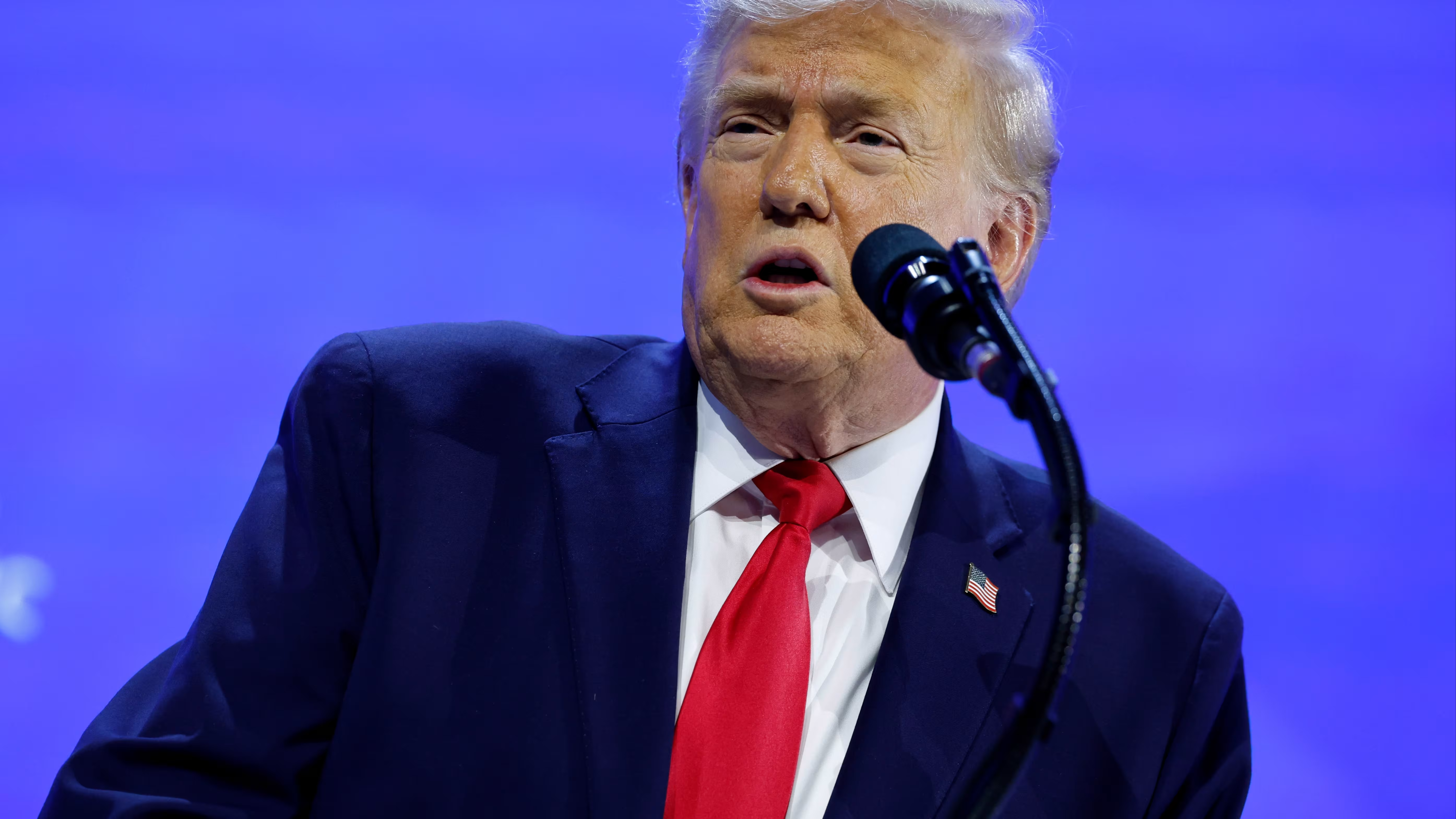
The intersection of high finance and national politics has reached a volatile new flashpoint as former President Donald Trump initiated a massive $5 billion lawsuit against JPMorgan Chase, the United States’ largest banking institution. The legal action, which centers on allegations of "debanking"—the practice of a financial institution terminating services to a client based on perceived political risk or personal affiliation—represents a significant escalation in the ongoing tension between the MAGA movement and Wall Street’s executive leadership. By seeking such a substantial sum in damages, the lawsuit aims not only to address specific grievances related to the closure of accounts but also to challenge the broader discretionary powers held by private financial entities over the economic participation of public figures.
At the heart of the complaint is the assertion that JPMorgan Chase engaged in a systematic effort to distance itself from the former president and his associated business entities following the events of January 6, 2021. The legal filing alleges that the bank’s decision to sever ties was not based on traditional credit risk or financial viability but was instead a politically motivated maneuver intended to appease activists and align with a specific ideological agenda. Trump’s legal team argues that this exclusion constitutes a breach of contract and a violation of consumer protection laws, suggesting that the bank’s actions caused irreparable harm to his brand, his ability to conduct international business, and his overall net worth.
The concept of debanking has emerged as a major point of contention in global economic circles over the last several years. While banks have long had the authority to terminate relationships with clients who fail to meet Anti-Money Laundering (AML) or Know Your Customer (KYC) requirements, the definition of "risk" has expanded significantly. In the modern regulatory environment, "reputational risk" has become a catch-all category that allows institutions to offboard clients whose public statements or political activities might lead to negative publicity or pressure from ESG (Environmental, Social, and Governance) focused investment groups. For the former president, this $5 billion claim is an attempt to quantify the cost of being locked out of the world’s most liquid and essential financial infrastructure.
JPMorgan Chase, led by Chairman and CEO Jamie Dimon, has historically maintained that its decisions are driven by internal risk assessments and the strict adherence to federal regulations. The bank has not yet provided a detailed public rebuttal to the specific $5 billion figure, but industry analysts suggest the defense will likely center on the "at-will" nature of banking relationships. In most jurisdictions, banks retain the right to terminate service for nearly any reason, provided it is not based on a protected class such as race or religion. However, the Trump legal team is attempting to forge a new legal precedent by arguing that political affiliation should, in certain contexts, be treated with similar protections, particularly when the institution in question holds a quasi-monopolistic position in the market.
The economic implications of this lawsuit extend far beyond the immediate parties involved. If the case proceeds to discovery, it could force JPMorgan to reveal internal communications regarding its "offboarding" processes, potentially exposing how the bank evaluates political figures. This comes at a time when financial institutions are under intense pressure from both sides of the aisle. While progressives have pushed for banks to divest from fossil fuels and firearm manufacturers, conservatives have increasingly introduced "fair access" legislation at the state level. These laws seek to prevent banks from denying services to businesses or individuals based on subjective "social credit" scores or political viewpoints.
The $5 billion damages claim is particularly striking when compared to recent regulatory fines. For context, JPMorgan Chase paid approximately $290 million in 2023 to settle a lawsuit related to its ties with Jeffrey Epstein, and it has faced various other billion-dollar settlements over the years for market manipulation and technical failures. A $5 billion judgment would be one of the largest civil awards ever leveled against a major bank in a case involving a single individual’s account termination. It underscores the scale of the perceived injury, with Trump’s attorneys claiming that the "financial blacklisting" hindered the Trump Organization’s ability to refinance debt and secure the necessary letters of credit for international expansion.
Global comparisons provide a broader perspective on the debanking phenomenon. In the United Kingdom, a similar controversy erupted when politician Nigel Farage was dropped as a client by Coutts, a private bank owned by NatWest. The ensuing scandal led to the resignation of NatWest’s CEO after internal documents revealed that Farage’s political views were a factor in the decision. The UK government subsequently moved to tighten regulations, requiring banks to provide clearer explanations and longer notice periods before closing accounts. The Trump lawsuit seeks to spark a similar reckoning in the United States, where the banking system is even more decentralized but dominated by a handful of "Too Big to Fail" institutions.
From a market perspective, the lawsuit adds another layer of complexity to the banking sector’s outlook. Investors are increasingly wary of how political polarization might affect bank valuations. If major institutions are perceived as being "weaponized" by one political faction, they risk alienating a significant portion of their customer base. Data suggests that since 2021, there has been a notable shift in where high-net-worth individuals and conservative-leaning businesses choose to deposit their capital, with a growing preference for regional banks in "business-friendly" states like Florida and Texas over the traditional money-center banks of New York and Charlotte.
The regulatory framework governing "Politically Exposed Persons" (PEPs) also plays a crucial role in this dispute. International standards set by the Financial Action Task Force (FATF) require banks to perform enhanced due diligence on PEPs—individuals who hold or have held prominent public functions—because they are considered higher risk for potential involvement in bribery or corruption. However, the Trump lawsuit argues that these compliance measures are being used as a pretext for "viewpoint discrimination." The challenge for the judiciary will be to distinguish between legitimate regulatory compliance and the arbitrary exclusion of a political rival.
As the legal proceedings unfold, the focus will likely turn to the role of the "special relationship" between the federal government and the banking industry. Critics of the current system argue that because banks enjoy federal deposit insurance and access to the Federal Reserve’s discount window, they should be held to a higher standard of neutrality, much like common carriers in the transportation or telecommunications industries. The outcome of Trump’s $5 billion suit against JPMorgan could potentially redefine the legal obligations of banks, moving them toward a model where they are required to provide service to all creditworthy individuals regardless of their political standing.
The financial sector is also bracing for the impact of this case on the 2024 election cycle. With Trump as a leading candidate, the lawsuit serves as a potent campaign narrative, reinforcing his message that the "establishment" is working to undermine his economic interests. For JPMorgan and the wider banking community, the goal will be to minimize the disruption while navigating an increasingly treacherous political landscape. Whether the $5 billion demand is a realistic pursuit or a strategic opening gambit, it has undoubtedly forced a long-overdue conversation about the power of the financial elite to decide who is—and who is not—allowed to participate in the modern economy.
Ultimately, the resolution of this conflict will depend on how the courts balance the private property rights of a corporation against the individual’s right to access essential services in a digital age. If Trump is successful, it could trigger a wave of similar litigation from other individuals and organizations who feel they have been unfairly targeted by the financial system. For now, the suit remains a stark reminder that in the 21st century, the most effective form of censorship may not be the silencing of a voice, but the closing of a bank account. As this multi-billion-dollar battle moves through the legal system, the eyes of the global financial community remain fixed on the precedent it will set for the future of money, power, and political dissent.