The British government has signaled a pivotal shift in its diplomatic and urban policy by clearing the way for the People’s Republic of China to construct a massive new embassy complex on the site of the former Royal Mint. This decision, which effectively overrides local planning resistance, marks a significant moment in the recalibration of Sino-British relations under the current administration. The project, set to be located in the historic Tower Hamlets district, represents not just a massive architectural undertaking but a symbolic cornerstone for Beijing’s presence in Western Europe. By greenlighting what is expected to be China’s largest diplomatic mission in the world, the UK government is attempting a delicate balancing act between national security concerns and the pragmatic necessity of economic engagement with the world’s second-largest economy.
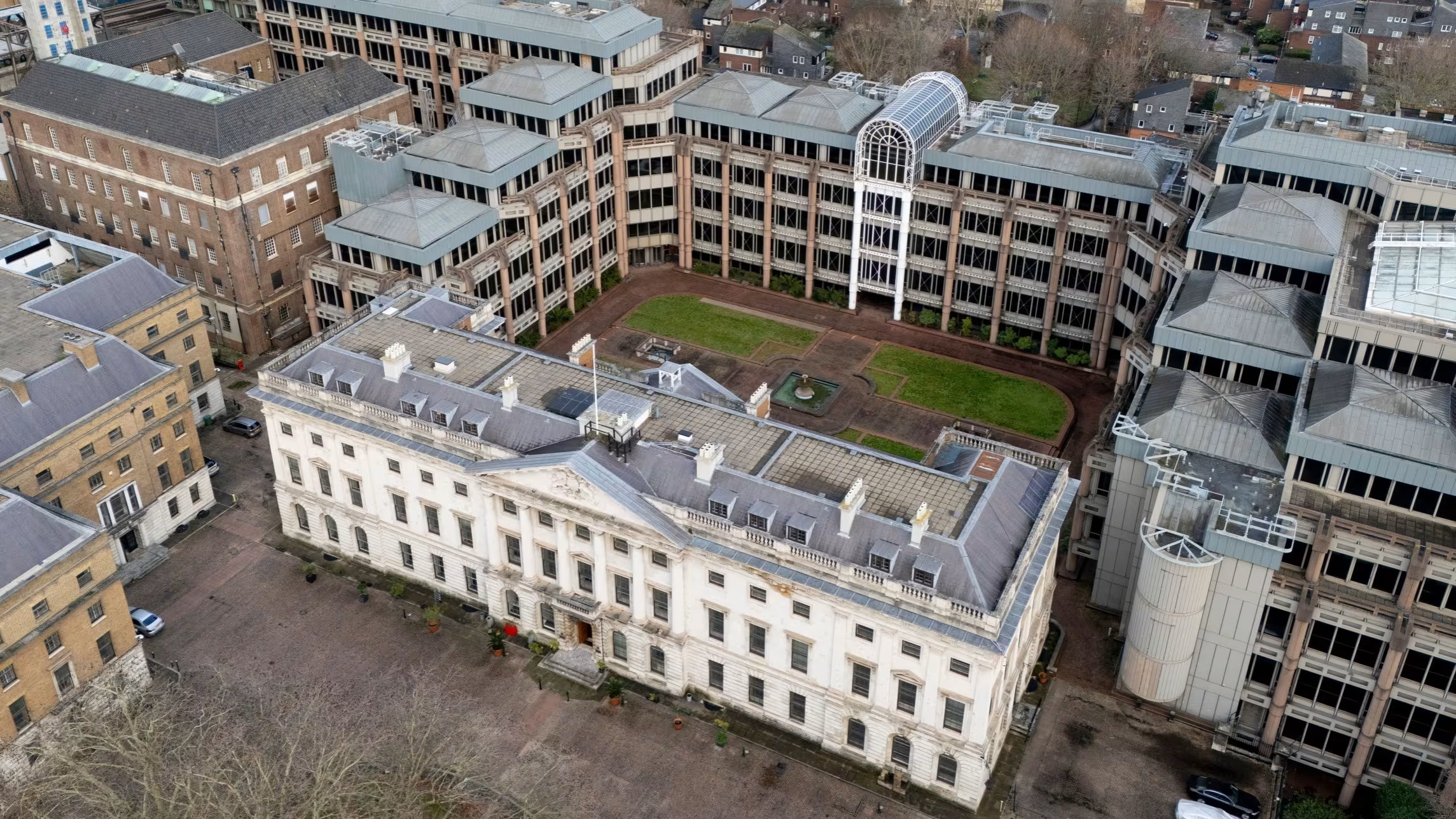
The site in question, Royal Mint Court, was purchased by the Chinese government in 2018 for an estimated £255 million. Located directly opposite the Tower of London, the 5.4-acre estate is steeped in British history, having served as the home of the Royal Mint for over 150 years. China’s proposal involves transforming this historic landmark into a 600,000-square-foot "mega-embassy," a facility that would dwarf the current mission in Marylebone and even rival the sprawling United States embassy in Nine Elms. The plans include not only administrative offices but also extensive living quarters for diplomatic staff, cultural exchange centers, and high-tech communication hubs.
The path to approval has been fraught with political and social friction. In late 2022, the Tower Hamlets local council unanimously rejected the planning application, citing a litany of concerns ranging from the impact on heritage sites to the potential for increased surveillance and the safety of local residents. The council’s refusal was heavily influenced by vocal protests from human rights groups and local communities, particularly those representing Hong Kongers, Uyghurs, and Tibetans, who feared the embassy would become a focal point for transnational repression. However, the central government’s decision to "call in" or support the progression of the project suggests that broader geopolitical considerations have taken precedence over local planning grievances.
From a strategic perspective, the approval is widely viewed as a "reset" gesture by the Labour government. Foreign Secretary David Lammy and Deputy Prime Minister Angela Rayner have inherited a relationship that had chilled significantly during the previous decade. The "Golden Era" of relations championed in 2015 was replaced by a period of "systemic challenge," characterized by disputes over Hong Kong’s autonomy, security concerns regarding Huawei’s role in 5G infrastructure, and sanctions placed on British parliamentarians. By facilitating the embassy project, London is signaling to Beijing that it is ready to move toward a more "predictable and stable" relationship, focusing on areas of mutual economic interest while managing deep-seated disagreements through diplomatic channels.
The economic implications of this development are substantial. China remains the United Kingdom’s fourth-largest trading partner, with total trade in goods and services reaching approximately £110 billion in recent fiscal years. For a post-Brexit Britain seeking to diversify its global trade portfolio and attract foreign direct investment, maintaining a functional relationship with China is essential. The construction of the embassy itself is expected to generate hundreds of local jobs and involve significant contracts for London-based engineering and architectural firms, even if the core security infrastructure remains under Beijing’s direct control. Furthermore, the presence of such a massive diplomatic mission is likely to anchor further Chinese commercial interest in the City of London’s eastern fringes.
However, security experts warn that the scale and location of the new embassy present unique challenges. The Royal Mint site sits at a critical junction of London’s financial district and its digital infrastructure. Concerns have been raised regarding the potential for electronic signals intelligence and the installation of sophisticated surveillance equipment that could monitor the heart of the UK’s financial capital. These fears are not without precedent; diplomatic missions globally have long been suspected of serving as dual-purpose facilities for both statecraft and intelligence gathering. The UK’s intelligence services will likely be tasked with implementing rigorous "counter-interference" measures to ensure that the embassy’s operations do not compromise national security.
The decision also touches upon the concept of "diplomatic reciprocity." For years, British diplomats have faced significant hurdles in upgrading or expanding the UK’s diplomatic footprint in Beijing. The approval of the Royal Mint site is seen by some as a bargaining chip, potentially smoothing the way for British interests in China. This "tit-for-tat" diplomacy is a standard feature of international relations, but the sheer scale of the London project suggests an imbalance that critics argue gives Beijing an outsized symbolic victory on British soil.
Comparisons to the United States’ embassy in London are inevitable. The US move from Grosvenor Square to Nine Elms in 2018, a project costing roughly $1 billion, was criticized at the time for its fortress-like appearance and its withdrawal from the city center. China’s choice to remain in a highly central, historically sensitive area like Tower Hill suggests a different strategy: one of visibility and integration into the historical fabric of the host city. The architectural challenge will be to modernize the Royal Mint Court while preserving its Grade II listed status, a requirement that will be monitored by Historic England and other heritage bodies.
The social impact on the Tower Hamlets borough remains a point of contention. The area is one of the most diverse in the UK, and local leaders have expressed concern that the embassy could become a site of frequent and potentially volatile protests. The 2022 incident at the Chinese consulate in Manchester, where a protester was dragged onto mission grounds and assaulted, remains fresh in the public consciousness. To mitigate these risks, the UK government is expected to mandate strict policing protocols and physical security buffers around the site, though these measures themselves often lead to friction with local residents who value open public spaces.
The broader European context also plays a role in this decision. As several EU nations reconsider their dependency on Chinese technology and investment, the UK’s move could be interpreted as a divergence from the burgeoning "de-risking" consensus in Brussels. While the US and parts of the EU have moved toward more restrictive postures, the UK appears to be testing a model of "progressive realism"—acknowledging China’s systemic importance while attempting to safeguard democratic values and national infrastructure.
As the project moves into its next phase, the focus will shift to the technicalities of the building process and the specific conditions attached to the planning permission. The UK government has emphasized that the approval is not a blank check; the development must adhere to stringent building regulations and transparency requirements. Nevertheless, the political message is clear: London is open for Chinese diplomatic expansion, provided it occurs within a framework that respects British law and, at least ostensibly, national security.
In the long term, the Royal Mint embassy will stand as a monument to a complex era in global politics. It will be a facility where the tensions of the 21st century—trade versus security, heritage versus modernization, and local activism versus global strategy—will play out daily. For the UK, the success of this project will be measured not just by the bricks and mortar of the new complex, but by whether this concession leads to a more stable, less confrontational relationship with a rising superpower. For China, the "mega-embassy" represents a permanent and powerful stake in the heart of one of the world’s premier financial capitals, a physical manifestation of its global ambitions and its enduring interest in the European theater.