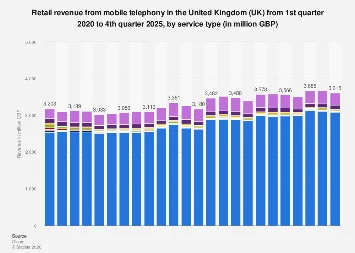
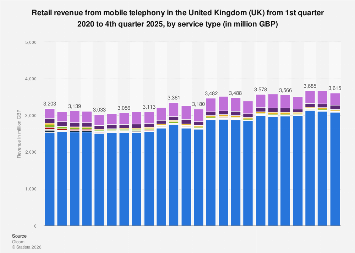
The United Kingdom’s mobile telecommunications sector is projected to generate significant revenue from access and bundle services by the fourth quarter of 2025, with estimates indicating a figure exceeding £5 billion. This segment is expected to continue its dominance, representing the largest contributor to the overall UK mobile retail revenue, which is anticipated to reach a substantial sum of £7.3 billion within the same period. This projection, spanning from the first quarter of 2020 through to the end of 2025, offers a granular view of how different mobile service components are shaping the financial landscape of this vital industry.
The Shifting Tides of Mobile Revenue Streams
Historically, revenue generation in the mobile telephony market was heavily reliant on voice calls and text messages. However, the landscape has undergone a dramatic transformation, driven by technological advancements and evolving consumer behaviour. While traditional voice and SMS revenues have seen a gradual decline, the advent of smartphones, high-speed mobile data, and bundled service packages has created new, powerful revenue streams for operators.
The data suggests a clear trend: the revenue derived from "Access and bundle services" has consistently been the bedrock of the UK mobile market. This category encompasses a broad spectrum of offerings, including monthly subscription plans that bundle data allowances, call minutes, and SMS messages, often with additional perks like streaming service subscriptions or international roaming benefits. The increasing complexity and value proposition of these bundled offerings are key to their strong performance.
Conversely, revenue from traditional voice call categories – both on-net (within the same network) and off-net (across different networks) – has shown a downward trajectory. This decline is largely attributable to the widespread adoption of over-the-top (OTT) communication apps such as WhatsApp, Signal, and Telegram, which leverage internet data to offer free or low-cost voice and messaging services. Similarly, revenue from SMS and MMS, once a lucrative income source, has also diminished as users opt for instant messaging platforms.
International calls, while still a component of revenue, represent a smaller fraction of the total. This segment’s performance is influenced by factors such as the cost of international call plans, the prevalence of video calling over data, and the increasing ease of global connectivity. "Other calls," a more nebulous category, likely captures niche services or less common call types, and its contribution remains comparatively minor.
Data Services: The Engine of Growth
The most significant growth driver within the mobile sector, and a key component of the dominant "Access and bundle services" category, is data services. As the demand for seamless internet access on the go intensifies – fueled by social media, video streaming, online gaming, and remote work – mobile operators have been investing heavily in expanding their network infrastructure, particularly 5G capabilities. The revenue generated from mobile data is not only from the volume of data consumed but also from the tiered pricing structures and premium data packages that cater to power users.
The projected figures for 2025 underscore the critical role of data in the mobile ecosystem. Operators are increasingly positioning themselves as providers of digital connectivity, with data being the primary currency. This has led to a strategic shift from a voice-centric business model to a data-centric one, where network capacity, speed, and reliability are paramount.
Market Dynamics and Competitive Landscape
The UK mobile market is characterized by intense competition among a few major players, including EE, O2, Vodafone, and Three. These operators are constantly innovating and refining their service offerings to attract and retain subscribers. Bundling strategies, in particular, have become a crucial differentiator. By integrating mobile services with broadband, TV, and even energy provisions, operators aim to create a more holistic and sticky customer relationship.
Regulatory oversight by Ofcom plays a significant role in shaping the market. Policies related to spectrum allocation, pricing transparency, and consumer protection influence the competitive dynamics and investment decisions of mobile operators. The ongoing transition to 5G networks requires substantial capital expenditure, and operators are keen to monetize these investments through enhanced data services and innovative applications.
Economic Impact and Future Outlook
The mobile telecommunications sector is a cornerstone of the modern digital economy, enabling innovation across various industries, from e-commerce and fintech to healthcare and education. The robust revenue generation projected for the UK mobile market signifies its continued economic importance. It supports a significant number of jobs, both directly within the telecom industry and indirectly through its enabling role in other sectors.
Looking beyond 2025, several trends are likely to continue shaping the mobile revenue landscape. The expansion of 5G will unlock new opportunities for advanced services, such as the Internet of Things (IoT), enhanced augmented reality (AR) and virtual reality (VR) experiences, and more sophisticated enterprise solutions. The drive towards convergent services, where mobile, fixed-line, and entertainment offerings are seamlessly integrated, is also expected to accelerate.
Furthermore, the increasing focus on sustainability and corporate social responsibility will likely influence operator strategies, potentially leading to new revenue streams related to green technology and digital inclusion initiatives. As the UK continues its digital transformation journey, the mobile telecommunications sector will remain a critical enabler, with its revenue streams evolving in tandem with technological progress and consumer demand. The data presented for 2025 provides a snapshot of this dynamic market, highlighting the enduring strength of bundled services and the escalating importance of mobile data.