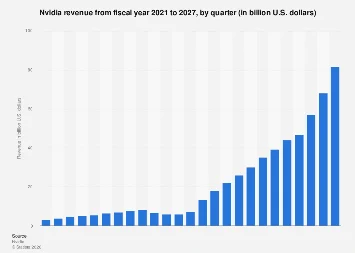
Nvidia, the undisputed leader in graphics processing units (GPUs) and a pivotal player in the artificial intelligence (AI) revolution, is poised for sustained, robust revenue growth through fiscal year 2027. While specific figures for future quarters are subject to market dynamics and company performance, projections indicate a trajectory of significant expansion, driven by insatiable demand for its cutting-edge AI accelerators, data center solutions, and advanced computing platforms. The company’s fiscal year concludes on the last Sunday in January, a crucial detail for interpreting its quarterly financial reporting.
The current fiscal year’s performance has already shattered expectations, with Nvidia consistently outperforming analyst predictions. This momentum is largely attributed to the escalating adoption of AI across virtually every industry, from cloud computing and autonomous vehicles to healthcare and scientific research. Nvidia’s CUDA platform and its Hopper architecture-based GPUs, such as the H100 and its successors, have become the de facto standard for training and deploying complex AI models, creating a powerful moat around its business.
Looking ahead, the demand for AI-specific hardware is projected to accelerate. Analysts anticipate that the total addressable market (TAM) for AI chips will continue its upward march, with some estimates suggesting it could reach hundreds of billions of dollars in the coming years. Nvidia, with its first-mover advantage and unparalleled technological prowess, is exceptionally well-positioned to capture a substantial share of this burgeoning market. The company’s strategic investments in research and development, coupled with its deep relationships with major cloud providers and enterprise clients, further solidify its competitive standing.
Nvidia’s revenue streams are increasingly diversified, though its Data Center segment remains the primary engine of growth. This segment encompasses its AI GPUs, networking solutions, and the broader ecosystem of software and services that support AI development and deployment. The company’s ability to offer integrated solutions, from the silicon itself to the software stack, provides a significant competitive advantage, making it a one-stop shop for organizations seeking to harness the power of AI.

The global push towards advanced computing, including the development of sophisticated AI models and the increasing complexity of data processing, creates a sustained demand for the high-performance computing power that Nvidia provides. Companies are investing heavily in upgrading their infrastructure to support these evolving needs, directly translating into increased sales for Nvidia’s products. The ongoing development of its next-generation architectures, codenamed "Blackwell" and beyond, are expected to offer even greater performance gains and energy efficiency, further stimulating upgrades and driving revenue.
Furthermore, Nvidia’s expansion into other areas, such as automotive, where its Drive platform is enabling the development of autonomous driving systems, and professional visualization, where its RTX GPUs are essential for content creation and design, contributes to its overall revenue growth. While these segments may represent a smaller portion of the company’s total revenue compared to Data Center, they offer significant long-term growth potential and underscore Nvidia’s strategic diversification.
Market analysts and industry observers are closely watching Nvidia’s quarterly reports for insights into the broader trends shaping the technology landscape. The company’s financial performance serves as a key indicator of the health and trajectory of the AI and high-performance computing markets. As AI continues its integration into mainstream applications and enterprise workflows, the demand for the specialized hardware that powers these advancements is expected to remain exceptionally strong.
The competitive landscape, while evolving, has yet to present a significant challenge to Nvidia’s dominance in AI accelerators. While competitors are investing heavily in their own AI chip development, Nvidia’s established ecosystem, extensive intellectual property, and continuous innovation provide a formidable barrier to entry. The company’s ability to forecast and meet the rapidly changing demands of the AI market has been a critical factor in its success.
The projected revenue figures, even with the necessary caveats of future market conditions, paint a picture of continued market leadership and financial strength for Nvidia. The company’s strategic focus on the transformative power of AI, coupled with its deep technological expertise, positions it for sustained growth and profitability in the years ahead. As the digital transformation accelerates globally, Nvidia’s role as a foundational technology provider is only set to become more critical, underpinning the innovations that will shape the future of computing and artificial intelligence. The company’s consistent ability to deliver on technological advancements and meet market demand has fostered a high degree of confidence among investors and customers alike, suggesting that its impressive revenue growth is likely to persist.