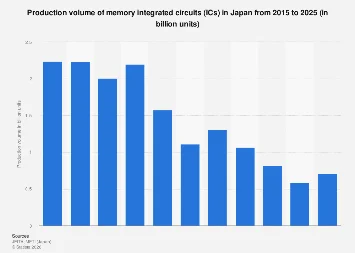
Japan’s semiconductor industry is projecting a substantial increase in the production volume of memory integrated circuits (ICs) leading up to and including 2025. This upward trend underscores the nation’s strategic importance in the global semiconductor supply chain, particularly in a sector critical for a wide array of modern technologies, from consumer electronics and automotive systems to artificial intelligence and cloud computing. While precise figures for the upcoming year are often subject to market dynamics and require subscription access, available data and industry analysis point towards a robust expansion in output.
The memory IC sector, a cornerstone of digital infrastructure, is experiencing renewed global demand. This surge is fueled by the ever-increasing data requirements of advanced applications. The Internet of Things (IoT) continues its rapid proliferation, generating vast amounts of data that necessitate sophisticated memory solutions for storage and processing. Similarly, the advancements in artificial intelligence (AI) and machine learning (ML) are driving demand for high-performance memory components capable of handling complex algorithms and massive datasets. The ongoing digitalization of industries worldwide, coupled with the sustained popularity of smartphones, gaming consoles, and data centers, further solidifies the need for an increased supply of memory chips.
In this context, Japan, historically a powerhouse in semiconductor manufacturing, is strategically positioning itself to capitalize on this burgeoning market. The nation’s commitment to innovation and its established expertise in high-precision manufacturing provide a strong foundation for meeting these growing demands. Government initiatives aimed at revitalizing the domestic semiconductor industry, alongside significant investments from major Japanese electronics conglomerates, are expected to bolster production capabilities. These efforts include not only expanding existing fabrication facilities but also investing in research and development for next-generation memory technologies.
The global memory market is characterized by its cyclical nature, influenced by supply-demand imbalances, technological advancements, and geopolitical factors. However, the long-term trajectory remains decidedly upward. Projections for the global semiconductor market, which heavily relies on memory components, consistently indicate year-over-year growth. For instance, market research firms have forecast the global semiconductor market to reach well over $600 billion in the coming years, with memory chips representing a significant portion of this value. Japan’s contribution to this global output is therefore crucial.
Analyzing Japan’s specific performance in memory IC production requires looking at trends over the past decade. While specific historical data points leading up to 2025 are proprietary, the general trajectory has been one of adaptation and strategic focus. Following periods of intense global competition, Japanese firms have increasingly specialized in high-value, niche segments of the semiconductor market, including advanced memory technologies. This strategic pivot has allowed them to maintain a competitive edge, even as manufacturing costs have become a significant factor in global production.
The production of memory ICs encompasses various types, including DRAM (Dynamic Random-Access Memory), NAND flash memory, and other specialized memory solutions. DRAM is essential for the temporary storage of data that a computer needs to access quickly, making it vital for PCs, servers, and smartphones. NAND flash memory is used for non-volatile storage, meaning it retains data even when power is turned off, and is found in solid-state drives (SSDs), USB drives, and memory cards. The demand for both these types of memory is robust, driven by different, yet complementary, technological advancements.
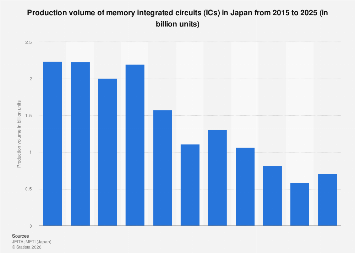
The projected increase in production volume by 2025 suggests that Japanese manufacturers are either expanding their existing capacity or are poised to ramp up production of advanced memory technologies. This could involve investments in new fabrication plants, upgrades to existing facilities to support more advanced manufacturing processes, or a strategic shift towards higher-margin memory products. The success of these endeavors will depend on several factors, including the ability to secure crucial raw materials, attract and retain skilled labor, and navigate the complex global trade landscape.
Furthermore, the development of new memory architectures and materials is an ongoing area of research and development. Japan has a strong track record in materials science and precision engineering, which are critical for pushing the boundaries of memory technology. Innovations in areas such as 3D NAND stacking, advanced DRAM cell designs, and emerging memory technologies like resistive RAM (ReRAM) or magnetoresistive RAM (MRAM) could play a significant role in Japan’s future memory production landscape. These advancements not only enhance performance and efficiency but also contribute to the development of more sustainable and energy-efficient electronic devices.
The economic impact of a strengthened memory IC production sector in Japan extends beyond the direct revenue generated by chip sales. It fosters a ripple effect throughout the broader economy. A robust semiconductor industry supports a wide range of downstream industries, including automotive, telecommunications, industrial automation, and healthcare, by providing them with the essential components they need to innovate and grow. The expansion of manufacturing capabilities also leads to job creation, both directly within the semiconductor plants and indirectly through supporting industries and services. Moreover, a strong domestic semiconductor sector enhances a nation’s technological sovereignty and reduces its reliance on foreign suppliers, which is an increasingly important consideration in the current geopolitical climate.
Global comparisons highlight the competitive nature of the memory market. South Korea, particularly through companies like Samsung Electronics and SK Hynix, has long been a dominant force in memory chip production. Taiwan, with TSMC being the world’s largest contract chip manufacturer, also plays a pivotal role, though its focus is broader than just memory. The United States has been actively working to re-establish a more robust domestic semiconductor manufacturing presence, with recent legislative efforts and investments aimed at boosting production. In this global arena, Japan’s renewed focus on memory ICs is a strategic move to solidify its position and regain market share where possible, particularly in specialized and high-performance segments.
The supplementary notes provided in the original data indicate that the figures are based on flush reports and do not account for amendments made after their announcement. This suggests that the projected production volumes are subject to refinement as market conditions evolve and new data becomes available. Additionally, the practice of rounding values is standard in statistical reporting to present data in a clear and concise manner. The fact that data prior to 2025 comes from previous reporting indicates a continuity in the data collection and projection methodology, providing a basis for understanding the trend over time.
In conclusion, the projected increase in Japan’s memory integrated circuit production volume through 2025 signifies a strategic and potentially impactful resurgence in a critical technology sector. Driven by global demand for advanced digital solutions, government support, and the inherent strengths of Japanese manufacturing, this growth is poised to contribute significantly to both the national economy and the global technological landscape. The continued evolution of memory technology and the competitive dynamics of the global market will be key factors in shaping the ultimate realization of these projections.