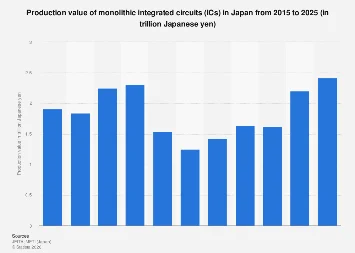
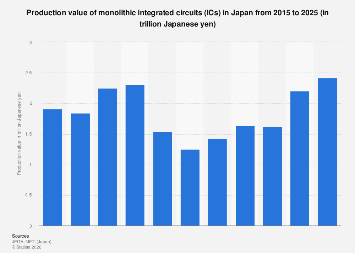
Japan is poised for a significant rebound in its crucial semiconductor industry, with projections indicating that the production value of monolithic integrated circuits (ICs) will reach an estimated **** trillion Japanese yen by 2025. This figure represents a substantial economic milestone, underscoring the nation’s ongoing strategic investment and renewed focus on reclaiming its leadership in the global semiconductor landscape. The category of monolithic ICs, which encompasses both linear and digital integrated circuits, forms the bedrock of modern electronics, powering everything from consumer gadgets and automotive systems to advanced industrial machinery and sophisticated defense technology.
The trajectory of Japan’s IC production value over the past decade, and its projected growth, is a narrative of resilience and strategic adaptation. While the nation has faced intense competition from global rivals, particularly in recent decades, this projected figure for 2025 signifies a strong commitment to revitalizing its domestic semiconductor manufacturing capabilities. This resurgence is not merely about historical dominance but about securing a vital component of the global digital economy. The value of these minuscule yet immensely powerful chips is intrinsically linked to technological advancement and economic competitiveness.
The Japanese government and major industry players have recognized the strategic imperative of semiconductor self-sufficiency and technological leadership. Initiatives such as the establishment of the Rapidus Corporation, a joint venture backed by several of Japan’s leading business conglomerates, exemplify this renewed ambition. Rapidus aims to develop and manufacture advanced logic semiconductors, including next-generation chips with sub-2-nanometer process technology, by the end of the decade. This ambitious undertaking, if successful, could significantly bolster Japan’s position in the high-end semiconductor market, currently dominated by a few key players.
Furthermore, substantial government subsidies and incentives are being channeled into encouraging both domestic chip production and attracting foreign investment in the sector. These policies are designed to de-risk the enormous capital expenditure required for state-of-the-art semiconductor fabrication plants, known as foundries. The global shortage of semiconductors experienced in recent years has served as a stark reminder of the vulnerabilities associated with highly concentrated supply chains. Japan, by bolstering its domestic production capacity, aims to mitigate these risks and ensure a more stable supply of critical components for its own industries and for global markets.
The economic implications of this projected growth are far-reaching. A robust domestic semiconductor industry not only contributes directly to the nation’s Gross Domestic Product (GDP) through manufacturing output and employment but also acts as a powerful catalyst for innovation across a multitude of downstream industries. Sectors such as automotive manufacturing, which is increasingly reliant on advanced semiconductors for electric vehicles and autonomous driving systems, will benefit immensely from a stable and high-quality domestic supply. Similarly, the telecommunications, robotics, and artificial intelligence sectors, all areas where Japan has traditionally excelled, will be further empowered by readily available cutting-edge ICs.
Global comparisons highlight the strategic importance of this sector. South Korea, Taiwan, and the United States are major players in the global semiconductor market, with significant investments in R&D and manufacturing capacity. Japan’s renewed focus aims to carve out a stronger niche, particularly in advanced logic and memory chips, while leveraging its existing strengths in materials science and precision manufacturing. The world’s reliance on semiconductors is only set to grow, driven by the proliferation of 5G networks, the Internet of Things (IoT), and the accelerating development of AI and quantum computing.
The production of monolithic ICs involves complex and highly sophisticated manufacturing processes. These chips are fabricated on silicon wafers through a series of photolithography, etching, and deposition steps. The precision and purity required at each stage are extraordinary, demanding advanced materials, specialized equipment, and a highly skilled workforce. Japan’s historical expertise in materials science and manufacturing excellence provides a strong foundation for its ambitions in this field. Companies like Tokyo Ohka Kogyo (TOK) are world leaders in photoresists, a critical material used in the lithography process, showcasing Japan’s continued strength in critical upstream components of the semiconductor supply chain.
The projected value for 2025 is not merely an abstract number; it represents tangible economic activity, job creation, and technological advancement. It signifies the output of highly automated and technologically advanced factories, employing a sophisticated workforce trained in fields such as electrical engineering, materials science, and process control. The ripple effect extends to research and development institutions, universities, and a network of supporting industries that provide specialized equipment, chemicals, and services.
However, achieving and sustaining this projected value is not without its challenges. The semiconductor industry is characterized by rapid technological obsolescence, immense capital requirements, and intense global competition. Continuous investment in research and development is paramount to stay at the forefront of innovation. Furthermore, nurturing and retaining a highly skilled workforce is crucial, as the demand for specialized talent in the semiconductor sector is global. Geopolitical factors and trade relations also play a significant role, influencing access to raw materials and global market dynamics.
The data, which encompasses projections up to 2025, serves as a key indicator for investors, policymakers, and industry analysts. It suggests a positive outlook for Japan’s semiconductor manufacturing sector, reflecting a concerted effort to regain competitiveness and secure a vital position in the global technology ecosystem. The **** trillion yen figure is a testament to the strategic importance placed on semiconductors and the belief in Japan’s capacity to once again be a dominant force in their production. This renewed focus is critical not just for Japan’s economic future but also for the global technological landscape, ensuring a more diversified and resilient supply of the essential building blocks of the digital age. The coming years will be pivotal in observing whether these projections translate into sustained growth and a solidified position for Japan in the ever-evolving world of integrated circuit manufacturing.