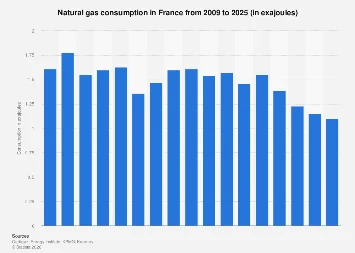
France’s projected natural gas consumption for 2025 signals a continued evolution in the nation’s energy mix, reflecting a broader European commitment to decarbonization and energy security. While specific figures for 2025 remain under subscription for detailed analysis, historical data and expert projections point towards a dynamic period of transition. The nation’s energy policy, heavily influenced by European Union directives and a growing emphasis on renewable sources, is reshaping the role of natural gas.
Historically, natural gas has played a significant role in France’s energy portfolio, serving as a crucial bridge fuel in the transition away from more carbon-intensive sources like coal and oil. It underpins a substantial portion of the country’s heating, electricity generation, and industrial processes. Consumption patterns have historically shown fluctuations driven by factors such as economic activity, weather variations (particularly for heating demand), and the availability and price of alternative energy sources. The peak consumption observed in 2010, for instance, likely reflected a confluence of robust industrial demand and colder-than-average weather conditions.
The most recent available data, prior to 2025 projections, indicates a trend of moderating or declining natural gas consumption in recent years. This deceleration is not an isolated French phenomenon but rather a characteristic of the wider European energy market. Several overarching forces are at play. Firstly, the ambitious renewable energy targets set by the EU, and consequently by member states like France, are leading to increased integration of wind, solar, and other low-carbon technologies into the energy grid. As these renewables become more prevalent and cost-competitive, they directly displace the need for natural gas in electricity generation.
Secondly, a heightened focus on energy efficiency measures across residential, commercial, and industrial sectors is contributing to reduced overall energy demand, including for natural gas. Building retrofits, more efficient appliances, and optimized industrial processes all play a part in this trend. Thirdly, the ongoing development and deployment of alternative low-carbon fuels, such as hydrogen and biogas, are beginning to offer viable substitutes for natural gas in certain applications, particularly in hard-to-abate industrial sectors.
The projected figures for 2025, even with the caveat of requiring subscription for exact values, are expected to align with this overarching trajectory of reduced reliance on natural gas. Analysts anticipate that the downward trend observed in recent years will likely persist. This is driven by a combination of policy imperatives and market dynamics. The European Green Deal, with its ambitious climate neutrality goals, continues to exert significant influence, incentivizing investments in renewable energy and discouraging fossil fuel consumption. Furthermore, the volatility of global natural gas prices, exacerbated by geopolitical events, has further underscored the strategic importance of diversifying energy sources and reducing dependence on imported fossil fuels.
The economic implications of these shifts are multifaceted. For the natural gas industry, a sustained decline in consumption necessitates strategic adaptation. This could involve a greater focus on liquefied natural gas (LNG) imports to ensure supply diversity and price stability, alongside investments in green gases like hydrogen and biomethane. For consumers, the transition could offer long-term benefits in terms of lower and more stable energy costs as renewable sources become more dominant and less susceptible to global commodity market fluctuations. However, the transition period may also present challenges, including the need for significant infrastructure upgrades and potential short-term price volatility.
Globally, France’s energy strategy is part of a broader international movement towards cleaner energy systems. Many developed nations are grappling with similar challenges of balancing energy security, affordability, and environmental sustainability. Countries that have heavily invested in renewable energy infrastructure and energy efficiency programs are generally better positioned to navigate this transition. Comparisons with countries like Germany, which has a strong commitment to its Energiewende (energy transition), or Nordic nations with high shares of renewable electricity, offer valuable insights into potential pathways and lessons learned.
The role of natural gas in France’s energy future is therefore poised for a redefinition. While it may continue to serve as a transitional fuel, its dominance is expected to wane as the nation progresses towards its climate objectives. The precise magnitude of this shift, as indicated by the detailed consumption figures for 2025 and beyond, will be a key indicator of the pace and success of France’s ambitious energy transition. The coming years will be critical in observing how the nation navigates this complex interplay of economic, environmental, and geopolitical forces to shape a sustainable and secure energy future. The ongoing development of technologies for carbon capture and utilization, alongside advancements in renewable gas production, will also play a crucial role in determining the long-term viability of gas infrastructure within a decarbonized economy. The strategic importance of ensuring diverse and secure energy supplies, particularly in light of recent global supply chain disruptions, will continue to inform policy decisions and investment priorities in the French energy sector.