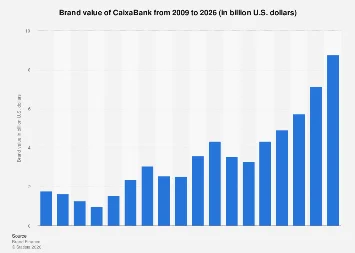
CaixaBank’s brand value has undergone a significant evolution from 2009, charting a course through economic shifts and strategic initiatives, with projections indicating continued growth through 2026. This Spanish financial institution, a cornerstone of the Iberian banking sector, has seen its intangible asset of brand worth fluctuate, reflecting both market dynamics and its own operational performance. While precise figures for specific years remain proprietary and subject to subscription access, the overarching trend points towards a substantial increase in its perceived market worth over the analyzed period. Initial valuations in the early part of this timeframe, specifically in 2012, registered at their lowest, underscoring the challenging economic climate of the post-financial crisis era. However, the trajectory has since been upward, with projections for 2026 suggesting CaixaBank’s brand will command its highest valuation to date within this multi-year span.
The methodology for assessing brand value, as outlined by industry standard-setters, typically involves a complex interplay of factors. This often includes the Brand Strength Index (BSI), which measures a brand’s relative performance against competitors, factoring in elements like market leadership, customer loyalty, and innovation. This index is then combined with the Brand Royalty Rate, an estimation of the royalty a company would pay to license its own brand, and crucially, brand-specific revenues. These revenues are derived from the financial performance directly attributable to the brand’s influence, distinguishing it from generic market share. Consequently, CaixaBank’s brand valuation is not merely a reflection of its balance sheet but a sophisticated economic indicator of its market standing, customer trust, and long-term competitive advantage.
The period between 2009 and 2026 encompasses a turbulent phase for the global financial industry. The aftermath of the 2008 global financial crisis, followed by the European sovereign debt crisis, created significant headwinds for banking institutions worldwide. During these years, many banks saw their valuations, both tangible and intangible, diminish as regulatory scrutiny intensified, profitability came under pressure, and public trust wavered. CaixaBank, like its peers, navigated these challenges through a combination of restructuring, strategic mergers and acquisitions, and a renewed focus on digital transformation and customer centricity. The initial dip in brand value observed around 2012 can be attributed to these prevailing macroeconomic uncertainties and the need for significant recalibration within the sector.
By the mid-2010s, a gradual recovery began to take shape. Banks that successfully adapted to the new regulatory landscape and embraced technological advancements started to rebuild their brand equity. CaixaBank’s strategic moves, including its significant merger with Bankia in 2021, were pivotal. This consolidation not only bolstered its market share, making it the largest domestic bank in Spain by assets, but also presented an opportunity to rationalize operations, enhance its digital offering, and project an image of strength and resilience. Such large-scale integrations, while complex, can significantly amplify a bank’s brand value by expanding its customer base, geographical reach, and the perceived stability and robustness of its operations.
The concept of brand value in the financial services sector is particularly critical. Unlike consumer goods where brand appeal might be more visceral, a bank’s brand is intrinsically linked to trust, reliability, and perceived security. A strong brand reassures customers about the safety of their deposits, the competence of financial advice, and the bank’s ability to weather economic storms. This trust translates directly into customer retention, acquisition, and the willingness of clients to engage with a broader range of the bank’s products and services, from simple savings accounts to complex investment and lending solutions. Therefore, an increase in brand value signifies a deeper level of customer confidence and loyalty, which are invaluable assets in a highly competitive market.
Looking ahead to 2026, the projected increase in CaixaBank’s brand value suggests an optimistic outlook driven by several factors. The continued digitization of banking services is paramount. Banks that excel in providing seamless, intuitive digital experiences are increasingly favored by consumers. CaixaBank’s investment in its digital platforms and mobile banking applications is likely a key contributor to its projected growth. Furthermore, a focus on environmental, social, and governance (ESG) principles has become a significant differentiator. As investors and consumers alike become more conscious of a company’s societal and environmental impact, banks that demonstrate strong ESG credentials can enhance their brand reputation and attract a more socially responsible customer base.
Global comparisons offer further context. Leading international banks, such as JPMorgan Chase, HSBC, and ICBC, consistently rank among the world’s most valuable brands. Their sustained high valuations are often a result of decades of consistent performance, global reach, diversified revenue streams, and strong brand messaging that emphasizes innovation, security, and customer service. CaixaBank, while primarily focused on the Spanish market, operates within this global competitive framework. Its ability to grow its brand value indicates its success in carving out a strong position within its domestic market and potentially expanding its influence in international arenas where it has a presence. The continued growth of the Spanish economy, coupled with CaixaBank’s strategic positioning, supports the expectation of enhanced brand equity.
The economic impact of a strong brand value extends beyond mere reputation. For a financial institution, it can lead to a lower cost of capital, as investors perceive less risk and greater stability. It can also facilitate easier access to funding and a stronger negotiating position with partners and suppliers. Moreover, a well-regarded brand can attract and retain top talent, creating a virtuous cycle of innovation and performance. In essence, brand value acts as a multiplier, amplifying the positive effects of sound financial management and strategic decision-making. The sustained upward trend projected for CaixaBank’s brand value through 2026 suggests a positive reinforcement of these economic benefits, solidifying its position as a leading financial entity in Spain and a significant player within the European banking landscape. The bank’s ability to maintain this momentum will depend on its continued adaptation to evolving market demands, technological advancements, and the ever-present imperative of fostering deep and enduring customer trust.