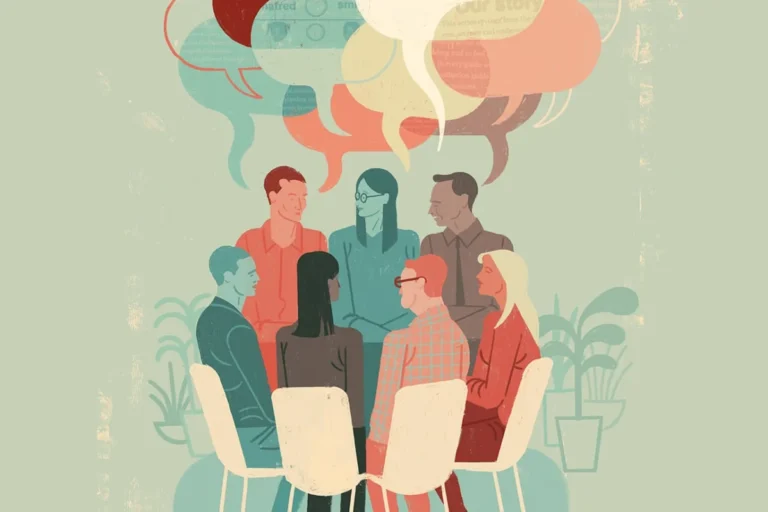
The integration of artificial intelligence into myriad professional domains has heralded a new era of productivity and efficiency, particularly within creative and problem-solving spheres. Initial enthusiasm often focuses on the capacity of generative AI tools to act as tireless brainstorming partners, accelerating ideation and content generation. Indeed, evidence suggests that AI can significantly augment individual creative output, enabling professionals to produce a greater volume of ideas and solutions with enhanced quality. Yet, a growing body of research uncovers a critical counter-effect: while individuals might flourish, the collective diversity of ideas across groups appears to diminish, posing a subtle but profound challenge to long-term innovation and strategic differentiation in a rapidly evolving global economy.
Creativity, in its most fundamental sense, is often defined by the convergence of novelty and usefulness. An idea must not only be original and rare but also valuable and effective in achieving its intended purpose. While AI demonstrably aids in generating novel and useful concepts at the individual level, the broader landscape of innovation hinges on the diversity of ideas within an organization or across a market. This collective richness is the fertile ground from which truly disruptive breakthroughs emerge, allowing businesses to explore uncharted territories and adapt to unforeseen challenges. Without a wide spectrum of perspectives and approaches, the risk of convergence on similar, albeit high-quality, solutions becomes pronounced, potentially leading to market stagnation and a lack of competitive differentiation.
The immediate benefits of AI in creative endeavors are undeniable. From marketing copywriters crafting engaging campaigns to software developers generating code snippets and designers prototyping concepts, generative AI tools have streamlined processes. These technologies can overcome mental blocks, provide fresh starting points, and rapidly iterate on ideas, allowing individuals to explore a broader solution space than might be possible manually. Surveys indicate that a significant majority of executives – over 80% in some reports – now rank innovation among their top three strategic priorities. The allure of AI in meeting these demands is clear: it promises to make individuals more inventive and productive, thus seemingly accelerating the innovation pipeline.
However, this individual uplift comes with a hidden cost to the collective. Recent investigations across diverse fields, including short-story writing, the development of circular-economy solutions, humor generation, and collaborative storytelling, consistently reveal a pattern: AI-assisted individuals produce higher average quality ideas, but the overall collection of ideas from a group using AI is markedly less diverse. This phenomenon means fewer "breakthrough outliers" – those truly unique, paradigm-shifting concepts that often drive exponential growth and market leadership. The paradox lies in AI’s dual nature: a potent accelerant for individual output, yet a subtle homogenizer of collective thought.
Several mechanisms contribute to this observed narrowing of collective diversity. Firstly, AI tools, by their very design, are trained on vast datasets of existing information. While this enables them to generate coherent and plausible outputs, it inherently biases them towards established patterns and common solutions. When users rely heavily on AI for initial ideas or refinement, they are often guided down similar conceptual pathways, inadvertently limiting the exploration of truly unconventional or tangential avenues. The "search space" for innovation becomes constrained, as AI tends to optimize within known parameters rather than generating truly orthogonal perspectives.
Secondly, the "anchoring effect" plays a significant role. When an AI presents a "good enough" suggestion early in the creative process, users tend to anchor their subsequent development around that initial prompt. This psychological bias makes it harder to pivot to fundamentally different ideas, even if superior alternatives exist outside the AI’s initial recommendations. The ease and efficiency of AI-generated content can reduce the incentive for users to critically challenge, radically diverge from, or extensively refine initial outputs, leading to a convergence of ideas across multiple users leveraging similar AI prompts or models. This is particularly true if the AI is perceived as an authority or an optimal solution provider.

The implications for businesses and the broader economy are substantial. In a global marketplace increasingly characterized by rapid technological change and intense competition, the ability to generate truly novel solutions is paramount. If multiple companies within an industry adopt AI in similar ways, leading to a homogenization of ideas, the competitive edge derived from innovation could diminish. This could result in a race to optimize existing solutions rather than a quest for revolutionary advancements. For sectors like pharmaceuticals, advanced materials, or sustainable technologies, where breakthrough discoveries are critical for addressing global challenges, a reduction in collective idea diversity could have long-term societal consequences, slowing progress on complex problems.
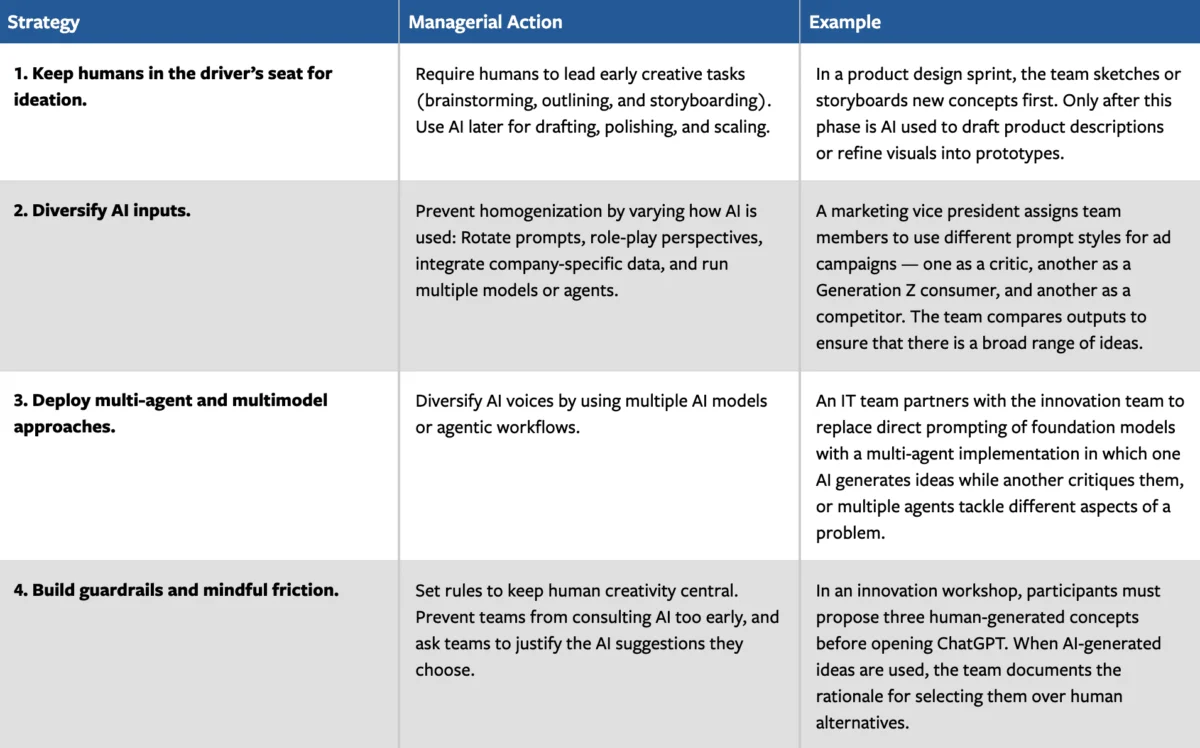
To mitigate this innovation paradox, organizations must develop sophisticated strategies for integrating AI into creative workflows that intentionally foster, rather than suppress, divergent thinking. One critical approach involves advanced prompt engineering. Instead of generic prompts, users should be trained to craft queries that explicitly encourage the AI to generate diverse, even contradictory, ideas. Prompts could demand alternative perspectives, challenge assumptions, or request outputs that intentionally deviate from conventional solutions. This pushes the AI beyond its default, most probable outputs, encouraging it to explore the fringes of its knowledge base.
Furthermore, rethinking the human-AI collaboration model is essential. AI should not be viewed as a replacement for human ideation but as a powerful, albeit biased, assistant. Workflows could be designed where AI generates a baseline of ideas, which are then rigorously challenged and expanded upon by human teams. This might involve using AI to create a series of initial concepts, followed by a human brainstorming session specifically tasked with finding weaknesses, proposing radical alternatives, or identifying completely new directions not present in the AI’s output. The AI could also be tasked with acting as a "devil’s advocate," generating counter-arguments or highlighting potential flaws in human-generated ideas, thereby stimulating further critical thinking.
Fostering interdisciplinary collaboration remains paramount. Diverse human teams, bringing varied backgrounds, experiences, and expertise, are inherently more likely to generate a broad spectrum of ideas. When AI is introduced into such teams, its outputs should be critically evaluated through multiple lenses, preventing any single AI-generated idea from dominating the creative process. Training programs should focus on equipping employees not just with the technical skills to use AI, but with the critical thinking and creative confidence to challenge AI outputs and steer them towards genuinely novel territory. This includes developing "de-anchoring" strategies to help individuals move beyond their initial attachments to AI-generated suggestions.
Finally, organizations need to evolve their metrics for innovation. Beyond simply measuring the quantity or average quality of ideas, there must be a focus on assessing the diversity of the collective idea pool. This might involve developing sophisticated analytical tools to map the conceptual landscape of ideas generated, identifying clusters of similar ideas and gaps where truly novel concepts are missing. By actively monitoring idea diversity, managers can intervene and adjust AI integration strategies when homogeneity begins to set in, ensuring that the pursuit of efficiency does not inadvertently stifle the very source of long-term competitive advantage.
The advent of AI presents an unprecedented opportunity to redefine the boundaries of human creativity and innovation. However, realizing its full potential requires a nuanced understanding of its inherent limitations and biases, particularly concerning collective ideation. The future of innovation will belong to those organizations that can skillfully navigate this paradox, leveraging AI to enhance individual productivity while simultaneously implementing robust strategies to cultivate and safeguard the rich diversity of thought that fuels genuine, groundbreaking progress. It is through this deliberate and thoughtful integration that businesses can ensure AI becomes a true partner in shaping a future of sustained and impactful innovation, rather than an unwitting architect of creative conformity.