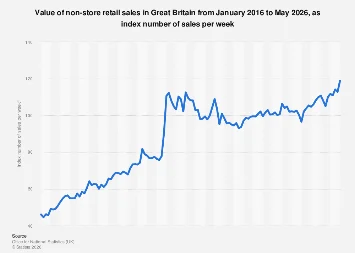
The digital marketplace continues its relentless expansion, with non-store retail sales in Great Britain demonstrating a robust upward trajectory throughout the observed period, culminating in a projected index value of 118.9 by May 2026. This figure, representing the value of sales per week as an index with 2023 set as the baseline of 100, underscores the enduring and growing significance of e-commerce and other non-traditional retail channels within the UK economy. The data, meticulously compiled and seasonally adjusted, offers a granular view of this dynamic sector’s performance from January 2016 to the projected figures for mid-2026, revealing a consistent evolution driven by changing consumer habits and technological advancements.
The narrative of non-store retail is one of consistent growth, punctuated by significant accelerations. From a modest index value of 46.1 in January 2016, the sector has more than doubled its relative weekly sales value over the decade. This sustained climb is not merely an incremental increase; it reflects a fundamental shift in how consumers in Great Britain engage with retail. The convenience of online shopping, the proliferation of mobile commerce, and the increasing sophistication of digital retail platforms have all contributed to this phenomenon. The period from 2016 to the present has witnessed an unprecedented surge in the adoption of online shopping, transforming it from a niche alternative to a mainstream mode of consumption.
Examining the historical data provides crucial context for understanding the current trajectory. In the early years of the dataset, non-store retail was still establishing its dominance. By December 2019, the index stood at 77.5, indicating it had gained considerable traction but still represented a smaller share of the overall retail landscape compared to brick-and-mortar establishments. The advent of 2020 marked a pivotal moment. The global pandemic, while devastating in many respects, acted as a powerful catalyst for e-commerce adoption. The index plummeted briefly in the initial months of lockdowns (77.8 in March 2020), likely due to supply chain disruptions and initial consumer uncertainty. However, it rapidly rebounded, soaring to 102.3 by December 2020, demonstrating the resilience and adaptability of online retail. This period cemented online shopping as an essential service for many households.
The post-pandemic era has seen a recalibration, but the underlying growth trend in non-store retail has largely persisted. While the frenetic growth rates seen during peak lockdown periods may have moderated, the sector has continued to expand its market share. The index figures for 2023 and early 2024 hover around the 100-103 mark, indicating a stabilization at a significantly higher level than pre-pandemic years. This suggests that many of the behavioral shifts adopted during the pandemic have become ingrained consumer habits.
Looking ahead to the projected figures for 2025 and 2026, the trend of growth is set to continue. The anticipated rise to 118.9 by May 2026 signals further market penetration and increased consumer spending through non-store channels. This projection is not without its economic underpinnings. Factors such as ongoing investment in logistics and delivery infrastructure, the expansion of product ranges offered online, and the increasing digital literacy across all demographics are likely to fuel this growth. Furthermore, the competitive landscape of non-store retail is intensifying, with established players and new entrants constantly innovating to capture consumer attention and spending.
The economic implications of this sustained growth are far-reaching. For businesses, it necessitates a strategic pivot towards omnichannel approaches, integrating online and offline experiences to meet consumer expectations. Companies that fail to adapt risk being left behind in an increasingly digital retail environment. The rise of non-store retail also has significant implications for employment, with a growing demand for roles in areas such as digital marketing, data analytics, logistics, and customer service, while potentially impacting traditional retail employment.
From a macroeconomic perspective, the growth in non-store retail contributes to overall consumer spending, a key driver of economic activity. It also plays a role in trade balances, as a significant portion of goods sold online may be imported. The efficiency of online retail, often characterized by lower overhead costs compared to physical stores, can also contribute to price competition and consumer savings. However, it also presents challenges for tax collection and regulatory oversight, requiring governments to adapt their frameworks to the evolving nature of commerce.
Global comparisons further highlight the significance of this trend. While Great Britain’s non-store retail sector is robust, other markets, particularly in Asia and North America, have also experienced similar or even more rapid growth. The United States, for instance, has seen its e-commerce share of total retail sales climb steadily. China remains the world’s largest e-commerce market, with a deeply entrenched digital retail culture. The UK’s performance, therefore, aligns with a broader global shift towards online consumption, positioning it as a mature but still expanding player in this international marketplace.
The definition of "non-store retail" is crucial to understanding these figures. It encompasses a broad spectrum of businesses that sell goods without a physical retail presence. This primarily includes online retailers, but also extends to mail order businesses, direct selling, and vending machines. The data’s focus on "sales per week" as an index, with 2023 as the benchmark, allows for a standardized comparison over time, smoothing out seasonal variations and providing a clear measure of relative sales performance. The supplementary note clarifying that these are "value of sales at current prices, seasonally adjusted" is important, as it indicates that inflation is factored into the nominal value, offering a more realistic picture of sales activity.
The consistent increase in the non-store retail sales index from 2016 through the projected figures for 2026 paints a compelling picture of a sector that is not only surviving but thriving. It represents a fundamental transformation in the retail landscape, driven by consumer demand for convenience, choice, and digital engagement. As technology continues to evolve and consumer preferences shift, the non-store retail sector is poised to remain a dominant force in the British economy, reshaping how goods are bought and sold for years to come. The projected figures for 2026 are not just statistical points; they are indicators of a deeply embedded and continuing revolution in commerce.