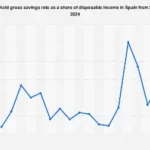
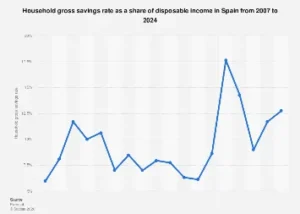

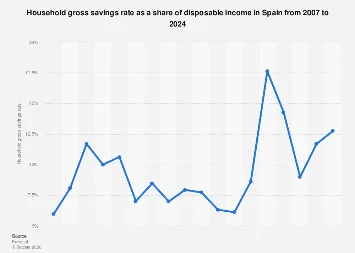
Spain’s household gross savings rate, a critical barometer of economic sentiment and financial resilience, has navigated a complex trajectory in recent years, reflecting both the inherent strengths of the Spanish economy and the pervasive influence of global economic headwinds. This metric, representing the proportion of disposable income that households do not spend on consumption, offers a crucial lens through which to assess consumer confidence, future investment potential, and the broader macroeconomic landscape. Understanding the nuances of this rate is vital for policymakers, financial institutions, and businesses seeking to comprehend the dynamics of consumer behavior and its impact on national economic health.
The household savings rate is not a static figure but rather a dynamic indicator that responds to a multitude of economic factors. Historically, Spain, like many developed nations, has witnessed fluctuations in this rate, influenced by periods of economic expansion, recession, inflation, and shifts in monetary policy. The post-financial crisis era, for instance, saw a general trend towards increased savings across many European economies as households became more cautious about their financial futures. However, the onset of the COVID-19 pandemic introduced unprecedented disruptions, leading to a complex interplay of factors that affected household finances. Lockdowns and restrictions on consumer spending, coupled with government support measures and uncertainty about future income, created a unique environment for savings behavior.
Recent data indicates that Spain’s household gross savings rate has shown signs of robustness, often outperforming the average for the Eurozone. This resilience can be attributed to several factors. Firstly, a significant portion of the Spanish population traditionally prioritizes saving, a cultural inclination often rooted in a desire for financial security and a preference for tangible assets. Secondly, the composition of the Spanish economy, with its strong service sector and a considerable proportion of small and medium-sized enterprises (SMEs), can influence how households manage their finances. While some sectors may have faced challenges, others, particularly those less directly impacted by immediate consumption shocks, may have maintained or even increased their savings capacity.
However, it is crucial to contextualize these figures within the broader economic environment. Inflationary pressures, particularly those experienced globally in the wake of supply chain disruptions and geopolitical events, have a direct impact on the real value of savings. While nominal savings might appear stable or even increase, the erosion of purchasing power due to rising prices can diminish the real wealth held by households. This poses a significant challenge, as households may need to dip into their savings to maintain their standard of living, thereby reducing the effective savings rate. Furthermore, the increase in interest rates by central banks, while aimed at curbing inflation, can also influence saving behavior by making saving more attractive relative to borrowing, but it also increases the cost of debt for those who rely on credit.
Comparing Spain’s savings rate to that of its European counterparts provides valuable insights. While Spain has demonstrated a commendable level of household savings, its performance can be benchmarked against countries like Germany, known for its high savings culture, or Southern European neighbors with potentially different economic structures and consumer habits. For example, a higher savings rate in Spain, relative to some other EU nations, might suggest a greater capacity for domestic investment and a buffer against economic downturns. Conversely, if this rate is significantly lower than historically observed levels or compared to more affluent economies, it could signal underlying economic fragilities or a decline in consumer confidence.
The economic implications of Spain’s household savings rate are far-reaching. A healthy savings rate fuels domestic investment, providing capital for businesses to expand, innovate, and create jobs. It also contributes to financial stability by reducing reliance on external debt. For the banking sector, higher household savings translate into a more stable deposit base, which can support lending activities. On a macroeconomic level, robust savings can contribute to a country’s current account balance and provide a cushion against external economic shocks. Conversely, a declining savings rate could signal potential future consumption slowdowns, reduced investment capacity, and increased household debt, posing risks to long-term economic growth.
Looking ahead, several factors will shape the trajectory of Spain’s household savings rate. The ongoing efforts to control inflation and stabilize the economy will be paramount. The evolution of the labor market, including employment levels and wage growth, will directly influence disposable income and, consequently, savings capacity. The effectiveness of government policies aimed at supporting households, such as social welfare programs and fiscal incentives, will also play a significant role. Furthermore, global economic trends, including the performance of major trading partners and the stability of international financial markets, will inevitably cast a long shadow.
Expert analysis often points to the importance of diversification in household savings strategies. While traditional savings vehicles remain important, the current economic climate necessitates a consideration of investments that can outpace inflation and offer real returns. This includes a growing interest in alternative investments, real estate, and financial markets, although the appetite for such ventures varies significantly across different demographic segments and income levels. The aging population in Spain also presents a long-term consideration, as retirement planning and the need for accumulated savings become increasingly critical.
In conclusion, Spain’s household gross savings rate stands as a vital indicator of its economic vitality. While recent performance has shown resilience, the path forward will be shaped by a complex interplay of domestic economic policies, global financial conditions, and evolving consumer behavior. A sustained focus on fostering financial stability, promoting responsible saving and investment, and adapting to the changing economic landscape will be crucial for ensuring the continued economic well-being of Spanish households and the nation as a whole. The ability of households to maintain and potentially grow their savings will be a key determinant of Spain’s capacity to weather future economic storms and capitalize on opportunities for sustainable growth.