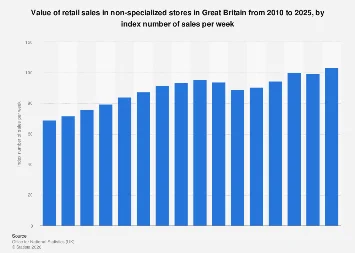
The retail landscape in Great Britain is projected to witness a significant uptick in the sales value of non-specialized department stores by 2025. Data indicates that the index number of weekly sales per store, with 2023 serving as the baseline year valued at 100, is anticipated to reach a peak, signifying robust consumer spending within this segment. This forecast suggests a positive trajectory for a sector that has historically played a pivotal role in the nation’s retail fabric, offering a wide array of goods under one roof.
The Retail Sales Index (RSI), a crucial barometer for the health of the UK’s retail economy, meticulously tracks both the value and volume of sales on a monthly basis. The data used for this index is gathered from a substantial sample of approximately 5,000 retail businesses. Critically, the survey targets businesses employing over 100 individuals or those with an annual turnover exceeding £60 million, ensuring a comprehensive and representative snapshot of market activity. The index specifically focuses on non-specialized, predominantly non-food stores, which crucially includes the traditional department store format. This definition encompasses establishments that offer a diverse range of products, from apparel and home goods to electronics and cosmetics, without specializing in a single category. The methodology, where 2023 is set as the reference year with an index value of 100, allows for clear year-on-year comparisons and trend analysis. While the precise index value for 2025 remains proprietary information, the upward projection underscores a prevailing sentiment of optimism for the sector’s financial performance.
The historical performance of department stores offers valuable context for understanding the current projections. In the years leading up to 2023, the retail sector, including department stores, navigated a complex economic environment marked by fluctuating consumer confidence, evolving shopping habits, and increased competition from online retailers. However, the resilience of established department store brands, coupled with strategic adaptations such as enhancing in-store experiences, integrating omnichannel strategies, and curating unique product assortments, has likely contributed to their ability to maintain market share and drive sales value. The projected growth in 2025 suggests that these strategies are bearing fruit, and that department stores continue to hold relevance in the modern retail ecosystem.
Examining global trends provides further perspective. Across developed economies, department stores have faced similar challenges, with some succumbing to market pressures while others have successfully reinvented themselves. Countries like France and the United States, with their own iconic department store chains, have seen varying degrees of success in adapting to e-commerce and changing consumer preferences. Those that have thrived often do so by focusing on experiential retail, personalized customer service, and exclusive brand partnerships, elements that online-only platforms struggle to replicate. The projected growth in Great Britain’s department store sector could indicate a successful implementation of these global best practices.
The economic impact of a flourishing department store sector extends beyond direct sales figures. These establishments are significant employers, providing jobs across a spectrum of roles, from sales associates and visual merchandisers to management and logistics personnel. An increase in sales value typically translates to a greater need for staffing, potentially boosting employment figures within the retail industry. Furthermore, department stores often act as anchors in shopping districts and retail centers, driving footfall and benefiting surrounding businesses, including smaller independent retailers and service providers. Their success can therefore have a ripple effect, contributing to the vitality of local economies and high streets.
The definition of "non-specialized predominantly non-food stores" is key to understanding the scope of this forecast. This category is distinct from supermarkets or convenience stores that primarily deal in food and groceries. Instead, it captures the essence of a traditional department store – a retail destination offering a broad range of consumer goods that are not food-related. This includes fashion, accessories, home furnishings, electronics, beauty products, and more. The value of sales in these stores is influenced by a multitude of factors, including discretionary spending power, consumer sentiment, seasonal demand, promotional activities, and the overall economic health of the nation. The projection for 2025 suggests that these factors are aligning favorably for this segment of the retail market.
The supplementary notes provided by the data source highlight the rigorous methodology behind the Retail Sales Index. The monthly collection of data from a large and representative sample of businesses ensures that the index is a reliable indicator of retail activity. The emphasis on seasonally adjusted data further refines the analysis by removing predictable seasonal patterns, allowing for a clearer view of underlying trends. By using 2023 as a benchmark, the index provides a standardized measure for evaluating the performance of department store sales value over time, enabling stakeholders to identify growth patterns and assess the impact of various economic and market dynamics.
Looking ahead, the sustained growth of department stores will likely depend on their continued ability to innovate and adapt. The consumer journey has become increasingly complex, with shoppers moving seamlessly between online research, in-store browsing, and mobile purchasing. Department stores that can effectively integrate these touchpoints, offering a cohesive and convenient experience, are best positioned for success. This might involve leveraging technology for personalized recommendations, offering flexible click-and-collect services, and creating engaging in-store environments that encourage exploration and discovery. The projected sales value increase for 2025 is a positive indicator, but the long-term health of the sector will hinge on its ongoing evolution in response to the ever-changing retail landscape. The ability to offer unique value propositions, beyond mere product availability, will be paramount in securing a prominent place in the consumer’s shopping repertoire.