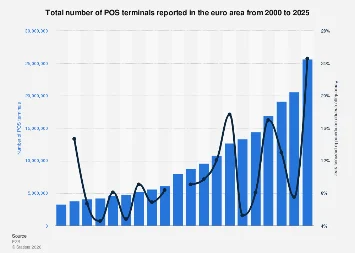
The Eurozone is on track for a substantial surge in the adoption of point-of-sale (POS) terminals, with projections indicating a nearly 25% year-on-year increase in deployment by 2025, reaching an estimated 25.66 million units. This anticipated growth trajectory underscores a fundamental shift in how transactions are conducted across the currency bloc, reflecting a deepening embrace of digital payment infrastructure and a corresponding decline in traditional cash reliance. The robust expansion forecast for POS terminals is not merely a reflection of increased business activity but a powerful indicator of evolving consumer behavior and the strategic investments made by businesses to adapt to the digital economy.
The figures reveal a consistent upward trend in POS terminal installations across the Eurozone over the past decade. From a base of approximately 8 million units in 2015, the number has steadily climbed, reaching over 19 million by 2023. While growth rates have fluctuated, often influenced by economic cycles and technological advancements, the overall momentum has been overwhelmingly positive. For instance, after a modest 7.5% increase in 2024, the projected 24.6% leap in 2025 signifies a significant acceleration, potentially driven by a combination of factors including the continued digitalization of small and medium-sized enterprises (SMEs), the expansion of e-commerce into physical retail, and the ongoing push for seamless, contactless payment experiences. This accelerated deployment contrasts with earlier periods, where annual growth rates were typically in the single digits or low double digits, highlighting a recent intensification of this trend.
This expansion is occurring against a backdrop of global digitalization efforts. Many developed economies are witnessing similar trends, with POS terminal penetration correlating closely with GDP per capita and the maturity of their financial services sectors. Countries like the United Kingdom and Canada have long had high POS terminal penetration, but the Eurozone’s projected growth rate in 2025 suggests it is actively closing any remaining gaps and potentially outpacing some established markets in terms of adoption velocity. This aggressive expansion is crucial for fostering a truly cashless society, which offers potential benefits such as increased transaction speed, enhanced security, reduced operational costs for businesses, and improved data analytics capabilities for understanding consumer spending patterns.
The economic implications of this burgeoning POS terminal landscape are far-reaching. For payment processors and financial technology (fintech) companies, this represents a significant market opportunity. The demand for hardware, software, and associated services – including transaction processing, data security, and analytics platforms – is expected to soar. This growth fuels innovation in areas like mobile POS solutions, integrated payment systems, and value-added services that businesses can offer to their customers. Furthermore, the increased adoption of digital payments can lead to a more efficient and transparent economy, potentially reducing the shadow economy and improving tax collection.
However, this digital transformation also presents challenges. The significant investment required for businesses, particularly smaller ones, to adopt new POS systems can be a barrier. Ensuring equitable access to these technologies across all business sizes and geographical regions within the Eurozone is paramount to avoid creating a digital divide. Moreover, the exponential growth in digital transactions necessitates robust cybersecurity measures to protect sensitive customer data from increasingly sophisticated cyber threats. Regulators will need to remain vigilant in ensuring fair competition within the payments ecosystem and protecting consumer rights in this evolving digital marketplace.
The trend towards digital payments is also inextricably linked to broader economic policies and consumer preferences. The European Central Bank (ECB) has been a strong advocate for digital innovation in payments, aiming to foster a more integrated and efficient single market. Initiatives like the development of a digital euro, while still in its conceptual stages, signal a forward-looking approach to the future of money. Consumer confidence in digital payment security and convenience continues to grow, driven by the widespread availability of smartphones and the increasing sophistication of mobile payment applications. The COVID-19 pandemic further accelerated this shift, as contactless payments became a preferred method for health and safety reasons, a trend that has largely persisted.
The projected figures for 2025 suggest that the Eurozone is moving decisively towards a future where card and digital wallet transactions are the norm, rather than the exception. This transformation impacts not only the retail sector but also hospitality, transportation, and a wide array of service industries. The ability of businesses to accept a diverse range of digital payments is becoming a critical factor in their competitiveness. As more consumers become accustomed to the speed and ease of digital transactions, businesses that lag in adopting these technologies risk losing customers to more digitally-enabled competitors.
Looking ahead, the sustained growth in POS terminal deployment is likely to be influenced by several key drivers. Continued advancements in NFC (Near Field Communication) technology, the proliferation of wearable payment devices, and the integration of AI-powered payment solutions are all poised to shape the future of transactions. Furthermore, the ongoing expansion of e-commerce will continue to drive the need for unified commerce solutions that seamlessly integrate online and offline payment experiences. The Eurozone’s commitment to digital transformation, coupled with evolving consumer habits, paints a clear picture of a rapidly digitizing economic landscape, with POS terminals serving as the crucial interface between businesses and their increasingly digital-savvy customers. The period leading up to and beyond 2025 will likely be characterized by a continuous evolution of payment technologies and a further consolidation of digital payment methods as the dominant force in the Eurozone’s economic activity.