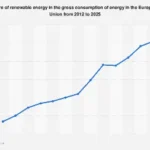
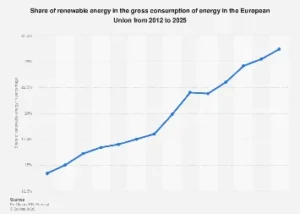


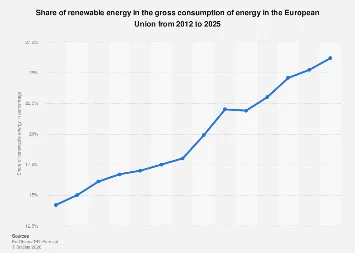
The European Union has demonstrated a consistent and significant upward trajectory in the proportion of renewable energy sources contributing to its gross final energy consumption, a trend projected to culminate in a notable milestone by 2025. Data reveals a steady climb from a 14.2% share in 2012 to an anticipated 26.2% in 2025, underscoring a decade-long commitment to decarbonization and energy independence. This progressive increase reflects the bloc’s ambitious climate policies and its strategic pivot away from fossil fuels, driven by both environmental imperatives and the pursuit of enhanced energy security.
The year-on-year data paints a clear picture of sustained growth. Following the 14.2% recorded in 2012, the share rose to 15% in 2013 and continued its ascent to 16.1% in 2014. By 2015, renewables accounted for 16.7% of the EU’s final energy consumption, a figure that nudged up to 17% in 2016 and further to 17.5% in 2017. A more substantial leap occurred in 2018, pushing the share to 18%. The subsequent years saw continued expansion, with 2019 registering 19.9%, and despite a slight dip in the growth rate, 2020 reached 22%. The momentum reasserted itself with 21.9% in 2021 and a significant increase to 23% in 2022. Projections indicate this trend will persist, with an estimated 24.58% in 2023 and 25.24% in 2024, culminating in the projected 26.2% for 2025. It is important to note that figures from 2019 onwards exclude the United Kingdom, following its departure from the European Union.
This sustained increase in renewable energy penetration is not merely an abstract statistic; it represents a fundamental shift in the EU’s energy landscape. The growth is largely attributable to advancements in solar photovoltaic and wind power technologies, coupled with supportive policy frameworks such as feed-in tariffs, renewable energy auctions, and carbon pricing mechanisms. The European Green Deal, a comprehensive package of policy initiatives aimed at making the EU climate-neutral by 2050, has been a key driver, setting binding targets for emission reductions and renewable energy deployment. The Renewable Energy Directive (RED) has been instrumental in this progress, setting specific targets for member states and promoting the use of renewable energy in electricity, heating and cooling, and transport sectors.
The economic implications of this transition are profound and multifaceted. On one hand, the expansion of renewables has spurred significant investment in manufacturing, installation, and maintenance of green technologies, creating new jobs and fostering innovation. Countries that have aggressively pursued renewable energy deployment have often seen their domestic industries benefit from this growth. For instance, Germany and Spain have been at the forefront of solar and wind energy development, leading to substantial employment in these sectors. However, the transition also presents challenges. The intermittency of some renewable sources, such as solar and wind, necessitates substantial investment in grid infrastructure, energy storage solutions, and smart grid technologies to ensure a stable and reliable energy supply. Furthermore, the phasing out of fossil fuel industries can lead to job losses in traditional sectors, requiring careful planning and just transition strategies to support affected communities and workers.
Globally, the EU’s progress serves as a benchmark and an inspiration. While other regions are also investing in renewables, the EU’s coordinated and legally binding approach has yielded impressive results. China, for example, is the world’s largest producer and consumer of renewable energy, particularly in solar and wind power, driven by ambitious national targets and industrial policy. The United States has also seen a significant surge in renewable energy adoption, boosted by tax incentives and falling technology costs. However, the EU’s commitment to a holistic energy transition, encompassing not just electricity generation but also heating, cooling, and transport, sets it apart. The target of 26.2% by 2025 signifies that the EU is on track to exceed its initial renewable energy targets, demonstrating the efficacy of its policy framework.
Looking ahead, the EU has set even more ambitious goals under the revised Renewable Energy Directive, aiming for at least 42.5% of its energy consumption to come from renewable sources by 2030, with an additional indicative target of 45%. Achieving these targets will require continued innovation, substantial investment, and sustained political will. The integration of renewable energy into sectors like industry and transport, which have historically been heavily reliant on fossil fuels, will be critical. Developments in green hydrogen, advanced biofuels, and offshore wind power are expected to play increasingly important roles. The success of the EU’s renewable energy strategy is not only crucial for meeting its climate objectives but also for enhancing its energy sovereignty and contributing to global efforts to combat climate change. The projected figures for 2024 and 2025 represent crucial stepping stones on this transformative journey, signaling a strong and accelerating shift towards a sustainable energy future for the continent.