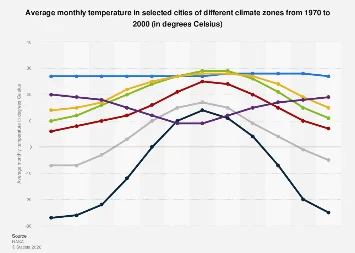
The Earth’s diverse climate zones, when examined through the lens of average monthly temperatures between 1970 and 2000, present a compelling narrative of climatic extremes and subtle variations. A comprehensive analysis of data from selected cities representing distinct ecological regions – from the humid tropics to the frigid Arctic – underscores the fundamental influence of latitude, geographical features, and atmospheric patterns on terrestrial warmth. These historical temperature averages provide a baseline against which contemporary climate shifts can be measured, offering crucial insights for global economic planning, agricultural strategies, and environmental policy.
In the heart of the Amazon basin, Manaus, Brazil, exemplifies the quintessential rainforest climate. Throughout the 1970-2000 period, its average monthly temperatures remained remarkably stable, hovering consistently around 27 to 28 degrees Celsius. This equatorial region experiences minimal seasonal fluctuation, a characteristic attributed to its consistent solar radiation and the moderating influence of dense vegetation and high humidity. Such climatic uniformity is vital for the region’s biodiversity and has historically shaped its agricultural practices, which often focus on perennial crops and the sustainable management of forest resources. The economic implications are significant, as this stable environment supports a vast array of natural resources and influences the development of industries reliant on consistent climatic conditions.
Contrast this with the extreme cold experienced in Aklavik, Canada, situated within the Arctic tundra. The data reveals a dramatic seasonal swing, with average January temperatures plummeting to a severe -27 degrees Celsius. Even during the brief Arctic summer, average temperatures struggle to climb above freezing, reaching a modest 14 degrees Celsius in July. This stark temperature differential, spanning nearly 40 degrees Celsius between the coldest and warmest months, is indicative of high-latitude climates where solar insolation varies drastically throughout the year. Economically, such regions face significant challenges related to infrastructure development, energy consumption for heating, and the viability of traditional agriculture. However, these areas also hold significant reserves of natural resources and are increasingly important for scientific research into climate change impacts.
Moving to the boreal regions, Lahti, Finland, representing a coniferous forest climate, displays a more moderate, yet still pronounced, seasonal temperature variation. Average January temperatures hover around -7 degrees Celsius, well below freezing, while July sees averages reach a pleasant 17 degrees Celsius. This pattern is typical of mid-latitude continental climates, where significant temperature differences between seasons are driven by the tilt of the Earth’s axis and the varying distance from the equator. For economies in these regions, understanding these seasonal shifts is critical for sectors like forestry, tourism, and winter sports, as well as for managing energy demands for both heating and cooling.
The temperate deciduous forest zone, exemplified by Madrid, Spain, presents a distinct climate profile characterized by warm summers and mild winters. Average January temperatures in Madrid during the 1970-2000 period were around 6 degrees Celsius, with July averages soaring to 25 degrees Celsius. This distinct seasonality supports a diverse range of flora and fauna and has historically fostered agricultural systems capable of adapting to these predictable climatic cycles. The economic landscape of such regions often benefits from a balanced agricultural output, robust tourism seasons, and industries that thrive in moderate conditions.
In the heartland of North America, Austin, Texas, a representative of a grassland climate, experiences hot summers and mild winters. Average January temperatures stand at 10 degrees Celsius, while July averages reach a sweltering 29 degrees Celsius. This climate is conducive to extensive agriculture, particularly grain production, and supports a vibrant economy. The substantial temperature range between winter and summer necessitates careful planning for energy consumption, particularly for air conditioning during the hot summer months.
The arid expanse of the desert climate, as seen in Cairo, Egypt, showcases exceptionally high temperatures, especially during the summer months. January averages around 14 degrees Celsius, while July and August climb to 28 degrees Celsius. This climatic zone is defined by extremely low rainfall and significant diurnal temperature variations. Economic activities in desert regions are often concentrated around water management, specialized agriculture (such as date farming), and tourism, with significant investment required to mitigate the challenges posed by extreme heat and aridity.
Finally, Johannesburg, South Africa, situated in a shrubland biome, presents a climate that is generally mild throughout the year, with distinct wet and dry seasons rather than extreme temperature variations. January averages 20 degrees Celsius, and July averages a cooler 9 degrees Celsius. This temperate highland climate supports a diverse economy, including agriculture and mining. The relatively stable temperatures, compared to some other zones, contribute to a more consistent environment for various economic activities, although rainfall patterns can significantly influence agricultural output.
The divergence in average monthly temperatures across these diverse climate zones, as documented for the period 1970-2000, highlights the fundamental climatic disparities that shape global ecosystems and economies. These historical data serve as a crucial benchmark, offering a foundational understanding of climatic norms. In an era of accelerating climate change, the analysis of such long-term temperature trends becomes increasingly vital. Understanding these historical patterns allows for a more precise assessment of contemporary deviations, informing projections about future climatic conditions and their profound economic and social implications worldwide. The stability of rainforests contrasts sharply with the extreme seasonality of tundra and continental climates, while temperate and shrubland zones offer more moderate, yet distinct, seasonal patterns. This intricate tapestry of global temperatures underscores the complex interplay between geography, atmospheric dynamics, and the human economies that depend on them.