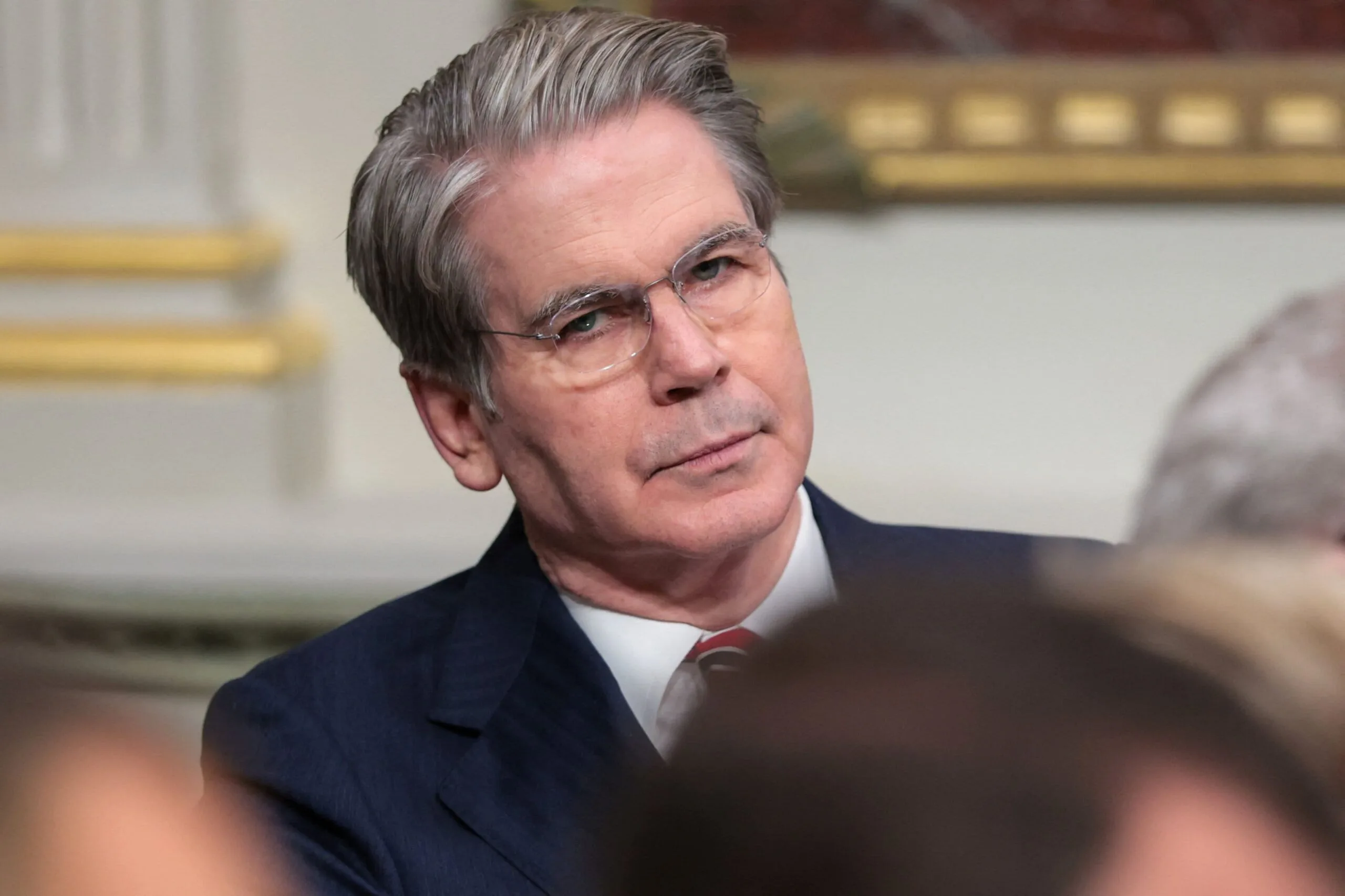
The delicate equilibrium between stimulating domestic economic growth and maintaining price stability has reached a critical juncture, as U.S. Treasury Secretary Scott Bessent signaled a nuanced shift in his advocacy for lower interest rates. Speaking at the Semafor World Economy Conference in Washington, D.C., Bessent articulated a position that balances his long-held desire for monetary easing with a pragmatic acknowledgement of the "wait-and-see" approach currently adopted by the Federal Reserve. While the Secretary remains a staunch proponent of the idea that lower borrowing costs are the "missing ingredient" for a more robust American economy, he conceded that the fog of geopolitical uncertainty—specifically the recent conflict involving Iran—justifies a period of strategic hesitation by central bank policymakers.
Bessent’s remarks represent a notable evolution in the ongoing dialogue between the executive branch and the independent Federal Reserve. Earlier this year, the Treasury Secretary was vocal in his belief that the Fed should accelerate the pace of rate reductions to capitalize on a strong labor market and burgeoning industrial activity. However, the eruption of hostilities in the Middle East in late February introduced a volatile variable into the economic equation, causing energy prices to surge and complicating the inflation narrative. As of mid-April, Bessent’s tone has shifted from one of urgent prodding to one of empathetic observation, reflecting the complex reality that headline inflation figures have been temporarily skewed by external shocks.
The statistical backdrop for this policy debate is a study in contrasts. In March, the U.S. economy saw consumer prices climb by 0.9%, while producer prices rose by 0.5%. At first glance, these figures might suggest a resurgence of the inflationary pressures that plagued the post-pandemic recovery. Yet, a closer inspection of the "core" data—which strips out the volatile categories of food and energy—reveals a much more stable environment. Core consumer inflation rose by a modest 0.2%, and wholesale core prices edged up by a mere 0.1%. This divergence highlights the extent to which the Iran-Israel conflict acted as a tax on the global economy, driving up the cost of oil and transportation while leaving the underlying price structure of goods and services relatively intact.
Secretary Bessent emphasized this distinction during his address, noting that he remains "highly confident" that core inflation is under control and continuing to trend downward across numerous categories. The Treasury Secretary’s optimism is bolstered by recent movements in the bond market. Treasury yields, which serve as a barometer for long-term inflation expectations and investor sentiment, have begun to retreat from their recent peaks. This cooling of yields follows the announcement of a ceasefire in the Middle East, which led to a sharp correction in crude oil prices. For the Treasury, this market reaction serves as a validation that the recent inflationary spike was a transient byproduct of war rather than a systemic failure of domestic policy.

Despite this optimism, the Federal Reserve faces a daunting task. The central bank’s dual mandate—to promote maximum employment and stable prices—is currently being tested by the specter of "stagflationary" indicators: slowing growth paired with headline inflation that remains above the 2% target. According to fed funds futures pricing, market participants have largely priced out the possibility of significant rate cuts in the immediate future, with some even whispering about the "slimmest possibility" of a further hike should energy costs rebound. This cautious market sentiment aligns with the Fed’s traditional preference for data consistency over several months before committing to a directional shift in policy.
The tension between the Treasury and the Fed is further complicated by a looming leadership transition and a burgeoning political standoff in the U.S. Senate. Fed Chair Jerome Powell’s term is set to expire in May, and the path forward for his successor is anything but clear. The White House’s nominee to lead the central bank, Kevin Warsh—a selection Bessent reportedly helped facilitate—is currently stalled in the confirmation process. Senator Thom Tillis, a key Republican from North Carolina, has vowed to block a vote on Warsh until a separate legal matter is resolved. This involves an investigation led by U.S. Attorney Jeanine Pirro into alleged cost overruns associated with Federal Reserve building projects.
Powell has characterized this investigation as a politically motivated attempt by the administration to exert pressure on the central bank to lower rates. This friction underscores a perennial debate in American governance: the sanctity of central bank independence. While the executive branch naturally favors lower rates to stimulate the economy and improve the fiscal outlook for debt servicing, the Federal Reserve is designed to act as a technocratic buffer against short-term political cycles. Bessent’s recent comments, while supportive of the Fed’s caution, do little to mask the underlying desire for a policy pivot that would ease the Treasury’s own burden of financing the national debt at elevated interest rates.
From a global perspective, the U.S. find itself in a unique position. While the European Central Bank and the Bank of England grapple with their own versions of "sticky" inflation and sluggish growth, the U.S. economy showed remarkable resilience in the first two months of the year. Bessent noted that January and February were periods of significant strength, a factor that gives the Fed more room to maintain higher rates without immediately triggering a recession. However, the long-term sustainability of this "higher for longer" stance is being questioned by international trade partners. A strong dollar, bolstered by high U.S. interest rates, has put downward pressure on emerging market currencies and complicated the global fight against inflation by making dollar-denominated commodities more expensive for the rest of the world.
The "wait and see" approach endorsed by Bessent also reflects a strategic gamble on the permanence of the Middle Eastern ceasefire. Should the region remain stable, the downward trajectory of energy prices will likely drag headline inflation back toward the core levels seen in the March data. If this occurs, the Fed would have the "clarity" it seeks to begin a cycle of easing by late summer or early autumn. Conversely, any flare-up in regional tensions would likely send oil prices back toward the $100-a-barrel mark, forcing the Fed to keep rates restrictive well into 2027, regardless of the political pressure from the Treasury or the White House.

Economic impact analysis suggests that for every 10% increase in oil prices, U.S. GDP growth can be shaved by roughly 0.1 to 0.2 percentage points over the following year, while adding a similar amount to headline CPI. For a Treasury Secretary tasked with managing the nation’s balance sheet, these margins are significant. High rates increase the cost of servicing the nearly $35 trillion national debt, diverting funds away from infrastructure, defense, and social programs. Thus, Bessent’s advocacy for rate cuts is not merely a matter of supporting growth, but a fiscal necessity in an era of expanding deficits.
In his concluding remarks at the conference, Bessent returned to the theme of the "missing ingredient." He argued that the American consumer and the American corporation have proven their resilience in the face of high borrowing costs, but that this resilience is not infinite. To transition from a period of "recovery" to one of "sustained expansion," the economy requires the oxygen of cheaper capital. The Secretary’s willingness to "understand" the Fed’s current hesitation is perhaps a tactical retreat—a recognition that in the current geopolitical climate, patience is the only currency that carries weight.
As the May deadline for Powell’s term approaches, the financial world remains on high alert. The intersection of war, inflation data, and a gridlocked Senate confirmation process has created a period of unprecedented uncertainty for U.S. monetary policy. Whether Kevin Warsh eventually takes the helm or Jerome Powell is forced into an extended "lame duck" period, the fundamental challenge remains: how to normalize interest rates without reigniting the inflationary fires that the geopolitical landscape seems so intent on fueling. For now, Secretary Bessent has signaled that while the Treasury’s destination remains unchanged, it is willing to accept a slower, more cautious route to get there.