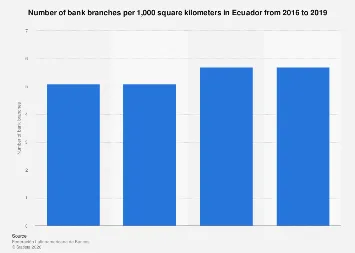
Ecuador’s financial sector is navigating a complex landscape where the traditional physical presence of bank branches is being re-evaluated against the relentless march of digital banking. While specific, up-to-the-minute figures on the exact number of bank branches per 1,000 square kilometers in Ecuador are often proprietary data points held by market research firms, the underlying trend is a global one: a gradual but significant recalibration of branch networks as financial institutions adapt to evolving customer behaviors and technological advancements. This phenomenon has profound implications for financial inclusion, economic development, and the operational strategies of banks within the Andean nation.
Historically, bank branches served as the primary nexus for customer interaction, transaction processing, and financial advice. Their density within a territory often correlated with the accessibility of financial services, particularly in regions with lower internet penetration or a higher proportion of the population less comfortable with digital platforms. In Ecuador, as in many developing economies, a robust branch network has been crucial for fostering trust and facilitating the adoption of formal financial services, thereby contributing to economic stability and growth. The physical footprint of a bank not only represents a service point but also a tangible commitment to local communities, impacting employment and local economic activity.
However, the advent of digital banking, mobile payments, and online financial management tools has begun to reshape this paradigm. Customers, especially younger demographics and those in urban centers, are increasingly opting for the convenience and speed offered by digital channels. This shift is compelling banks worldwide to reassess the cost-effectiveness and strategic necessity of maintaining extensive physical branch networks. The expenses associated with real estate, staffing, and operational overheads for a large number of branches are substantial. Consequently, many financial institutions are exploring strategies that include branch consolidation, the introduction of smaller, more technologically focused "digital hubs," or a hybrid model that integrates digital services with a reduced but strategically located branch presence.
The economic implications of branch density are multifaceted. A higher density can indicate greater financial inclusion, making it easier for individuals and small businesses to access credit, savings, and payment services, which are vital for economic participation. Conversely, a lower density might suggest a focus on cost efficiency or a deliberate strategic pivot towards digital-first strategies. For Ecuador, understanding this balance is critical. While a concentrated branch network can stimulate local economies and serve underserved populations, an over-reliance on physical infrastructure might lag behind global trends and potentially hinder innovation.
Globally, the trend is clear: a decline in the number of physical bank branches. For instance, in the United States, the number of bank branches has been on a steady downward trajectory for over a decade. Similar patterns are observed in Europe and parts of Asia, driven by the dual forces of digital adoption and the pursuit of operational efficiencies. This global context is important for Ecuador as it considers its own financial infrastructure strategy. The nation can learn from the successes and challenges faced by other markets, tailoring its approach to its unique socio-economic and geographical characteristics.
Several factors influence branch density in a country like Ecuador. Geographic diversity plays a significant role. The Andes mountains, the Amazon basin, and the coastal regions present distinct challenges and opportunities for branch accessibility. Reaching remote communities in the Amazon, for example, requires a different logistical approach than serving a densely populated urban area like Guayaquil or Quito. Furthermore, income levels and literacy rates impact the adoption of digital financial services. In areas where digital literacy is lower or internet access is limited, physical branches remain indispensable.
The regulatory environment also shapes branch network strategies. Central banks and financial regulators often have policies that govern the establishment and closure of branches, aiming to ensure financial stability and protect consumer interests. Any significant shift in branch density in Ecuador would likely be influenced by, and potentially necessitate adjustments to, these regulatory frameworks. Ensuring that digital transformation does not inadvertently lead to financial exclusion for vulnerable segments of the population is a key concern for policymakers.
Market data from financial technology (fintech) companies and banking industry reports often highlight the growth of digital transactions. Mobile banking adoption in Ecuador, while still evolving, is on an upward trend. This suggests that while physical branches will likely remain relevant for certain services and customer segments, their role is undoubtedly changing. Banks may increasingly focus branches on complex advisory services, high-value transactions, or serving specific customer segments that require face-to-face interaction, while routine transactions are migrated to digital platforms.
The economic impact of this evolution extends beyond the banking sector itself. Reduced branch networks can lead to job losses in traditional banking roles but can also spur job creation in the technology and digital services sector. Furthermore, the efficient allocation of capital away from expensive physical infrastructure towards digital innovation can potentially lead to more competitive financial products and services, benefiting consumers and businesses alike.
For Ecuador to thrive in this evolving financial landscape, a strategic and nuanced approach is required. This involves investing in digital infrastructure, promoting digital literacy, and ensuring that regulatory frameworks are adaptable to new technologies. Simultaneously, it necessitates a careful consideration of how to maintain and adapt the physical branch network to serve those who still rely on it, preventing a widening of the financial inclusion gap. The ideal scenario is likely a hybrid model that leverages the strengths of both physical and digital channels, creating a more resilient, accessible, and efficient financial system for all Ecuadoreans. The precise metrics of branch density per square kilometer are a snapshot, but the underlying forces of digital transformation and the strategic response of the banking sector are what truly define the future of financial access and services in Ecuador and across the globe.