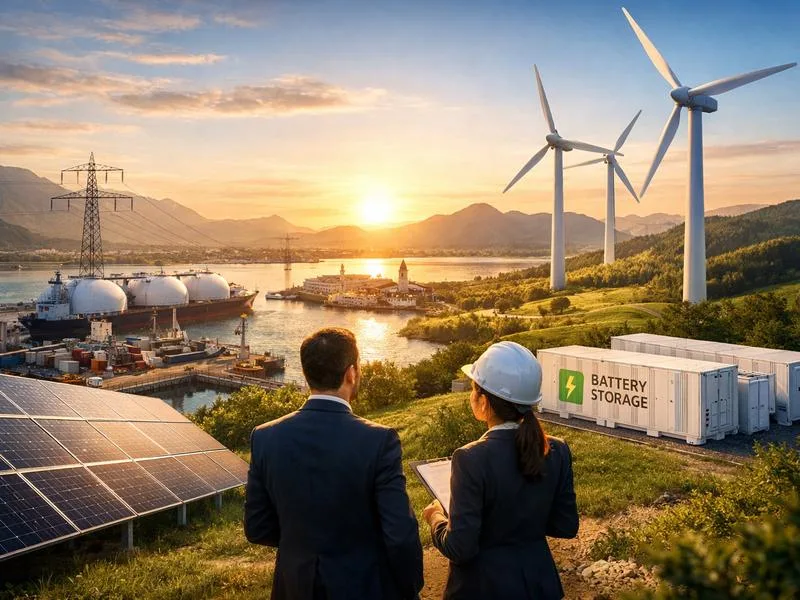
The global push to modernize and expand critical infrastructure, particularly within the energy sector, presents a complex yet opportunity-rich environment for institutional investors. As governments worldwide, including those in the UK, set ambitious targets for private capital allocation to large-scale assets, a primary concern for pension fund managers is the potential scarcity of high-quality, readily accessible investments. This challenge, however, is increasingly being addressed by a strategic focus on specialized market segments, or "niches," that offer the potential for stable, long-term value creation.
One such area generating significant investor interest is energy infrastructure, especially as the global energy landscape shifts towards greater decentralization. Christian Schwenkenbecher, Chief Client Officer at MPC Capital, a firm specializing in guiding institutional clients toward structural growth opportunities in maritime and energy infrastructure, highlights the burgeoning prospects within this domain. "Our investment philosophy in energy infrastructure centers on generation assets, encompassing onshore wind, solar photovoltaic (PV) installations, and energy storage solutions," Schwenkenbecher explains. "We prioritize structuring and securing long-term cash flows, predominantly through corporate offtake agreements. This approach allows us to operate as a vertically integrated investor, maintaining close proximity to the underlying assets. Looking ahead, we are actively identifying additional niche opportunities across the entire energy infrastructure value chain."
This hands-on, integrated approach provides investors with a reassuring degree of oversight and control, situating them at the heart of strategic decision-making. Schwenkenbecher elaborates on MPC Capital’s preferred investment model: "We seek majority ownership stakes in assets to fully leverage our active management capabilities. Nevertheless, we also recognize the value of strategic partnerships where complementary skillsets and aligned return and performance expectations exist. This dual strategy has enabled us to build a strong track record of successful collaboration with both institutional investment partners and industrial counterparts, a synergy we consider fundamental to achieving superior performance."
The strategic focus on Europe is underpinned by several compelling factors, including the availability of high-quality assets, the robustness of political and regulatory frameworks, and a substantial backlog of investment required to construct a new, more agile, and decentralized energy infrastructure system. Schwenkenbecher notes, "The industrial sector, in particular, will increasingly rely on private capital to finance economically viable decarbonization initiatives. This presents a potent investment thesis for institutional investors, including prominent private equity firms such as KKR, Apollo, and EQT, which have demonstrably increased their investment activity, with a notable concentration in Germany, Europe’s largest economy." The global energy market is projected to see significant capital deployment. Projections by the International Energy Agency (IEA) suggest that annual clean energy investment will need to more than triple by 2030 to around $4 trillion to meet climate goals. Within this vast sum, infrastructure development will be a cornerstone.
While MPC Capital’s core target markets are expected to remain consistent, Schwenkenbecher observes a growing appetite from international investors, particularly from the United States and the Middle East, to invest in European opportunities. This interest, he suggests, is amplified by recent geopolitical developments. He remains confident in the abundance of investment prospects within Europe, spanning the entire energy value chain from generation and transmission to distribution and energy services, offering potential across short, medium, and long investment horizons.

"Energy is poised to become a critical enabler for emerging technologies, such as artificial intelligence (AI), and will continue to fuel overall GDP growth and enhance domestic competitiveness," Schwenkenbecher asserts. "Positioning investments along these fundamental mega-trends and structural growth drivers appears to be a prudent strategy." The increasing demand for energy, driven by technological advancements and economic expansion, is a significant tailwind. For instance, the projected growth of data centers alone, crucial for AI and cloud computing, necessitates substantial investments in reliable and scalable power infrastructure.
While many governments are exploring the expansion of nuclear power as a component of their long-term energy security strategies, it does not represent a primary focus for MPC Capital. "We maintain an agnostic stance regarding specific energy sources," Schwenkenbecher clarifies. "However, our concentration on renewable energy production capacity is largely attributable to its cost competitiveness and shorter deployment timelines compared to nuclear power projects." The levelized cost of energy (LCOE) for solar and wind power has fallen dramatically over the past decade, making them increasingly attractive investment options compared to the long lead times and high capital costs associated with nuclear facilities.
The current era of geopolitical instability creates a strategic intersection with MPC Capital’s core expertise in maritime and energy assets. With many European nations, particularly those within the NATO alliance, committing to increasing defense spending to five percent of GDP over the next decade, a significant portion of this funding is earmarked for major port expansions. These expansions, in turn, require robust and modern energy infrastructure to support their operations. "The anticipated increase in spending on port infrastructure and other maritime assets underscores the strategic importance of both sectors," Schwenkenbecher notes. "Our focus on attractive niches is particularly geared towards the convergence of maritime and energy infrastructure." These broader macroeconomic, geopolitical, and regulatory considerations are under constant scrutiny. "We must remain attuned to the impact of interest rate fluctuations on both transaction and fundraising activities," he adds. "Consequently, we adopt a highly selective approach to overall transaction volume in the prevailing high-interest-rate environment. We anticipate exercising significant caution as central banks begin to ease monetary policy; however, a sustained trend of interest rate reductions should serve as a beneficial catalyst for our transaction endeavors."
Schwenkenbecher emphasizes the critical importance of balancing transactional and management-based revenues. He highlights that recurring service revenues have been a foundational element of MPC Capital’s resilient business model, enabling the firm to maintain its disciplined investment strategies while ensuring predictable earnings growth. The global infrastructure market is immense, with estimates suggesting that over $100 trillion in infrastructure investment will be needed globally by 2040 to support economic growth.
Regulatory frameworks and supportive policies are also pivotal in the capital allocation process. The seismic shifts in global energy markets following the Russian invasion of Ukraine have placed national energy security at the forefront of government agendas. To date, the tangible regulatory responses have been varied. "The imperative of sensible regulation in accelerating the development of energy infrastructure cannot be overstated," Schwenkenbecher states. "We have observed particularly encouraging regulatory approaches in the United Kingdom and the United States. We advocate for the implementation of similar regulatory measures in Germany to attract greater capital investment into the infrastructure sector." He concludes, "Private capital will undoubtedly play a crucial role, with governments expected to establish conducive frameworks to incentivize its deployment." The interplay between public policy and private investment is a recurring theme in infrastructure development, with successful projects often requiring a clear and stable regulatory environment to de-risk investments and attract the necessary capital.