

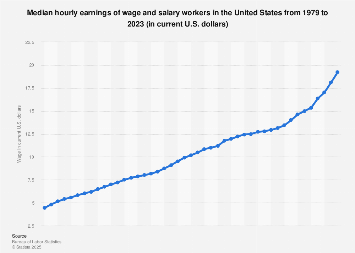
In 2024, the median hourly earnings for wage and salary workers across the United States stood at $20.30, a stark contrast to the $4.44 recorded in 1979. This nearly five-fold increase over more than four decades reflects a complex evolution in the American labor market, shaped by economic shifts, policy decisions, and persistent advocacy for fair compensation. While aggregate figures paint a picture of nominal wage growth, a deeper dive into the nuances of hourly versus salaried compensation, minimum wage debates, and demographic disparities reveals a more intricate reality for American workers.
The plight of hourly wage earners remains a focal point of economic discourse. The federal minimum wage, frozen at $7.25 per hour since 2009, has become a significant point of contention. Advocates argue that this stagnant figure is insufficient to cover the basic costs of living in a modern economy, fueling movements like "Fight for 15," which gained prominence in the early 2010s, demanding a $15 minimum wage. While federal action has been limited, a growing number of states and municipalities have taken the initiative to establish higher minimum wage floors. As of 2026, the District of Columbia leads the nation with a minimum wage of $17.95 per hour, closely followed by Washington State at $17.13, and New York State also implementing a $17.00 minimum. These localized adjustments highlight a patchwork of wage regulations across the country, with significant disparities in the purchasing power afforded to low-wage workers depending on their geographic location.
In contrast to hourly workers, salaried employees are compensated with a fixed remuneration, typically on a weekly or annual basis. The trajectory for this segment of the workforce has been one of consistent upward movement. Since 1979, median weekly earnings for full-time salaried workers have seen a steady increase, indicating a broader trend of wage growth within professional and managerial roles. Analysis of demographic data reveals persistent patterns in earnings, with Asian salaried workers consistently reporting the highest median hourly pay compared to other ethnic groups. This disparity underscores ongoing challenges in achieving equitable compensation across different demographics within the salaried workforce.
The gap between the federal minimum wage and the median hourly earnings of all wage and salary workers is substantial, signaling that a significant portion of the workforce earns above the statutory minimum. However, the median figure itself, while higher than in previous decades, is increasingly being scrutinized against the rising cost of living. Inflation, housing costs, healthcare expenses, and educational debt have all outpaced wage growth for many, leading to a perceived decline in real wages for some segments of the population. This phenomenon, often referred to as wage stagnation relative to expenses, contributes to economic anxieties and calls for policies that address not just nominal wage increases but also the erosion of purchasing power.
Examining global comparisons provides further context for the American compensation landscape. While the U.S. median hourly wage of $20.30 might appear robust when compared to some developing economies, it often falls short when benchmarked against highly developed nations with strong social safety nets and more aggressive minimum wage policies. For instance, many Western European countries have significantly higher statutory minimum wages and often implement mechanisms for automatic wage adjustments tied to inflation or collective bargaining agreements. The median wage in countries like Luxembourg, Australia, or certain Nordic nations can exceed that of the United States, reflecting different societal priorities regarding income distribution and worker welfare.
The economic implications of these wage trends are far-reaching. For hourly workers, higher minimum wages can boost consumer spending, particularly among lower-income households who tend to spend a larger proportion of their income. This increased demand can stimulate economic growth. However, businesses, particularly small and medium-sized enterprises, often express concerns about the potential for increased labor costs to lead to reduced hiring, price increases, or even business closures. The debate over the optimal minimum wage level involves balancing these competing economic forces.
For salaried workers, rising median earnings contribute to overall economic prosperity and can fuel investment and savings. The consistent growth in this sector suggests a robust demand for skilled labor and professional services. However, the persistent wage gap between ethnic groups and the broader issue of income inequality remain significant economic and social challenges. Addressing these disparities requires targeted policies, including investments in education and training, anti-discrimination measures in hiring and promotion, and initiatives to promote pay transparency.
The distinction between hourly and salaried compensation also reflects broader trends in labor market segmentation. The gig economy, freelance work, and contract positions, while offering flexibility, often blur the lines of traditional employment and can lead to less predictable income streams and fewer benefits compared to permanent salaried roles. The median hourly wage figures typically encompass a broad spectrum of employment types, but understanding the nuances within these categories is crucial for a complete picture of worker compensation.
Furthermore, the impact of technological advancements and automation cannot be ignored. As industries evolve, the demand for certain skills shifts, potentially leading to increased wages for highly specialized roles while displacing workers in more routine positions. This dynamic contributes to wage polarization, where high-skill, high-wage jobs and low-skill, low-wage jobs may grow, while middle-skill jobs, which have historically provided a pathway to a stable middle-class income, experience a decline. The median hourly earnings serve as a general indicator, but the distribution of wages around that median is increasingly important.
Looking ahead, the trajectory of American worker compensation will likely be shaped by a confluence of factors: the ongoing debate over federal and state minimum wage policies, the pace of technological innovation, the effectiveness of workforce development programs, and evolving societal expectations regarding fair labor practices. The $20.30 median hourly wage in 2024 represents a point in this ongoing evolution, a figure that will continue to be scrutinized against the backdrop of economic realities and the aspirations of millions of American workers. The long-term trend will depend on whether wage growth can consistently outpace inflation and the rising cost of essential goods and services, thereby ensuring a tangible improvement in the standard of living for all segments of the American workforce.