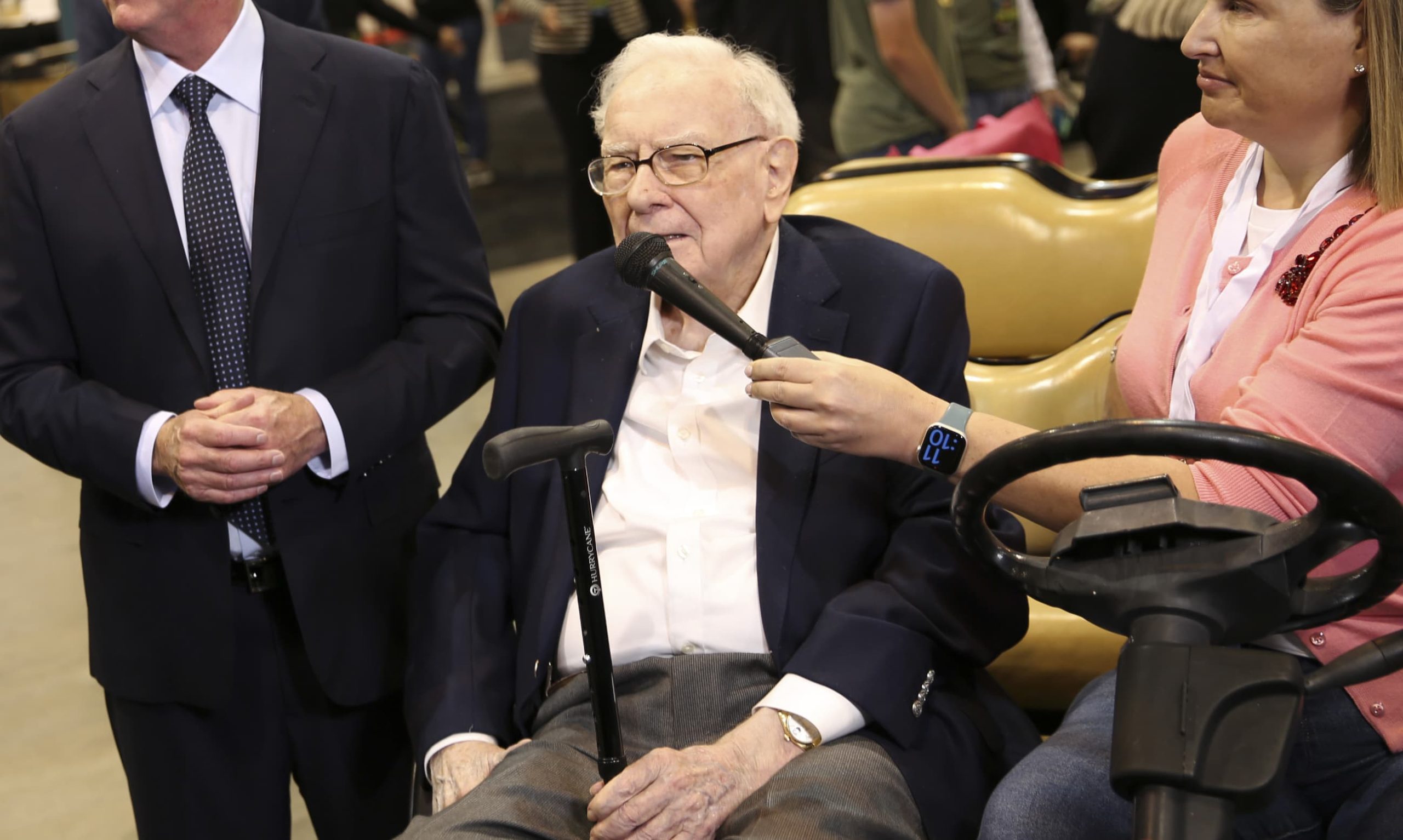
The transition of power at Berkshire Hathaway marks the end of perhaps the most storied tenure in the history of American capitalism, as Warren Buffett officially concludes his six-decade run as Chief Executive Officer. In a move that signals both a transformation in leadership and a steadfast commitment to the company’s foundational principles, Buffett has handed the "decider" role to Greg Abel, the long-anointed successor who now takes charge of a trillion-dollar empire. Despite the magnitude of the change, Buffett’s parting message is one of profound confidence, asserting that Berkshire Hathaway possesses the most resilient structural integrity of any corporation in existence today—a vehicle he believes is uniquely engineered to thrive for at least another hundred years.
The departure of the 95-year-old "Oracle of Omaha" from the CEO role is not merely a change in personnel; it is the conclusion of an era that saw a failing New England textile mill transformed into a global conglomerate of unprecedented scale. Under Buffett’s stewardship, Berkshire Hathaway achieved a staggering cumulative return of more than 5,000,000%, a figure that dwarfs the performance of the broader S&P 500 and has become the gold standard for value-oriented investing. As he steps into the role of Chairman, leaving the operational and capital allocation decisions to Abel, Buffett has made it clear that the company’s best days are not necessarily behind it.
In a recent assessment of the company’s future, Buffett emphasized that Berkshire’s diversified architecture provides a level of durability that is virtually unmatched in the corporate world. By operating across a vast spectrum of industries—ranging from the high-stakes world of insurance and reinsurance with GEICO and National Indemnity to the industrial backbone of the United States via BNSF Railway and Berkshire Hathaway Energy—the conglomerate has created a self-sustaining ecosystem. This diversification, coupled with a cash reserve that recently eclipsed $300 billion, provides a "fortress balance sheet" capable of weathering economic depressions, inflationary cycles, and technological disruptions that might topple less diversified firms.
The man now tasked with navigating this behemoth, Greg Abel, comes to the position with a reputation for operational precision and a low-profile, results-oriented demeanor. Formerly the head of Berkshire’s sprawling energy division, Abel has long been viewed by the board and by Buffett himself as the ideal custodian of the Berkshire culture. Buffett’s endorsement of Abel has been emphatic, noting that the new CEO’s efficiency often exceeds his own. The veteran investor remarked that Abel’s capacity for work and decision-making is such that he can accomplish in a single week what might take others a month to process. This vote of confidence is intended to soothe a market that has occasionally expressed trepidation about a post-Buffett future.
Market reactions to the transition have been characterized by a cautious "wait-and-see" approach. In the months following the initial retirement announcement, Berkshire’s Class B shares saw periods of underperformance relative to the broader market. Analysts suggest this "succession discount" reflects the uncertainty regarding whether Abel can replicate Buffett’s "magic touch" in capital allocation and maintain the "Buffett Premium"—the additional valuation investors have historically been willing to pay for the assurance of Buffett’s personal oversight. The challenge for Abel will be to prove that the Berkshire model is a repeatable system rather than the result of a singular genius.
Central to Berkshire’s longevity is its unique decentralized operating model. Unlike traditional conglomerates that often suffer from bureaucratic bloat and meddling headquarters, Berkshire allows its subsidiary companies to operate with almost total autonomy. This "hands-off" approach has made Berkshire the preferred home for founders and family-owned businesses who wish to sell their companies without losing their operational identity. For Abel, maintaining this culture of trust and autonomy will be critical. Buffett has noted that Abel’s temperament is perfectly suited for this role, describing him as a "sensible leader" who remains grounded despite his immense responsibility. Abel’s penchant for a quiet life, including playing ice hockey with his children, mirrors Buffett’s own famous frugality and aversion to the glitz of Wall Street.

From an economic perspective, Berkshire Hathaway serves as a microcosm of the American economy. Its performance is often viewed as a bellwether for domestic industrial health. With over 400,000 employees globally, the company’s reach is immense. The insurance segment, in particular, remains the engine of the enterprise. The "float"—the premiums collected before claims are paid out—provides Berkshire with a massive, low-cost pool of capital that can be deployed into equity investments or whole-company acquisitions. This structural advantage is a primary reason why Buffett believes the company can survive for a century; as long as people need insurance, energy, and freight transportation, Berkshire will have a steady stream of "dry powder" to exploit market panics.
However, the transition brings an inevitable shift in the public face of the company. For decades, the Berkshire Hathaway Annual Shareholders Meeting in Omaha has been a pilgrimage for tens of thousands of investors, dubbed the "Woodstock for Capitalists." The event was defined by hours of Buffett and his late partner, Charlie Munger, answering questions with a mix of folksy wisdom and sharp economic analysis. That era has now effectively ended. Buffett has indicated that while he will attend future meetings as a director, he will no longer take the stage as the primary speaker. This withdrawal from the spotlight signals a deliberate effort to empower Abel and Vice Chairman Ajit Jain, ensuring that the market begins to associate Berkshire’s success with the new leadership team rather than the legacy of its founder.
The global economic landscape Abel inherits is markedly different from the one Buffett navigated for much of the 20th century. Today’s market is dominated by high-growth technology firms and rapid AI-driven transformation. While Berkshire has historically been slow to embrace tech—famously avoiding the dot-com bubble—it has pivotally integrated tech through massive stakes in companies like Apple. Abel’s challenge will be to balance Buffett’s traditional value-investing tenets with the necessity of competing in an increasingly digital and decarbonizing global economy. Berkshire’s massive investments in renewable energy and grid infrastructure under Abel’s previous leadership suggest that the company is already positioning itself for these long-term shifts.
Expert insights suggest that the true test of the Abel era will come during the next major market downturn. Buffett’s greatest strength was his ability to remain greedy when others were fearful, famously providing lifelines to firms like Goldman Sachs and General Electric during the 2008 financial crisis in exchange for lucrative preferred shares. Whether Abel will have the same latitude from shareholders to make multi-billion-dollar bets during a crisis remains a point of intense discussion among institutional investors. Buffett’s assertion that he would rather have Abel managing his money than any other CEO in the country is a clear signal to the board and the public that the "decider" has the temperament required for such high-stakes maneuvering.
As the torch passes, the fundamental question remains whether a corporation of such massive scale can truly maintain its soul without its founding architect. History is littered with conglomerates that eventually drifted into mediocrity or were broken apart after their iconic leaders departed. Yet, Buffett’s confidence stems from the belief that he hasn’t just built a company, but a self-correcting system. By prioritizing character and culture alongside capital and cash flow, he has attempted to insulate Berkshire from the typical pitfalls of corporate succession.
The transition to Greg Abel is more than a change in the organizational chart; it is a test of the durability of value investing itself. As Buffett moves to the directors’ section, he leaves behind a trillion-dollar legacy and a blueprint for a century of stability. For the global financial community, the "Abel era" represents a fascinating experiment in corporate continuity, as one of the world’s most powerful financial institutions attempts to prove that its greatest strength lies not in a single man, but in a philosophy that transcends generations. If Buffett’s prediction holds true, the Berkshire Hathaway of 2125 will still be a dominant force, anchored by the same principles of patience, discipline, and a massive pile of cash.