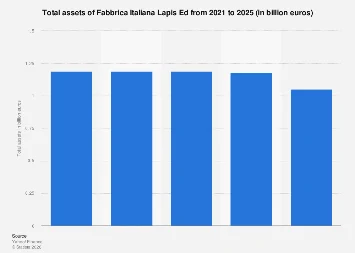
The landscape of traditional manufacturing, particularly within specialized sectors like stationery and art supplies, is increasingly shaped by a confluence of global economic forces, evolving consumer preferences, and strategic financial planning. Fabbrica Italiana Lapis Ed, a venerable Italian company with a deep-rooted history in the production of pencils and related artistic materials, is poised to navigate these complexities as it looks towards its projected financial standing in 2025. While specific, real-time asset figures for privately held entities or those not actively disclosing detailed financials publicly can be elusive without direct access to proprietary databases, an analysis of industry trends, company performance indicators, and broader economic forecasts allows for an informed perspective on its potential asset growth and valuation.
The company’s operational footprint, deeply embedded in Italy’s rich manufacturing heritage, likely encompasses a blend of tangible and intangible assets. Tangible assets would include its production facilities, machinery, raw material inventories, and finished goods ready for distribution. Intangible assets, critically important in today’s brand-conscious market, would encompass its brand reputation, intellectual property (such as proprietary manufacturing techniques or unique product designs), and established distribution networks. The projected total assets for Fabbrica Italiana Lapis Ed in 2025 will be a summation of the current value of these assets, augmented by strategic investments, potential acquisitions, and the accumulation of retained earnings, offset by depreciation and any divestitures.
Several key factors will influence this projection. Firstly, the global demand for high-quality, ethically sourced art and writing materials remains robust, particularly among professional artists, students, and a growing segment of consumers seeking sustainable and artisanal products. Companies like Fabbrica Italiana Lapis Ed, with their heritage and commitment to quality, are well-positioned to capitalize on this niche. Market research from firms like Mordor Intelligence indicates a steady growth trajectory for the global art supplies market, driven by increasing disposable incomes in emerging economies and a heightened interest in creative pursuits. This sustained demand translates directly into potential revenue growth, which, when managed effectively, contributes to asset appreciation through increased profitability and reinvestment.
Secondly, the company’s strategic approach to innovation and product diversification will play a pivotal role. Beyond traditional graphite pencils, Fabbrica Italiana Lapis Ed may have expanded its portfolio to include colored pencils, pastels, markers, and other art mediums, or perhaps ventured into sustainable materials and eco-friendly packaging solutions, a trend increasingly favored by environmentally conscious consumers and corporate buyers. Investments in research and development to create novel products or improve existing ones can lead to the acquisition of new intellectual property and enhance the company’s competitive edge, thereby increasing its intangible asset value.
The economic environment in Italy and the broader European Union will also be a significant determinant. Italy, a member of the Eurozone, benefits from the stability of a single currency but is also subject to the economic cycles and policy decisions impacting the bloc. Factors such as inflation rates, interest rates, and trade policies can influence the cost of raw materials, operational expenses, and the overall profitability of the business. Furthermore, government initiatives aimed at supporting manufacturing and exports, or conversely, regulatory changes, could impact the company’s financial performance and asset base. According to Eurostat data, the manufacturing sector in Italy has shown resilience, albeit with fluctuations, underscoring the importance of adapting to evolving market conditions.
From a financial management perspective, the company’s ability to manage its working capital efficiently will be crucial. This includes optimizing inventory levels, managing accounts receivable and payable, and ensuring sufficient liquidity to meet short-term obligations. A well-managed balance sheet, characterized by a healthy ratio of current assets to current liabilities, contributes to overall financial stability and can attract investment or facilitate borrowing for expansion, thereby bolstering total assets.
Moreover, the global competitive landscape presents both challenges and opportunities. While Fabbrica Italiana Lapis Ed operates in a specialized segment, it faces competition from both established international players and emerging manufacturers, particularly from Asia, which often compete on price. Success in this environment hinges on differentiation, often achieved through superior product quality, brand storytelling, and a commitment to sustainability and ethical production. The company’s ability to maintain and enhance its brand equity, a significant intangible asset, is paramount. Brand value is not merely about recognition; it is about customer loyalty, perceived quality, and the premium pricing the brand can command, all of which contribute to its overall economic worth.
Projections for total assets in 2025 would likely reflect a careful balance of these internal operational strategies and external economic and market influences. If the company continues to invest in modernizing its production facilities, adopting new technologies to improve efficiency and sustainability, and expanding its market reach through strategic partnerships or direct sales channels, its tangible asset base could see steady growth. Simultaneously, a strong brand performance and successful product innovation would bolster its intangible assets.
Consider the broader context of the global stationery and art supplies market. Statista reports indicate a steady, albeit moderate, growth in this sector. For instance, the global art supplies market was valued at approximately USD 12 billion in 2022 and is projected to grow at a Compound Annual Growth Rate (CAGR) of around 4-5% over the next few years. While Fabbrica Italiana Lapis Ed’s specific market share is not publicly detailed, its growth would likely mirror or slightly exceed this industry trend, assuming effective strategic execution. This growth translates into potential increases in retained earnings, which are a core component of a company’s total assets.
Furthermore, the company’s approach to mergers and acquisitions, or strategic alliances, could significantly alter its asset trajectory. While there have been no major announcements regarding such activities for Fabbrica Italiana Lapis Ed in recent times, such strategic moves are common in mature industries seeking to consolidate market share, access new technologies, or enter new geographic regions. Any such development would need to be factored into a precise asset projection.
In terms of economic impact, a growing asset base for Fabbrica Italiana Lapis Ed signifies financial health and potential for expansion. This, in turn, can lead to increased employment opportunities in its manufacturing facilities and offices, contribute to local and national economies through tax revenues, and support a network of suppliers and distributors. The company’s ability to invest in its future, signaled by growing assets, is a positive indicator for its stakeholders and the broader economic ecosystem it operates within.
Without access to the company’s internal financial statements and forward-looking projections, providing an exact numerical forecast for total assets in 2025 is speculative. However, by analyzing industry trends, the company’s operational strengths, and the prevailing economic climate, it is reasonable to infer that Fabbrica Italiana Lapis Ed is likely to pursue a strategy aimed at sustainable asset growth. This growth will be contingent upon its continued ability to innovate, maintain its brand’s esteemed reputation for quality, and adapt to the dynamic global marketplace, thereby solidifying its position as a key player in the fine art and stationery manufacturing sector. The company’s financial trajectory towards 2025 will be a testament to its enduring legacy and its capacity to evolve within the modern economic paradigm.