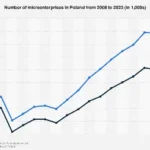

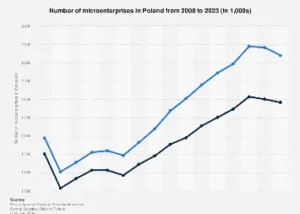

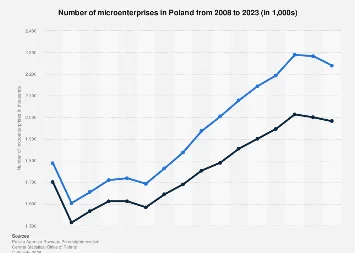
In 2023, Poland witnessed a significant expansion in its microenterprise sector, a trend that underscores the nation’s robust economic performance and the dynamic entrepreneurial spirit driving its growth. Microenterprises, typically defined as businesses employing fewer than ten individuals and with an annual turnover or balance sheet total not exceeding two million euros, form the bedrock of many national economies, and Poland is no exception. The sustained increase in their numbers suggests a healthy business environment, capable of fostering innovation and job creation at the foundational level.
This burgeoning microenterprise ecosystem in Poland is not occurring in a vacuum. It is a reflection of broader European economic trends, albeit with distinct national characteristics. Across the European Union, small and medium-sized enterprises (SMEs) are recognized as crucial engines of economic growth, employment, and innovation. Microenterprises, as the smallest segment within this category, often serve as incubators for new ideas and as agile players able to adapt quickly to market shifts. Poland’s success in cultivating this sector positions it favorably within the regional economic landscape.
Several factors likely contribute to this upward trajectory. A supportive regulatory environment, aimed at simplifying business registration and reducing administrative burdens for small businesses, plays a pivotal role. Government initiatives, such as access to subsidized loans, grants for startups, and advisory services, provide essential capital and guidance for nascent entrepreneurs. Furthermore, a growing domestic market, coupled with Poland’s strategic location as a gateway to Eastern Europe, offers significant opportunities for microenterprises to scale and expand their reach.
The composition of Poland’s microenterprise sector is diverse, spanning a wide array of industries. While traditional sectors like retail, services, and crafts remain prominent, there has been a notable rise in technology-driven microenterprises. This includes startups in areas such as software development, digital marketing, e-commerce solutions, and specialized IT consulting. The increasing digitalization of the economy, accelerated by global events, has created fertile ground for these tech-focused ventures to thrive. The ability of microenterprises to leverage digital tools for marketing, sales, and operations allows them to compete effectively with larger, more established firms.
Statistics from various economic observatories and national statistical offices paint a picture of consistent growth. While precise, real-time figures for the entirety of 2023 are still being consolidated, preliminary data and year-on-year comparisons indicate a substantial increase in registrations and operational entities within the microenterprise category. This growth contrasts with the performance of some larger corporations, which may face more complex challenges in navigating global supply chain disruptions, inflation, and geopolitical uncertainties. The agility and lean structures of microenterprises often allow them to weather such storms more effectively.
The economic impact of this microenterprise boom is multifaceted. Firstly, it translates directly into job creation. Each new microenterprise, even with its small team, contributes to lowering unemployment rates and providing livelihoods for individuals and families. This is particularly important in regional areas where larger industrial employers may be scarce. Secondly, the increased competition fostered by a larger number of microenterprises can lead to greater efficiency and innovation across entire sectors. Consumers and other businesses often benefit from a wider range of choices, improved service quality, and potentially lower prices as businesses vie for market share.
Moreover, microenterprises are significant contributors to tax revenues, albeit on a smaller scale individually. Collectively, however, their growing numbers create a more diversified and resilient tax base for the government, funding public services and infrastructure projects. Their innovative capabilities also fuel the broader economic dynamism, leading to the development of new products and services that can eventually be adopted and scaled by larger entities.
Looking at international comparisons, Poland’s performance in nurturing its microenterprise sector is noteworthy. Many developed economies grapple with issues of business consolidation and the dominance of large corporations. Countries that actively support their SME and microenterprise ecosystems, such as Denmark and the Netherlands, often exhibit higher levels of economic resilience and entrepreneurial activity. Poland’s trajectory suggests it is moving in a similar direction, building a more decentralized and dynamic economic structure.
The challenges, however, are not insignificant. Access to finance remains a perennial hurdle for many microenterprises, particularly in their early stages. While government support schemes exist, navigating the application processes and securing adequate funding can be daunting. Scaling up presents another significant obstacle. As microenterprises grow, they often encounter the need for more sophisticated management, larger capital investments, and broader market access, which can strain their limited resources. Competition from established players and the constant need to adapt to evolving market demands also require continuous strategic planning and investment.
Despite these challenges, the prevailing sentiment within the Polish business community and among economic analysts is one of optimism regarding the microenterprise sector. The data points towards a thriving ecosystem that is not only expanding in numbers but also maturing in its capabilities. The adaptability and entrepreneurial spirit inherent in these small businesses are crucial assets for Poland as it navigates the complexities of the global economy in the coming years. Their growth is a strong indicator of a healthy, diversified, and forward-looking Polish economy.
The ongoing development of digital infrastructure and the increasing adoption of e-commerce platforms further enhance the potential for Polish microenterprises. These tools democratize market access, allowing even the smallest businesses to reach national and international customer bases without the need for extensive physical retail presence or complex distribution networks. This technological empowerment is a critical factor in sustaining the growth momentum observed in 2023.
As Poland continues to invest in education and skills development, the pipeline of talent equipped to start and run microenterprises is likely to strengthen. A skilled workforce is fundamental to innovation and productivity, and the synergy between educational institutions and the entrepreneurial community will be key to unlocking the full potential of this vital economic segment. The trends observed in 2023 suggest that Poland is well-positioned to harness the power of its microenterprises for sustained economic prosperity.