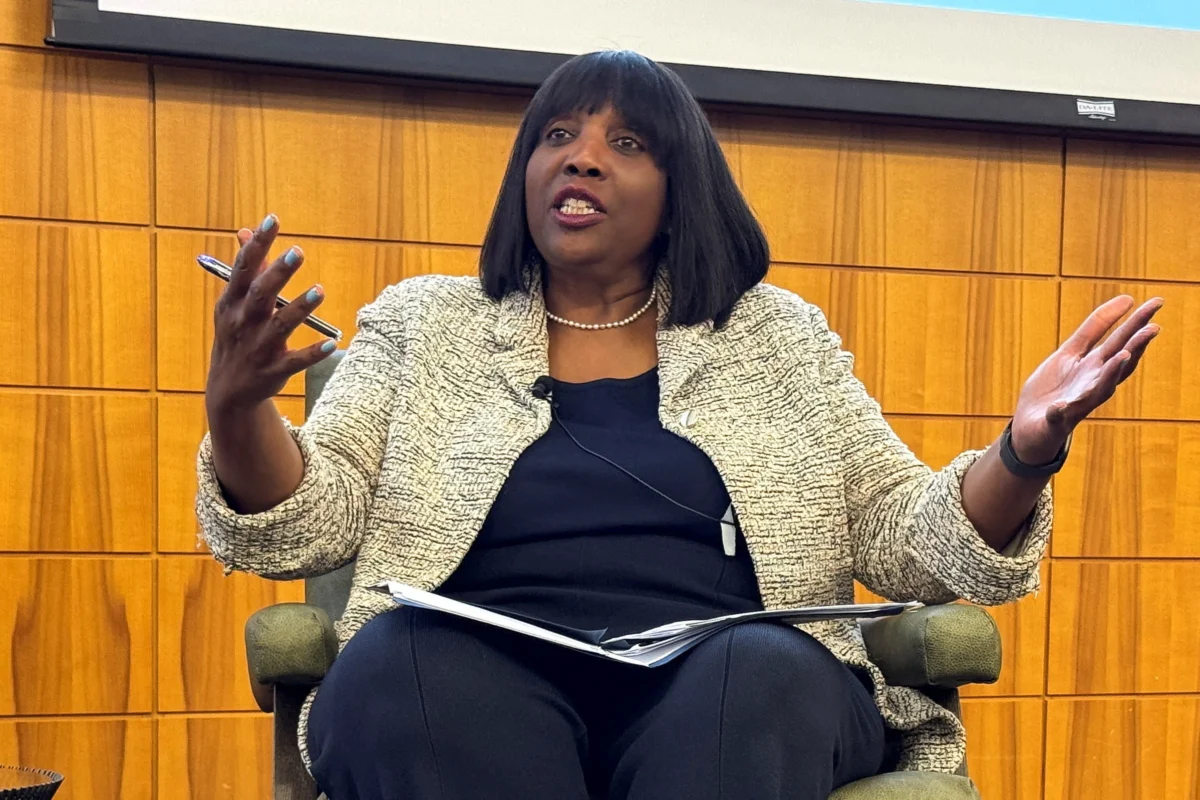
The delicate equilibrium of American monetary policy faces a pivotal moment as Federal Reserve Governor Lisa Cook signaled a sharpened readiness to escalate interest rates if inflationary pressures fail to subside. Speaking before an audience at a recent summit in Anchorage, Alaska, Cook underscored a significant shift in the central bank’s internal risk assessment, suggesting that the "dual mandate" of price stability and maximum employment is currently tilted heavily toward the former. Her remarks highlight a growing impatience within the Federal Open Market Committee (FOMC) as the United States enters its fifth consecutive year of inflation tracking above the long-term 2% target, a duration that many economists fear could fundamentally alter the nation’s economic psychology.
Governor Cook’s stance arrives at a complex juncture for the U.S. economy, characterized by cooling but still-elevated price indices and a softening growth trajectory. While the FOMC recently voted 9-3 to maintain the federal funds rate in the 3.5% to 3.75% corridor, the consensus for a "pause" appears increasingly fragile. Cook, who was part of the majority that opted for stability in the most recent policy meeting, has now made it clear that her support for a holding pattern is conditional. The governor’s rhetoric suggests that the window for a "wait-and-see" approach is closing, particularly as the risks of inflation becoming "entrenched" in the domestic economy grow more pronounced with each passing month of above-target data.
The most recent economic indicators provide a bifurcated view of the inflationary landscape. June’s data offered a momentary reprieve, with headline inflation easing on the back of a significant retreat in global energy prices. However, core inflation—which strips out the volatile food and energy sectors—remains stubbornly pinned at 3.3%. This disparity is a primary concern for policymakers like Cook, who cautioned against over-interpreting a single month of cooling data. From the perspective of the Fed, the "noise" of fluctuating oil prices often masks the "signal" of underlying service-sector inflation and wage growth, both of which have shown a historical tendency to remain "sticky" once they take hold.
The backdrop of this potential policy pivot is a global economy increasingly defined by supply-side shocks and geopolitical volatility. The ongoing conflict involving Iran has introduced a permanent "war premium" into energy markets, creating a baseline of uncertainty for manufacturing and transportation costs. Simultaneously, the aggressive implementation of trade tariffs has begun to percolate through the supply chain, raising the cost of imported intermediate goods. Governor Cook specifically cited these factors, alongside the massive capital expenditures required for the global artificial intelligence buildout, as new structural pressures that could keep inflation higher for longer. The AI revolution, while promising long-term productivity gains, is currently acting as a massive sink for energy and high-end hardware, contributing to a "demand-pull" inflationary environment in the tech sector that eventually spills over into the broader economy.
The risk of "inflationary entrenchment" is perhaps the most significant psychological hurdle facing the Federal Reserve. When consumers and businesses begin to expect 3% or 4% inflation as the norm, they adjust their wage demands and pricing strategies accordingly. This creates a self-fulfilling prophecy known as a wage-price spiral, which historically requires a much more painful economic contraction to break. Cook’s observation that the U.S. has endured five years of above-target inflation is a stark admission of the challenge at hand. Unlike the transitory spikes of previous decades, the current inflationary era has lasted long enough to potentially reshape the "neutral rate" of interest—the rate at which the economy neither expands nor contracts—forcing the Fed to reconsider its long-term policy framework.
Internal divisions within the Fed are also becoming more visible, reflecting the high stakes of the current cycle. The 9-3 vote to hold rates steady was notable for its dissent, with Minneapolis Fed President Neel Kashkari leading the hawkish charge. Kashkari has publicly argued that the time for incrementalism has passed and that the central bank should proactively raise rates to crush the remaining inflationary embers before they can be fanned by further supply shocks. While Cook has remained in the more cautious majority for now, her Anchorage speech aligns her more closely with the hawks, suggesting that the "center" of the FOMC is shifting toward a more aggressive posture.
Financial markets have reacted to these signals with a mixture of volatility and recalibration. According to the CME Group’s FedWatch tool, traders are no longer betting on a series of rapid rate cuts. Instead, the probability of a rate hike as early as September has surged, with October being priced in as the most likely window for a 25-basis-point increase if the next two rounds of Consumer Price Index (CPI) data do not show a clear downward trend. The bond market has mirrored this sentiment, with yields on the 10-year Treasury note inching higher as investors prepare for a "higher-for-longer" interest rate environment. This shift has significant implications for the broader economy, particularly the housing market, where mortgage rates have remained at levels not seen in two decades, severely constraining inventory and affordability.
The broader macroeconomic context further complicates the Fed’s path. The U.S. economy slowed to a 1.5% growth rate in the second quarter, a figure that suggests the "soft landing" sought by Chairman Jerome Powell is still on a knife-edge. A rate hike in an environment of sub-2% growth carries the inherent risk of tipping the economy into a technical recession. However, Cook’s comments suggest the Fed is willing to accept a period of below-trend growth—or even a mild contraction—as a necessary price for restoring price stability. The rationale is that a short-term recession is preferable to the long-term destruction of purchasing power caused by runaway inflation.
In a global context, the Federal Reserve’s potential move toward higher rates contrasts sharply with other major central banks. The European Central Bank (ECB) and the Bank of England have faced similar inflationary pressures but are grappling with even more stagnant growth profiles, leading to a more hesitant approach to tightening. This divergence in monetary policy often leads to a strengthening of the U.S. dollar, which, while helpful in lowering the cost of imports and thus dampening domestic inflation, places immense pressure on emerging markets that hold significant debt denominated in greenbacks. The Fed’s decisions, therefore, do not occur in a vacuum; they act as a gravitational force for the entire global financial system.
Expert analysis suggests that the Fed is also closely monitoring the labor market for signs of cooling that have yet to fully materialize. While some sectors, particularly tech and finance, have seen layoffs, the broader labor market remains remarkably resilient. This resilience is a double-edged sword: it prevents a hard economic crash, but it also maintains upward pressure on wages. Governor Cook’s assertion that the risks to the inflation side of the mandate currently outweigh the risks to employment indicates that the Fed will not be deterred by a slightly higher unemployment rate if it means achieving the 2% inflation goal.
As the FOMC prepares for its upcoming sessions, the focus will remain squarely on "continued disinflation." The "luxury of waiting," as Cook put it, has been exhausted by years of persistent price increases. The central bank finds itself in a defensive crouch, ready to deploy its most potent tool—the interest rate hike—to protect the credibility of its 2% target. Whether the economy can withstand further tightening without breaking remains the primary question for investors, businesses, and households alike. For now, the message from the Fed’s inner circle is clear: the battle against inflation is far from over, and the era of easy money is unlikely to return anytime soon. The coming months will be a test of the Fed’s resolve and its ability to navigate a global economy that remains fraught with unpredictable shocks and structural shifts.