The United States electronics and appliance retail sector is poised for a dynamic performance throughout 2025, with monthly sales figures exhibiting distinct seasonal patterns and reflecting broader economic currents. Analysis of historical data and forward projections indicates that while overall annual revenues can be substantial, the monthly fluctuations are critical for businesses to understand for inventory management, marketing strategies, and financial forecasting. The sector, encompassing everything from high-definition televisions and sophisticated home theater systems to essential kitchen appliances and personal computing devices, remains a significant contributor to the U.S. economy, with its performance often serving as a barometer for consumer confidence and discretionary spending power.
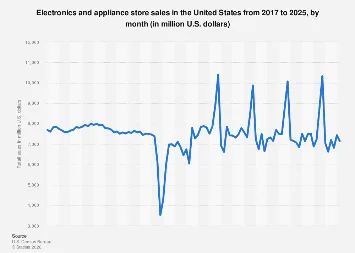
Throughout the period from 2017 to mid-2025, monthly sales within this segment have demonstrated a predictable rhythm. Typically, the year begins with a slight dip following the robust holiday shopping season of the preceding fourth quarter. January and February often represent a period of consolidation, with consumers recalibrating their budgets after significant end-of-year expenditures. However, this lull is usually short-lived, as anticipation for spring and new product releases begins to build.
As the first quarter progresses into March and April, sales typically see a modest uptick. This period can be influenced by tax refunds, which inject additional disposable income into consumer households, and by an increased interest in home improvement projects, often leading to purchases of new appliances or home entertainment systems. Retailers may leverage these months with promotional events to capitalize on this renewed spending activity.
The second quarter, encompassing April, May, and June, generally marks a period of sustained growth, leading up to a mid-year peak. This ascent is frequently driven by significant purchasing events such as Memorial Day sales and graduations, where electronics and appliances are popular gift items. Furthermore, the desire to upgrade home technology or replace aging appliances before the summer heat intensifies can contribute to increased demand. For instance, air conditioning units and outdoor entertainment systems often see a surge in interest during these months. Projections for June 2025 suggest that sales within this category will likely reach several billion U.S. dollars, underscoring the sector’s considerable economic weight. Major players in this market, such as Best Buy, whose performance is closely watched as an indicator of the sector’s health, will be strategizing to capture a significant share of this consumer spending.
The third quarter, from July through September, often experiences a slight moderation after the second-quarter highs. While summer continues to drive demand for certain products like portable electronics and outdoor appliances, the back-to-school season can divert some consumer spending towards educational necessities. However, this period also offers opportunities for retailers to clear out older inventory and introduce new models in preparation for the critical holiday shopping season. Sales during this time, while potentially less explosive than the preceding quarter, remain substantial and are crucial for maintaining year-round revenue streams.
It is the fourth quarter, however, that consistently represents the apex of the annual sales cycle for electronics and appliance retailers. Beginning in October and accelerating through November and December, consumer spending reaches its zenith, fueled by Black Friday, Cyber Monday, and the broader holiday gift-buying frenzy. This period is characterized by aggressive promotional pricing, extensive marketing campaigns, and a surge in demand for high-ticket items. Consumers are more willing to make significant purchases, driven by the allure of discounts and the desire to acquire the latest technology or upgrade their home environments. Historically, this quarter can account for a disproportionately large percentage of annual sales, making it the most crucial period for profitability for many businesses in the sector.
Looking ahead to 2025, the dynamics are expected to remain largely consistent with historical trends, albeit influenced by prevailing economic conditions. Factors such as inflation rates, interest rate policies, employment figures, and consumer sentiment will play a pivotal role in shaping the actual sales performance each month. A robust labor market and stable inflation would likely support higher discretionary spending, bolstering sales across all product categories. Conversely, economic headwinds such as rising interest rates or a slowdown in job growth could dampen consumer enthusiasm for large purchases, leading to more conservative spending patterns.
The competitive landscape within the electronics and appliance retail sector is also a significant factor. The rise of e-commerce has fundamentally altered how consumers shop, with online platforms offering convenience and often competitive pricing. Retailers must maintain a strong online presence, alongside their brick-and-mortar operations, to capture market share. Innovations in product technology, such as the increasing integration of artificial intelligence in smart home devices and advancements in energy-efficient appliances, will also drive consumer interest and purchasing decisions throughout 2025.
Furthermore, global supply chain resilience continues to be a concern for the industry. Disruptions, whether due to geopolitical events, natural disasters, or trade disputes, can impact the availability and cost of goods, thereby influencing monthly sales figures. Manufacturers and retailers are increasingly focused on diversifying their supply chains and adopting more agile inventory management strategies to mitigate these risks.
In conclusion, the monthly sales trajectory for U.S. electronics and appliance stores in 2025 is anticipated to follow a predictable pattern of seasonal peaks and troughs, with the fourth quarter emerging as the dominant revenue-generating period. While historical data provides a strong foundation for forecasting, the sector’s performance will ultimately be shaped by a complex interplay of macroeconomic factors, evolving consumer behavior, technological innovation, and the ongoing adaptation to a dynamic retail environment. Businesses that can effectively navigate these cyclical tides and proactively address emerging challenges are best positioned for success in the coming year.