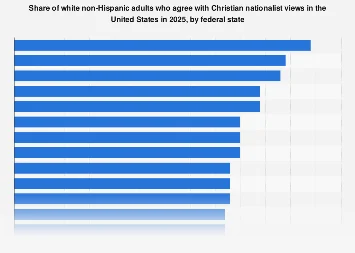
A recent comprehensive survey conducted in 2025 reveals a complex and varied landscape of support for Christian nationalist views among white, non-Hispanic adults across the United States, highlighting significant regional disparities. The data, gathered from over 20,000 respondents nationwide, quantifies adherence to a set of beliefs that posit the United States as a nation uniquely favored by God and that its laws and societal structures should be explicitly aligned with Christian principles. This intricate web of beliefs, often referred to as Christian nationalism, shows marked variations in its prevalence, with certain states exhibiting substantially higher levels of agreement than others.
At the upper echelon of this sentiment, states like Arkansas registered a notable percentage of white non-Hispanic adults who align with Christian nationalist viewpoints. This finding suggests a strong correlation between regional cultural norms, historical religious demographics, and the embrace of these specific ideologies. Conversely, states such as Massachusetts presented a considerably lower incidence of support, indicating a more diverse religious and secular landscape where Christian nationalist tenets hold less sway among this demographic.
The survey methodology employed a detailed scoring system based on respondents’ agreement or disagreement with five core statements. These statements probed fundamental aspects of Christian nationalism, including the proposition that the U.S. government should formally declare America a Christian nation; that American laws ought to be founded upon Christian values; the belief that a departure from Christian foundations would imperil the nation’s existence; the assertion that being Christian is integral to being truly American; and the conviction that Christians are divinely mandated to exert dominion over all sectors of American society. Individuals were categorized based on their composite scores, ranging from "adherents" (high agreement) to "sympathizers," "skeptics," and "rejecters" (low or no agreement).
This granular analysis provides a nuanced view beyond broad national trends, allowing for an examination of how religious identity and political ideology intersect within specific geographical contexts. The data suggests that factors such as the historical dominance of certain religious denominations, the ongoing demographic shifts within religious communities, and the influence of political discourse all play a role in shaping the prevalence of Christian nationalist sentiment.
For instance, in regions with a historically strong evangelical Protestant presence, such as parts of the South and Midwest, higher levels of agreement with Christian nationalist statements might be anticipated. These areas often feature deeply embedded religious traditions that have historically influenced public life and civic identity. The survey data would likely reflect this by showing a greater proportion of respondents in these states falling into the "adherent" or "sympathizer" categories. This phenomenon can be linked to what scholars often term the "Bible Belt," a region where religious observance and influence are traditionally more pronounced.
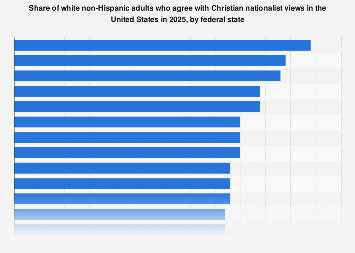
Conversely, states with more religiously diverse populations, a greater secular population, or a historical tradition of religious pluralism, such as those in the Northeast or on the West Coast, tend to exhibit lower levels of Christian nationalist endorsement. In these areas, societal norms may be more accepting of a wider array of religious beliefs and practices, or a greater separation between religious faith and national identity. Massachusetts, often cited for its liberal social policies and diverse religious fabric, serves as a prime example of a state where Christian nationalist views may find less traction, even among the white non-Hispanic population.
The economic implications of such deeply held beliefs, while not directly measured by this survey, can be indirectly inferred. Regions with a higher concentration of Christian nationalist adherents might see these views reflected in local and state-level policy debates, influencing areas such as education, healthcare, and social welfare programs. For example, the emphasis on basing laws on Christian values could translate into legislative efforts to align public policy with specific religious doctrines, potentially impacting business operations, labor practices, and consumer markets.
Furthermore, the perception of a nation’s identity, whether explicitly tied to Christian foundations or not, can influence economic competitiveness and investment. Foreign investors and businesses often assess a country’s social and political climate as part of their due diligence. A strong public embrace of Christian nationalism might be perceived by some as a sign of cultural insularity, while others might view it as a marker of shared values and stability. This can create a complex calculus for economic development and international trade.
The survey’s findings also prompt a broader discussion about the evolving nature of religious identity in the United States. While Christianity remains the dominant religious tradition, its adherents are increasingly diverse in their beliefs and practices. Christian nationalism represents one particular expression of Christian identity, emphasizing a fusion of faith and national allegiance. Understanding its prevalence across different states is crucial for grasping the contemporary American religious and political landscape.
The methodology used in the survey, involving an online panel, is a common approach in contemporary social science research. However, it is important to acknowledge potential limitations, such as ensuring representative sampling across all demographics and geographical areas, and the inherent complexities of measuring nuanced ideological stances through survey questions. The exclusion of Hawaii from the reported data, as noted in the source information, also means that the full geographical spectrum of the United States is not represented in this particular analysis.
Looking ahead, the data suggests that the interplay between religious belief, cultural identity, and political ideology will continue to be a significant factor in shaping American society and its economic trajectory. The state-by-state variations in support for Christian nationalist views underscore the deep-seated regional differences that characterize the nation, providing valuable insights for policymakers, social scientists, and business leaders seeking to understand and navigate the complexities of the American context. The ongoing evolution of religious demographics and the dynamic nature of ideological adherence mean that future surveys will be critical for tracking these trends and their broader societal implications.