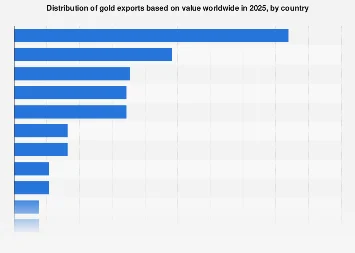
Switzerland emerged as the undisputed leader in global gold exports by value in 2025, commanding a significant 21% share of the total worldwide market. This positions the Alpine nation at the forefront of international precious metals trade, underscoring its pivotal role as a hub for refining and distribution. The total value of gold exported by all countries in 2025 reached an impressive $936.8 billion USD, highlighting the immense economic importance of this commodity.
Following Switzerland, the United Arab Emirates secured the second-largest share of gold exports, accounting for 12.1% of the global value. This highlights the growing influence of the Middle East as a key player in the gold market, driven by its strategic location and robust trade infrastructure. The United Kingdom followed in third place with 8.9% of the export value, demonstrating its continued significance as a financial center and trading post for precious metals. Hong Kong and the United States each captured 8.6% of the market, underscoring their roles as major conduits for gold trade, particularly within their respective continental spheres.
The data reveals a concentration of gold export activity among a few key nations. Switzerland’s substantial lead is not merely a reflection of its export volume but also its sophisticated refining capabilities. The country is a world leader in gold refining, processing a significant portion of the global output. This allows it to add value to raw gold, making its exported products highly sought after. In 2025 alone, Switzerland’s gold exports were valued at over $196 billion USD, a figure that dwarfs many other nations’ total trade in the precious metal. This dominance is further amplified by Switzerland’s position as the world’s leading importer of gold, indicating a cyclical flow where it processes and then re-exports refined gold, creating a powerful domestic industry.
Beyond the top contenders, other nations play crucial roles in the global gold export landscape. Canada and Australia, both major gold-producing countries, each held a 4.1% share of the export value. Their significant mining output naturally translates into substantial export volumes, though their market share is more modest compared to the refining and trading hubs. Japan and China, despite being major economic powers, accounted for 2.7% each of the global gold export value. While China is a significant consumer and producer of gold, its export share reflects a greater focus on domestic demand and industrial use.
Singapore, a vital trading hub in Asia, secured a 1.9% share, leveraging its strategic position and financial services to facilitate gold transactions. Peru and Germany also represented 1.9% and 1.8% of the export value, respectively. Peru’s contribution is largely driven by its significant mining sector, while Germany’s presence indicates its role as a European financial and trading center. Uzbekistan and Russia, both with notable gold mining operations, each accounted for 1.7% of the global export value. Russia’s participation, even at this level, is significant given its substantial gold reserves and production capacity, suggesting a strategic approach to its gold exports. Thailand rounded out the top exporting nations with a 1.4% share.
The global distribution of gold exports is a complex interplay of mining output, refining capacity, financial market infrastructure, and geopolitical considerations. Switzerland’s leading position is a testament to its specialized industry, which has positioned it as an indispensable node in the international gold supply chain. The UAE’s strong performance highlights the evolving dynamics of global trade, with emerging economies increasingly playing a central role in commodity markets.
The economic impact of gold exports extends beyond the immediate trade figures. For producing nations like Australia, Canada, and Peru, gold mining and exports are significant sources of foreign exchange, employment, and government revenue. These activities often drive investment in infrastructure and support ancillary industries. For refining and trading centers like Switzerland, the UAE, and the UK, gold exports contribute to their financial services sectors, creating high-value jobs and attracting international capital. The intricate web of gold trade also influences global financial stability, as gold often serves as a safe-haven asset during times of economic uncertainty.
Furthermore, the geographic concentration of gold exports can have geopolitical implications. Nations that control a significant portion of the refined gold market can wield considerable influence in international finance. The increasing involvement of countries like the UAE and emerging economies in gold trading suggests a potential shift in this balance of power over time. Understanding these export dynamics is crucial for policymakers, investors, and businesses operating within or adjacent to the global precious metals market. The figures for 2025 provide a snapshot of a dynamic industry, where established players maintain their dominance while new contenders steadily gain ground, shaping the future of international gold commerce.