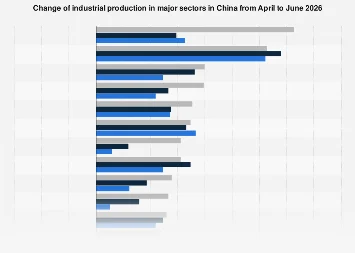
China’s industrial production, a critical barometer of its economic health and a linchpin of global supply chains, is poised for a period of nuanced growth and recalibration through 2026. While headline figures often capture the broad strokes of manufacturing output, a deeper examination of sectoral performance reveals a complex tapestry of varying momentum, technological advancements, and evolving market demands. Understanding these granular shifts is paramount for businesses, policymakers, and investors navigating the intricate landscape of the world’s second-largest economy.
The manufacturing sector, the engine of China’s industrial might, has historically demonstrated remarkable resilience and adaptability. However, the coming years are expected to be characterized by a divergence in growth rates across different sub-sectors. Industries heavily reliant on traditional manufacturing processes and labor-intensive production may experience more moderate expansion, potentially facing headwinds from rising domestic labor costs and increasing competition from emerging economies. Conversely, sectors embracing advanced manufacturing, automation, and digitalization are anticipated to be the primary drivers of future industrial growth. This includes areas such as high-end equipment manufacturing, new energy vehicles, advanced materials, and pharmaceuticals.
Statistical projections, when accessible and detailed, typically paint a picture of an overall positive, albeit measured, growth trajectory for China’s industrial production. For instance, while specific year-on-year percentage increases for each sector are proprietary and require specialized access, the underlying trends point towards an average annual growth rate that, while potentially lower than the double-digit surges of past decades, remains significant on a global scale. This moderated growth reflects a strategic shift by Beijing towards higher-quality, more sustainable development, emphasizing innovation and efficiency over sheer volume.
The automotive sector, particularly the electric vehicle (EV) segment, stands out as a prominent growth area. China has firmly established itself as the world’s largest EV market, both in terms of production and sales. Government incentives, substantial investment in charging infrastructure, and a growing consumer appetite for greener transportation solutions are fueling this expansion. Projections for the EV sub-sector suggest continued robust growth, driven by both domestic demand and increasing export opportunities as Chinese automakers expand their global footprint. This surge in EV production is not only impacting the automotive industry but also creating ripple effects across related sectors, including battery manufacturing, rare earth materials, and semiconductor production.
In contrast, some traditional sectors might see more subdued growth. The textile and apparel industry, for example, a long-standing pillar of China’s manufacturing base, is likely to face challenges. While still a dominant global player, this sector is increasingly grappling with rising wages, environmental regulations, and a shift in consumer preferences towards more sustainable and ethically sourced products. Growth in this area will likely be driven by innovation in materials, increased automation, and a focus on higher-value, niche markets rather than mass production.
The electronics manufacturing sector, another cornerstone of China’s industrial output, presents a mixed outlook. While the demand for consumer electronics remains strong, geopolitical tensions and efforts by Western nations to diversify their supply chains could introduce complexities. However, China’s deep integration into global electronics value chains, its vast domestic market, and its continued investment in research and development, particularly in areas like semiconductors and artificial intelligence, are likely to sustain its position as a leading producer. Growth within this sector will be increasingly concentrated in more advanced components and sophisticated electronic devices, moving away from simpler assembly operations.
The chemical industry, a foundational sector for numerous downstream industries, is expected to experience steady growth, driven by demand from sectors such as construction, agriculture, and advanced manufacturing. However, there is a significant global push towards more sustainable chemical production, with a focus on reducing environmental impact and developing greener alternatives. Chinese chemical manufacturers are increasingly investing in R&D to meet these evolving demands, focusing on specialty chemicals, bio-based materials, and processes that minimize waste and emissions.
Statistics on industrial production are often analyzed through the lens of key economic indicators. For instance, the Purchasing Managers’ Index (PMI) serves as a timely indicator of manufacturing activity. A PMI reading above 50 generally signifies expansion, while a reading below 50 indicates contraction. Fluctuations in the PMI, as well as data on new orders, production output, and employment within the manufacturing sector, provide crucial insights into the prevailing economic sentiment and the health of industrial enterprises.
The economic impact of China’s industrial performance extends far beyond its borders. As the "world’s factory," China’s manufacturing output directly influences global supply chains, affecting the availability and cost of goods worldwide. A slowdown in Chinese industrial production can lead to shortages and price increases for a wide range of products, from electronics and automobiles to textiles and machinery. Conversely, robust growth in China’s industrial sector can stimulate global demand, boost commodity prices, and contribute to overall economic expansion.
Global comparisons highlight China’s unique position. While developed economies are increasingly shifting towards service-based industries and advanced technology, China’s industrial sector remains a critical component of its economic structure. However, the nature of this industrial sector is evolving. The emphasis is shifting from low-cost, high-volume production to innovation-driven, high-value manufacturing, mirroring trends seen in more developed economies but on a vastly different scale. Countries that are heavily reliant on China for manufactured goods are keenly observing these shifts, seeking to understand the implications for their own economies and supply chain strategies.
Investment in research and development (R&D) is a key determinant of future industrial growth. China has been significantly increasing its R&D expenditure, aiming to move up the value chain and become a leader in technological innovation. Sectors that are benefiting most from this increased investment include artificial intelligence, biotechnology, aerospace, and advanced materials. The success of these initiatives will directly impact the competitiveness and growth potential of China’s industrial landscape in the years to come.
Furthermore, government policies play a pivotal role in shaping the trajectory of China’s industrial production. Strategic initiatives such as "Made in China 2025" have aimed to upgrade the country’s manufacturing capabilities and reduce reliance on foreign technology. While specific policy goals and their implementation can evolve, the overarching objective remains to foster a more advanced, innovative, and self-sufficient industrial base. These policies, coupled with investments in infrastructure, education, and talent development, are designed to ensure sustained industrial growth and maintain China’s competitive edge in the global economy.
The energy intensity and environmental impact of industrial production are also becoming increasingly critical considerations. China has committed to ambitious climate goals, including reaching peak carbon emissions before 2030 and achieving carbon neutrality before 2060. This commitment is driving a transformation within the industrial sector, with a growing emphasis on energy efficiency, the adoption of renewable energy sources, and the development of cleaner production technologies. Sectors that are slow to adapt to these environmental imperatives may face regulatory challenges and declining market share.
In conclusion, China’s industrial production through 2026 is expected to be a dynamic story of evolving strengths and strategic adaptations. While overall growth may moderate compared to past eras, the focus on advanced manufacturing, technological innovation, and sustainable development promises to create new engines of economic expansion. The nuanced performance across various sectors, from the booming electric vehicle market to the challenges faced by traditional industries, underscores the ongoing transformation of China’s industrial landscape and its profound implications for the global economic order. Understanding these sectoral shifts and the underlying policy drivers is essential for anyone seeking to comprehend the future of global manufacturing and trade.