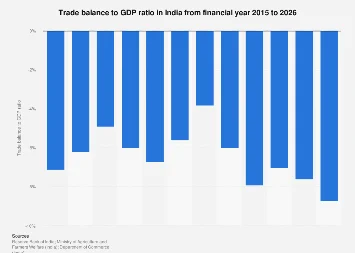
India’s trade balance, a critical indicator of its international economic engagement, is projected to experience a notable shift in its relationship with the Gross Domestic Product (GDP) by 2026. While precise figures often require subscription-based access, available analyses and forecasts suggest a dynamic evolution in the nation’s net trade position as a percentage of its overall economic output. This metric, representing the difference between exports and imports as a proportion of GDP, offers a vital lens through which to assess the competitiveness of a nation’s industries, the sustainability of its consumption patterns, and its overall economic resilience. As India continues its trajectory as a major global economic power, understanding the nuances of this trade-to-GDP ratio is paramount for investors, policymakers, and international trade partners alike.
The trade balance as a percentage of GDP provides a standardized measure that facilitates international comparisons. A positive ratio indicates a trade surplus, where exports exceed imports, contributing positively to aggregate demand and potentially signaling a strong export sector. Conversely, a negative ratio signifies a trade deficit, suggesting that a country is importing more goods and services than it is exporting. This can have implications for currency valuation, foreign debt levels, and the domestic production landscape. For India, a rapidly developing economy with a burgeoning consumer base and an ambitious manufacturing agenda, the movement of this ratio is closely watched. Projections for 2026 are influenced by a confluence of factors, including global economic growth, commodity price fluctuations, domestic policy initiatives aimed at boosting exports and controlling imports, and the evolving landscape of international trade agreements.
Recent trends indicate that India has historically navigated periods of both trade surplus and deficit. However, the increasing integration of the Indian economy into global value chains and the government’s "Make in India" and Production Linked Incentive (PLI) schemes are designed to bolster domestic manufacturing capabilities and enhance export competitiveness. These initiatives aim to reduce reliance on imported finished goods and increase the value of Indian-made products in the international market. Consequently, analysts are closely monitoring whether these efforts will translate into a sustained improvement in the trade balance relative to GDP. The sheer scale of India’s economy, now among the fastest-growing major economies globally, means that even marginal shifts in the trade balance can represent substantial absolute values, impacting foreign exchange reserves and the nation’s current account.
The composition of India’s trade is also a crucial determinant of its trade balance. While the country has traditionally been a significant exporter of services, particularly in the IT and business process outsourcing sectors, there is a concerted push to expand its footprint in merchandise exports. Key export categories include petroleum products, pharmaceuticals, engineering goods, textiles, and agricultural products. Conversely, major import categories often comprise crude oil, electronics, machinery, and gold. The volatility in global crude oil prices, a significant import item, can disproportionately affect India’s trade balance. Similarly, the demand for electronics and machinery reflects the pace of India’s industrialization and technological advancement.
Global economic conditions play a pivotal role in shaping India’s trade performance. A slowdown in major economies that are key export destinations for India could dampen demand for Indian goods and services. Conversely, robust global growth, particularly in Asia and North America, typically translates into higher export volumes for India. Furthermore, geopolitical developments and trade protectionist measures adopted by other nations can create headwinds or tailwinds for Indian exports. The ongoing re-evaluation of global supply chains, spurred by recent disruptions, presents both challenges and opportunities for India to position itself as a more reliable and diversified manufacturing hub.
The projected trade balance-to-GDP ratio for 2026 is not merely a statistical forecast; it carries significant economic implications. A narrowing trade deficit, or even a move towards a surplus, could bolster investor confidence, support the rupee’s valuation, and reduce the need for external borrowing to finance imports. This would contribute to greater macroeconomic stability and fiscal prudence. Conversely, a widening deficit could exert downward pressure on the rupee, potentially leading to inflationary pressures as imported goods become more expensive, and increasing the nation’s external debt burden. Policymakers will be keenly focused on managing these dynamics through a combination of trade facilitation measures, export promotion strategies, and prudent fiscal and monetary policies.
In the context of emerging markets, India’s trade performance is often benchmarked against peers like China, Vietnam, and other Southeast Asian nations. China, for instance, has long maintained a substantial trade surplus, fueled by its manufacturing prowess. Vietnam has emerged as a significant beneficiary of shifting global supply chains, often exhibiting a favorable trade balance. India’s ambition is to carve out a similar, if not more diversified, position in the global trading system. The success of its export-oriented policies and its ability to attract foreign direct investment into manufacturing will be key determinants of its long-term trade competitiveness.
The influence of domestic demand on the trade balance cannot be overstated. As India’s middle class expands and disposable incomes rise, the demand for imported consumer goods and capital equipment is likely to increase. While this signals economic prosperity, it can also contribute to a widening trade deficit if domestic production capacity does not keep pace or if imported goods offer superior value or technology. Therefore, policies aimed at enhancing domestic production efficiency, fostering innovation, and promoting import substitution in strategic sectors are crucial for maintaining a healthy trade balance.
Looking ahead to 2026, the interplay of these domestic and international factors will shape India’s trade balance relative to its GDP. The government’s commitment to structural reforms, its engagement in bilateral and multilateral trade negotiations, and its ability to adapt to evolving global trade dynamics will be critical. A positive and sustained improvement in this ratio would be a strong testament to India’s growing economic strength and its capacity to compete effectively on the global stage, contributing to its overall economic stability and prosperity. The journey towards achieving a more favorable trade balance is an ongoing endeavor, requiring strategic foresight, consistent policy implementation, and adaptability in the face of an ever-changing global economic landscape.