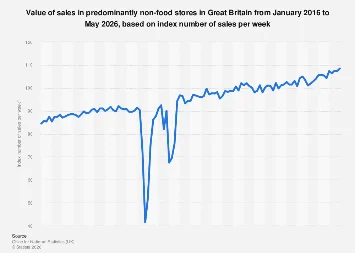
The value of retail sales within predominantly non-food stores across Great Britain has charted a complex trajectory from early 2016 through projections extending to mid-2026, reflecting a dynamic interplay of consumer confidence, economic headwinds, and evolving market conditions. This period has been particularly marked by significant disruptions, most notably the profound impact of the COVID-19 pandemic starting in early 2020, which triggered an unprecedented contraction in retail activity. However, the sector has demonstrated resilience, with periods of sharp recovery and subsequent adjustments.
Analysis of the sales value index, which benchmarks weekly sales against a 2023 base of 100, reveals a period of relative stability in the pre-pandemic years. This baseline provided a measure against which subsequent fluctuations could be assessed. The onset of the global health crisis in early 2020 led to a precipitous decline in consumer spending as lockdowns and social distancing measures curtailed discretionary purchases and restricted store operations. Non-essential retail, encompassing a wide array of non-food goods from apparel and electronics to furniture and household items, bore the brunt of these restrictions.
The immediate aftermath of the initial lockdowns saw a noticeable rebound in sales value from May through October 2020. This surge can be attributed to a confluence of factors, including pent-up demand, government stimulus measures, and a shift in consumer spending from services to goods. As households adapted to new realities, there was an increased focus on home improvements, entertainment, and durable goods. However, this recovery proved to be somewhat fragile. The imposition of further restrictions in late 2020 and early 2021 led to another dip in sales values, particularly in December 2020 and January 2021, as Christmas spending was impacted and new lockdowns took effect.
Following this dip, the non-food retail sector began a more sustained period of recovery from February 2021 onwards. This phase was supported by the gradual easing of restrictions, the rollout of vaccination programs, and a growing sense of economic optimism. Consumer spending power was further bolstered by accumulated savings during periods of lockdown and continued government support for households and businesses. The index numbers during this period indicated a steady, albeit sometimes uneven, climb as high street retailers and online platforms worked to regain momentum.
Looking towards the latter half of the projection period, the trajectory of non-food retail sales value is subject to various economic forecasts. While specific figures for May 2026 are masked in the provided data, indicating a need for subscription access, the underlying trends suggest a market continuing to navigate global economic uncertainties. Factors such as inflation, interest rate policies, and geopolitical stability all play a crucial role in shaping consumer sentiment and disposable income.
The United Kingdom, as a developed economy with a sophisticated retail landscape, provides a microcosm of broader global trends. In comparative terms, many developed nations experienced similar patterns of disruption and recovery in their non-food retail sectors. For instance, the United States saw substantial stimulus-driven retail surges, while European economies grappled with varying lockdown durations and recovery speeds. The growth of e-commerce, a trend accelerated by the pandemic, continues to be a dominant force, reshaping physical retail strategies and consumer purchasing habits. Data from the Office for National Statistics (ONS) in the UK consistently highlights the growing share of online sales within the overall retail pie, a trend that shows no signs of abating. Projections from industry analysts suggest that by 2025-2026, the proportion of retail sales conducted online will continue to represent a significant and growing segment of the market.
The economic impact of these sales trends extends far beyond the retail industry itself. Fluctuations in non-food retail sales directly influence employment levels, particularly in sectors such as logistics, warehousing, and customer service. A robust retail sector contributes to broader economic activity through investment in infrastructure, technology, and marketing. Conversely, sustained downturns can lead to job losses, reduced business investment, and a dampening effect on overall GDP growth. The resilience of the non-food retail sector is therefore a key indicator of the broader economic health of Great Britain.
Furthermore, the composition of non-food retail is itself undergoing a transformation. Categories like consumer electronics, home furnishings, and hobby and leisure goods have shown varying degrees of resilience and growth. The demand for sustainable and ethically sourced products is also becoming a more significant driver of purchasing decisions, influencing product development and marketing strategies. Retailers are increasingly investing in omni-channel experiences, integrating their online and offline presence to offer seamless customer journeys.
The period between 2016 and 2026 represents a decade of significant change for British non-food retail. From a period of steady growth to unprecedented disruption and subsequent adaptation, the sector has proven its ability to evolve. While future economic forecasts will undoubtedly be subject to revision based on unfolding events, the underlying trends point towards a continued emphasis on digital integration, consumer value, and a nuanced understanding of evolving consumer preferences. The ability of businesses within this sector to remain agile and responsive to these forces will be paramount to their sustained success in the coming years. The masked data for May 2026 serves as a reminder that precise, forward-looking economic analysis often requires deeper access to granular data, underscoring the importance of continued data collection and interpretation in understanding complex market dynamics.