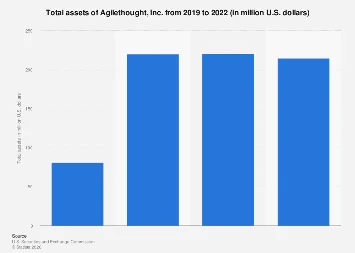
Agilethought, Inc., a U.S.-headquartered firm, has witnessed a dynamic evolution in its total asset base over the four-year period spanning 2019 through 2022. While precise figures for the aggregate value of its assets in 2022 remain proprietary, the available data points to a significant, albeit non-linear, expansion of the company’s financial holdings. This period has been marked by strategic maneuvers and market shifts that have collectively shaped Agilethought’s balance sheet. Understanding the nuances of this asset growth is crucial for stakeholders seeking to gauge the company’s financial health, operational capacity, and its positioning within the competitive landscape of the technology and consulting services sector.
The fiscal year ending December 31st serves as the benchmark for reporting these asset figures. The observed trend from 2019 to 2022 suggests that Agilethought’s asset accumulation has not been a steady, incremental climb. Instead, it indicates periods of substantial growth interspersed with potential plateaus or even contractions, a characteristic often seen in companies navigating rapid technological advancements, mergers and acquisitions, or fluctuating market demand. This variability underscores the importance of analyzing asset trends not just as a single data point, but as a narrative of strategic financial management and response to external economic forces.
To contextualize Agilethought’s asset performance, it’s beneficial to consider broader industry trends. The technology services sector, where Agilethought operates, has experienced robust growth, driven by digital transformation initiatives across nearly every industry. Companies are increasingly investing in cloud computing, artificial intelligence, data analytics, and cybersecurity solutions, creating a sustained demand for the expertise and services offered by firms like Agilethought. This heightened demand can translate into increased revenue, which, in turn, can fuel asset growth through investments in infrastructure, intellectual property, and talent acquisition. However, the sector is also highly competitive, with constant pressure to innovate and adapt, which can necessitate significant capital expenditure and influence asset values.
For instance, companies in this space often see their total assets comprise a mix of current assets (such as cash, accounts receivable, and short-term investments) and non-current assets (including property, plant, and equipment, intangible assets like goodwill and software, and long-term investments). Fluctuations in any of these categories can significantly impact the overall asset figure. A surge in accounts receivable, for example, might indicate strong sales but also a potential cash flow strain if collections are slow. Conversely, substantial investment in new technologies or acquisitions could lead to a significant increase in intangible assets and property, plant, and equipment.
Global economic conditions also play a pivotal role. The period from 2019 to 2022 encompassed a unique economic landscape, including the initial stages of the COVID-19 pandemic, supply chain disruptions, rising inflation, and subsequent interest rate hikes by central banks. These macroeconomic factors can directly and indirectly affect a company’s asset base. For example, supply chain issues might impact the value of inventory or the cost of acquiring new equipment. Inflation could drive up the replacement cost of fixed assets. Furthermore, shifts in global investment patterns and the cost of capital can influence a company’s ability to finance asset acquisitions or expansions.
When examining Agilethought’s asset trajectory, it’s important to consider what drives such movements. Potential drivers for an increase in total assets could include:
- Strategic Acquisitions: If Agilethought has acquired other companies during this period, the assets of the acquired entities would be consolidated onto its balance sheet, leading to a significant jump in total assets. This is a common growth strategy in the technology consulting sector, allowing companies to expand their service offerings, client base, or geographic reach.
- Investment in Infrastructure and Technology: As a technology-focused firm, Agilethought likely invests heavily in its own technological infrastructure, software development, and potentially physical office spaces. Significant capital expenditures in these areas would directly contribute to an increase in non-current assets.
- Growth in Intangible Assets: This could include the capitalization of research and development expenses, the acquisition of patents or licenses, or the recognition of goodwill from profitable acquisitions. In the knowledge-intensive tech sector, intangible assets often represent a substantial portion of a company’s value.
- Increased Cash Reserves and Marketable Securities: A period of strong profitability and prudent cash management could lead to an accumulation of cash and short-term investments, boosting current assets.
- Expansion of Service Lines: Developing and launching new service offerings or expanding into new markets often requires upfront investment in resources, personnel, and potentially technology, all of which contribute to asset growth.
Conversely, a decrease or stagnation in total assets might be attributable to:
- Divestitures: Selling off non-core business units or assets would naturally reduce the total asset base.
- Depreciation and Amortization: Tangible and intangible assets lose value over time through depreciation and amortization, which are recorded as expenses and reduce the net book value of these assets.
- Economic Downturns: A slowdown in client spending or a general economic recession could impact revenue and profitability, potentially leading to a reduction in asset growth or even asset write-downs.
- Strategic Restructuring: Companies sometimes undertake restructuring efforts that involve shedding less profitable assets to focus on core competencies.
The fact that the increase from 2019 to 2022 was not continuous suggests that Agilethought has likely engaged in a combination of these strategic and reactive measures. For instance, a company might experience a substantial asset increase following a major acquisition in one year, followed by a period of organic growth and asset consolidation, and then perhaps a period where depreciation outpaces new capital investment. This pattern is typical for companies that are actively managing their portfolios and responding to evolving market dynamics.
To gain a more comprehensive understanding of Agilethought’s financial standing, analysts would typically look beyond total assets to other key financial metrics. These include revenue growth, profitability margins (gross profit margin, operating margin, net profit margin), debt-to-equity ratios, and cash flow from operations. Comparing Agilethought’s asset growth against these other indicators provides a more holistic view of its performance and financial strategy. For example, if total assets have grown significantly but profitability has lagged, it might suggest inefficiencies in asset utilization or aggressive, potentially over-leveraged, expansion.
In the broader context of the global technology services market, which is valued in the trillions of dollars, Agilethought’s asset base, while important for its internal operations and strategic capabilities, represents a specific facet of its overall market presence. Companies in this sector range from massive multinational corporations with asset bases in the hundreds of billions to smaller, specialized firms. Agilethought’s asset trajectory, therefore, is a critical indicator of its internal financial health and its capacity for future growth and investment within this dynamic and highly competitive global arena. The unmasking of precise asset figures for 2022 would allow for a more granular analysis of its financial performance relative to its peers and its own historical trends.