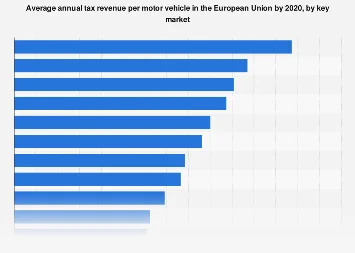
Belgium emerged in 2020 as the European nation generating the highest average annual tax revenue per motor vehicle, signaling a significant divergence in fiscal approaches to transportation across the European Union. This leading position, with an estimated revenue exceeding €1,000 per vehicle, highlights Belgium’s aggressive taxation strategy for its automotive sector. The figures, derived from total vehicle fleet volumes and national tax receipts, underscore the substantial financial contributions vehicles make to state coffers in certain member states.
Following closely behind Belgium were Austria and Finland, both demonstrating substantial per-vehicle tax revenues in excess of €800 annually. These countries also appear to leverage motor vehicle taxation as a significant source of public funding. The consistent high ranking of these nations suggests a policy inclination towards internalizing the costs associated with vehicle use, potentially through a combination of registration fees, road taxes, fuel duties, and value-added tax (VAT) on vehicle purchases and maintenance. This approach can be viewed as a mechanism to fund public services, infrastructure development, and environmental initiatives, while also potentially influencing consumer behavior towards more sustainable transport options.
In stark contrast, the fiscal burden on vehicle owners in countries like Greece and Spain was considerably lower in the same year. Greece recorded an average tax revenue of approximately €300 per vehicle, while Spain’s figure was even more modest, hovering around €250. This significant disparity suggests differing national priorities and economic conditions influencing taxation policies. Lower tax revenues per vehicle could be attributed to a variety of factors, including policies aimed at stimulating the automotive market, supporting lower-income households, or prioritizing different sectors for public revenue generation. It also raises questions about the potential for greater revenue generation and the alignment of taxation with environmental objectives in these economies.
The European Union as a whole exhibits a complex and varied landscape of motor vehicle taxation. While a precise EU-wide average is not readily available without specific data access, the range observed among key markets indicates substantial national autonomy in fiscal policy. This autonomy allows member states to tailor their tax regimes to specific economic, social, and environmental goals. However, it also leads to considerable disparities in the cost of vehicle ownership and operation across the bloc, potentially impacting cross-border trade, tourism, and the competitiveness of the automotive industry within different regions.
The data for 2020 provides a snapshot of a dynamic fiscal environment. Economic fluctuations, evolving environmental regulations, and shifts in government policy can all influence these revenue figures over time. For instance, the increasing focus on electric vehicles (EVs) is prompting many governments to re-evaluate existing tax structures. While some countries are offering tax incentives to promote EV adoption, others are exploring ways to compensate for lost fuel tax revenue and to ensure that all road users contribute to infrastructure maintenance. The transition to cleaner mobility solutions presents both challenges and opportunities for national treasuries, potentially leading to further divergence or convergence in motor vehicle taxation policies across Europe.
Expert analysis suggests that the rationale behind higher vehicle taxation in countries like Belgium and Austria might extend beyond mere revenue generation. These nations may be more proactively employing fiscal tools to address externalities associated with private vehicle use, such as traffic congestion, air pollution, and carbon emissions. Higher taxes can act as a deterrent to excessive vehicle ownership and usage, encouraging a shift towards public transport, cycling, walking, or the adoption of more fuel-efficient or zero-emission vehicles. This aligns with broader EU objectives related to the European Green Deal and the pursuit of climate neutrality.
Conversely, lower taxation in countries like Greece and Spain could reflect a strategic decision to support domestic consumption, bolster the automotive sector as a contributor to employment and economic activity, or address concerns about the affordability of private transportation for citizens. These countries might rely more heavily on other forms of taxation, such as income tax or value-added tax on a wider range of goods and services, to fund public expenditure. The choice of tax mix is a fundamental aspect of economic policy, reflecting a nation’s specific circumstances and policy preferences.
The economic impact of these divergent tax regimes is multifaceted. For consumers, the cost of purchasing and operating a vehicle can vary significantly, influencing purchasing decisions and mobility patterns. Businesses operating in the automotive sector, including manufacturers, dealerships, and service providers, also face different market conditions depending on the tax environment of the countries in which they operate. For example, a higher tax burden on new vehicle purchases could dampen demand in one market, while a more favorable regime might stimulate it in another.
Furthermore, differences in vehicle taxation can have implications for fiscal sustainability. Countries with lower per-vehicle revenues might need to find alternative revenue streams to maintain public services and infrastructure, especially as the composition of vehicle fleets changes. The ongoing electrification of transport, for instance, necessitates a rethink of fuel excise duties, which have traditionally been a significant source of revenue. New models of taxation, such as road usage charges based on mileage or time of travel, are being considered and piloted in various European countries to adapt to these evolving trends.
The European Commission also plays a role in coordinating fiscal policies among member states, although direct harmonization of motor vehicle taxes has been limited. The focus has often been on ensuring a level playing field for businesses and preventing tax avoidance. However, the increasing emphasis on environmental objectives could lead to greater convergence in certain aspects of vehicle taxation in the future, particularly concerning emissions standards and incentives for sustainable transport.
In conclusion, the 2020 data on average annual motor vehicle tax revenue per vehicle in the European Union paints a picture of considerable fiscal diversity. While Belgium, Austria, and Finland lead in revenue generation, suggesting a robust approach to taxing vehicle use and its associated externalities, countries like Greece and Spain exhibit a more modest fiscal approach. These differences reflect distinct national policy choices shaped by economic priorities, social considerations, and environmental ambitions. As the automotive landscape continues to transform with the rise of electric mobility and evolving sustainability goals, European nations will likely continue to grapple with the complex task of designing motor vehicle tax systems that are both fiscally sound and aligned with the broader objectives of the European Union. The long-term implications of these varied fiscal strategies will be crucial for understanding the future trajectory of transportation, economic development, and environmental policy across the continent.