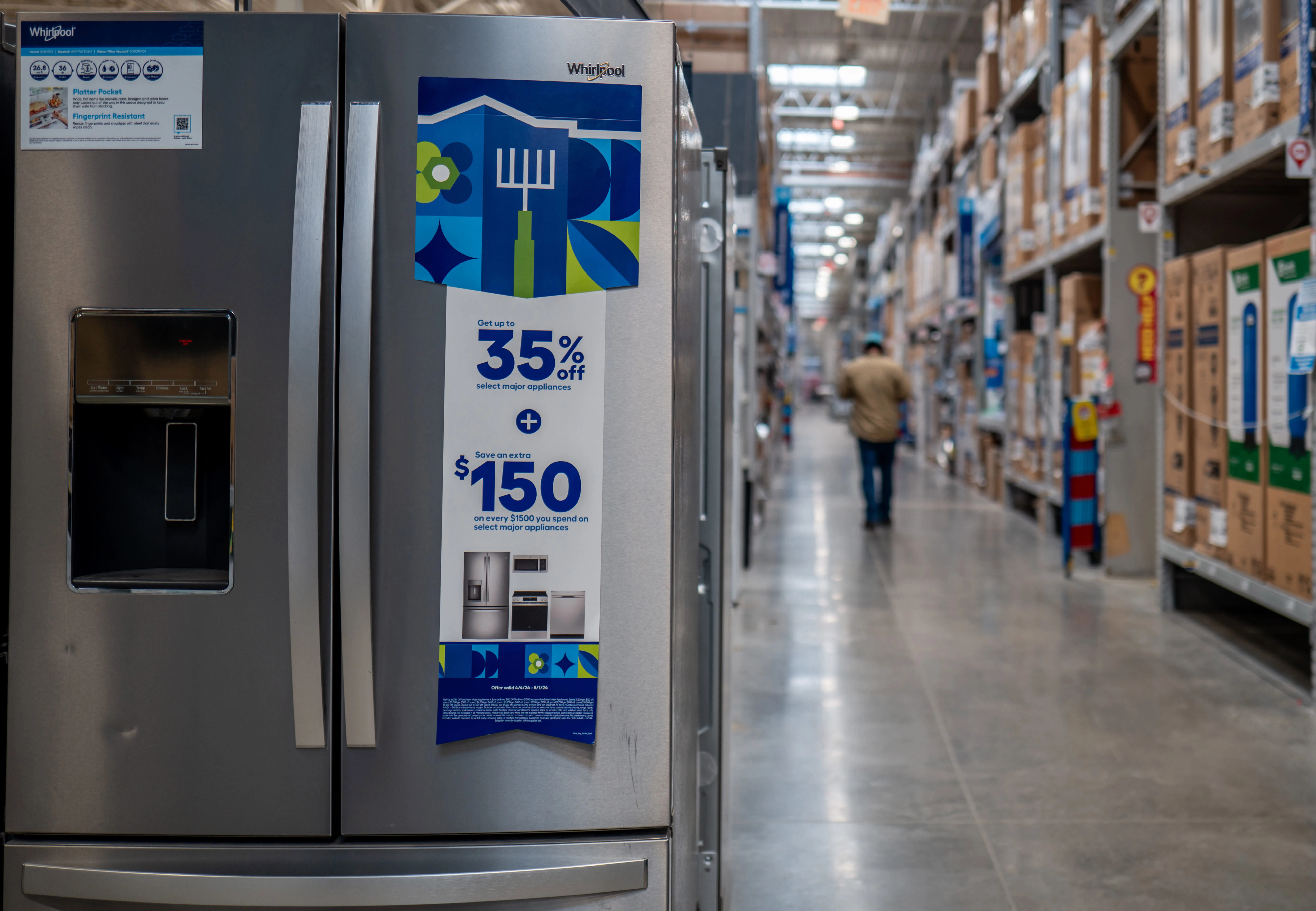
The global appliance industry, long considered a barometer for the health of the middle-class consumer, is currently grappling with a sudden and severe contraction that mirrors the darkest days of past economic downturns. Whirlpool Corporation, the venerable American multinational and a titan of the home appliance sector, saw its shares plummet by 12% in a single trading session this Thursday. The catalyst for this sharp devaluation was an unusually blunt warning from the company’s leadership regarding the escalating conflict in Iran, which they claim has triggered a "recession-level industry decline" across the United States. This development serves as a stark reminder of how sensitive big-ticket consumer discretionary spending is to geopolitical shocks, energy price volatility, and the fragile psychology of the modern consumer.
The conflict in Iran has sent shockwaves through global energy markets, driving U.S. crude oil prices consistently above the $90-per-barrel mark. While the direct physical impact of the war may be geographically contained, its economic shadow is long and dark. For companies like Whirlpool, which manufacture large-scale appliances such as washing machines, dryers, and dishwashers, the surge in fuel prices acts as a double-edged sword. First, it significantly inflates the cost of logistics and raw materials, particularly steel and resins, which are essential to their manufacturing processes. Second, and perhaps more critically, it acts as a regressive tax on the consumer. When the cost of filling a gasoline tank rises abruptly, households frequently defer "white goods" purchases—non-essential upgrades or replacements of major home appliances—to preserve liquidity for immediate necessities.
Whirlpool’s internal data highlights a dramatic shift in consumer behavior that began in late February and accelerated through March. During this period, as news of the conflict dominated headlines and energy prices spiked, the company observed a collapse in consumer confidence. This observation is backed by broader economic indicators; the University of Michigan’s Consumer Sentiment Index recently touched historic lows, reflecting a public that is increasingly wary of the future. The "recession-level" terminology used by Whirlpool is not mere hyperbole; it reflects a volume decline in unit sales that historically correlates with periods of negative GDP growth. For an industry that relies on high-volume turnover to maintain thin margins, such a sudden drop in demand is catastrophic.
The financial fallout for Whirlpool has been immediate and severe. In a move that surprised many Wall Street analysts, the company slashed its full-year earnings guidance by nearly 50%. Previously, the manufacturer had projected earnings in the neighborhood of $6.00 per share; that forecast has now been aggressively reined in to a range of $3.00 to $3.50 per share. This downward revision suggests that the company does not expect a "V-shaped" recovery in the second half of the year. Furthermore, in a bid to preserve capital and shore up its balance sheet, Whirlpool announced the suspension of its dividend. For a company with a long history of returning value to shareholders, the suspension of a dividend is a clear signal of a "batten down the hatches" mentality. The priority has shifted from growth and yield to debt reduction and liquidity preservation.
Industry analysts at JPMorgan have pointed out that Whirlpool’s predicament is multifaceted. It is not just a story of declining demand, but also one of mounting costs. The company is facing a "perfect storm" of raw material inflation and the lingering impact of net tariffs. While CEO Marc Bitzer noted that changes in Section 232 trade policies—which provide protections for domestic steel and aluminum production—could eventually favor Whirlpool’s American-made products, the short-term reality is one of higher input costs. The company is caught between the need to raise prices to cover these costs and the reality that a cash-strapped consumer cannot or will not absorb those increases. This leads to a "weaker price and product mix," where consumers who do buy appliances opt for entry-level, lower-margin models rather than the premium, feature-rich units that drive corporate profitability.

Interestingly, Whirlpool’s dire outlook provides a counter-narrative to the "resilient consumer" story that has been touted by other sectors of the economy. Recent earnings reports from travel and service-oriented giants like Disney and Uber have suggested that the American consumer is still willing to spend on experiences, vacations, and convenience. However, economists suggest we are witnessing a "bifurcated" economy. While "revenge travel" and service spending remain robust following years of pandemic-induced lockdowns, the demand for durable goods—which surged during the 2020-2022 period—is now facing a natural cyclical cooling, further exacerbated by the geopolitical climate. The refrigerator that a family bought in 2021 does not need replacing in 2024, and the war in Iran provides the perfect psychological reason to cancel a planned kitchen renovation.
The broader economic impact of this industrial slowdown cannot be overstated. The appliance industry is a major employer and a significant driver of secondary economic activity, from shipping and logistics to retail and installation services. A sustained downturn in this sector often precedes a wider cooling of the housing market. Historically, appliance sales and home sales move in lockstep; when people stop buying houses, they stop buying the machines to fill them. With mortgage rates remaining elevated and consumer confidence shaken by international conflict, the "wealth effect"—whereby consumers feel more comfortable spending because their assets are increasing in value—is rapidly evaporating.
Global comparisons further illustrate the gravity of the situation. In Europe, where energy dependency on volatile regions is even more pronounced, appliance manufacturers are facing similar headwinds. The disruption of trade routes and the threat of expanded sanctions have made global supply chain management an exercise in crisis mitigation. Whirlpool’s decision to pivot toward its "American-made" identity is a strategic attempt to insulate itself from some of these global vulnerabilities, but domestic manufacturing is not an island; it remains tethered to global commodity prices.
As the market waits for a potential resolution to the conflict in Iran, the immediate future for Whirlpool and its peers remains clouded. While some investors hold out hope that a peace proposal or a diplomatic breakthrough could lower oil prices and restore confidence, the structural damage to the fiscal year may already be done. The 12% drop in share price reflects a market that is pricing in a long, cold winter for the manufacturing sector.
Whirlpool’s proactive cost-cutting measures, including executive adjustments and operational streamlining, are necessary steps, but they may not be enough if the macroeconomic environment continues to deteriorate. The company’s situation serves as a cautionary tale for the broader market: geopolitical events in one corner of the world can almost instantly dismantle the financial forecasts of industrial icons half a world away. For now, the "recession-level" decline in the appliance industry stands as a sobering indicator that while some parts of the economy are still partying, the engine room of American manufacturing is sounding an urgent alarm. The coming months will determine if this is a temporary localized shock or the first domino to fall in a broader domestic industrial contraction. For the time being, the focus for Whirlpool remains squarely on survival, deleveraging, and waiting for the consumer to once again feel secure enough to invest in the future of their homes.