For over seven decades, Germany has presented a compelling narrative of postwar recovery, a beacon of economic prosperity, democratic stability, and international admiration. From the foundational leadership of Konrad Adenauer through the tenures of Willy Brandt, Helmut Schmidt, Helmut Kohl, and the extended sixteen years under Angela Merkel, the Federal Republic’s economic and political landscape appeared remarkably resilient. This perceived bedrock of stability even facilitated the swift integration of the former East German economy following the fall of the Berlin Wall in 1989. While the post-World War II era was not without its turbulence—marked by incidents such as the Red Army Faction terrorism of the 1970s and the economic shocks of oil price surges during the same decade—Germany’s economy largely sustained a trajectory of steady, inclusive growth, underpinned by robust manufacturing exports. However, the nation is currently navigating a period of economic stagnation, a stark contrast to its earlier dynamism. The very export-oriented model that propelled its ascent is now faltering under the weight of diminished global competitiveness, particularly against rising economic powerhouses like China. Concurrently, societal divisions have deepened, with resentment towards immigration reaching post-war highs, exacerbated by Chancellor Merkel’s 2015 decision to open the country’s borders to over a million refugees. This confluence of economic headwinds and social anxieties has fueled a resurgence of right-wing populism, exemplified by the Alternative for Germany (AfD) party, which challenges the fundamental political norms and assumptions that have defined the Federal Republic since its inception in 1949.
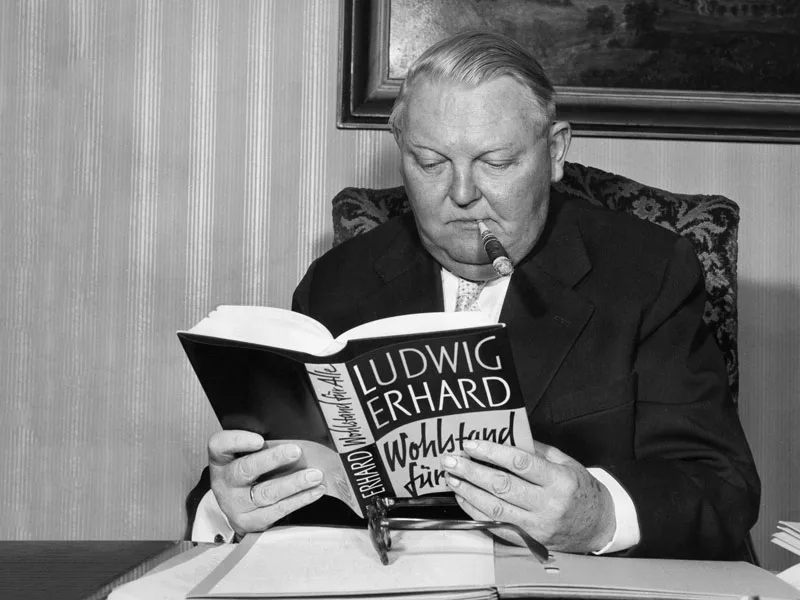
The architects of the post-war economic revival, often referred to as the "Wirtschaftswunder," are frequently attributed to the visionary currency reform spearheaded by Ludwig Erhard and the significant financial assistance provided by the European Recovery Programme (ERP), popularly known as the Marshall Plan. The ERP, signed into law by U.S. President Harry Truman on April 3, 1948, saw its initial disbursements reach Germany by early July. In return for this crucial aid, Germany was mandated to adhere to stringent economic policies: balancing its budget, curbing inflation, dismantling rationing systems, removing price and wage controls, fostering private enterprise, and liberalizing trade. These stipulations closely mirrored what would later be recognized globally as the "Washington Consensus."
A pivotal moment in this economic transformation was Erhard’s currency reform, implemented midway between the ERP’s legislative enactment and the arrival of the first aid shipments. On June 20, 1948, the Deutsche Mark replaced the Reichsmark as the official currency in the Bizone, the combined Anglo-American occupation zone. This reform effectively addressed the substantial monetary overhang that had fueled black market inflation and exacerbated shortages within the controlled economy, converting Reichsmarks to Deutsche Marks at a ratio of approximately ten to one. Ludwig Erhard, serving as the highest-ranking German economic official under the occupation authorities, oversaw the introduction of the new currency. Crucially, on June 21st, acting unilaterally, he abolished the majority of price controls and rationing measures.
The combined effect of eliminating the monetary overhang, implementing fiscal restraint, and dismantling price controls led to the remarkable resurgence of goods on previously bare store shelves. Farmers, now possessing a stable currency, could invest in essential equipment and fertilizers, much of which was supplied through the Marshall Plan. This newfound purchasing power incentivized them to bring produce to market, alleviating food scarcity. The stabilization of the exchange rate also empowered businesses to export their products and sell domestically, prompting increased hiring, investment, and production. According to triumphalist narratives of the Wirtschaftswunder, this period witnessed an unprecedented economic expansion, with West Germany achieving an average annual growth rate of six percent over the subsequent quarter-century. By 1973, the Federal Republic of Germany had ascended to become the world’s third-largest economy.
However, more recent scholarly analyses, notably from Carl-Ludwig Holtfrerich, a former economics professor at the Free University of Berlin, and Tobias Straumann, a professor of economics at the University of Zurich, offer a more nuanced perspective, challenging the conventional account of the Wirtschaftswunder’s origins. Holtfrerich posits that Erhard played a minimal role in the design of the currency reform, despite his persistent claims of authorship throughout his political career. Straumann, meanwhile, argues that West Germany’s economic recovery remained precarious in the aftermath of the 1948 reforms. He contends that the long-term sustainability of the economic miracle was contingent upon the 1953 London Debt Agreement. This agreement crucially absolved Germany of crippling reparation obligations to its former adversaries, a stark contrast to the punitive reparations imposed after World War I.
The London Debt Agreement was the culmination of extensive negotiations between a German delegation, led by Hermann Josef Abs of Deutsche Bank, and twenty creditor nations, with the United States, the United Kingdom, and France holding significant influence. Straumann suggests a straightforward "lessons of history" hypothesis to explain the agreement’s favorable outcome for Germany. Negotiators across the board drew a direct line from the economically devastating and politically humiliating reparations imposed in 1921 to the collapse of the Weimar Republic and the subsequent rise of Adolf Hitler and the Nazi Party. Consequently, a paramount objective following World War II was to prevent a similar sequence of events at all costs.
While historical lessons undoubtedly played a role, Straumann acknowledges that the full narrative is more intricate. The geopolitical context of the Cold War in the 1950s was critically important, creating an urgent imperative for economic recovery in West Germany, which was absent among the victors of World War I. With the Soviet Union posing a significant threat to Western Europe, reactivating West Germany’s economy, a vital source of capital goods for the continent, became paramount. This necessitated avoiding excessive reparation burdens on Germany, but it also required normalizing the Federal Republic’s financial relations with the international community. This normalization was essential to enable German firms to secure foreign loans and export their goods without the risk of seizure, thereby fostering a more stable and predictable business environment.
Under the terms of the London Debt Agreement, the newly formed West German government committed to servicing and repaying pre-war (Reich and Weimar era) foreign debts and post-war loans from Western governments. However, crucially, Nazi-era war debts and occupation costs were excluded. All reparations obligations were deferred indefinitely, contingent upon the eventual reunification of the two Germanys. Another significant departure from the post-World War I scenario, closely linked to the debt resolution, was the burgeoning process of European integration.
In parallel with the debt negotiations, French Foreign Minister Robert Schuman initiated a groundbreaking plan for the joint control of French and German heavy industry, which evolved into the European Coal and Steel Community (ECSC). The perceived Soviet threat underscored the necessity of restoring Western Europe’s heavy industry, particularly Germany’s, to full operational capacity. However, this required assurances that Germany’s industrial might would not again be weaponized against its neighbors. The ECSC effectively addressed this concern. It is difficult to overstate the importance of progress on the debt front in facilitating the successful launch of the ECSC. In a notable aside, Straumann recounts the startled and strongly negative reaction of British Foreign Minister Ernest Bevin and other British officials when the French plan was unveiled, foreshadowing a persistent ambivalence within the UK towards what would become the European Community and subsequently the European Union.
Furthermore, the London Debt Agreement enabled the new German government to begin normalizing relations with Israel, a significant step in the wake of the Holocaust’s horrors. Without this agreement, the Federal Republic would have lacked both the financial resources and the political will to provide DM3 billion in German goods to Israel or to finance Israel’s critically needed imports from British oil companies.
While Straumann’s work offers a political and historical narrative, Holtfrerich’s biography focuses on Edward Tenenbaum, whom he identifies as the true architect of the currency reform. Holtfrerich’s account traces Tenenbaum’s journey from the immigration of his Jewish parents from Polish Galicia, through his formative years in New York, and his education at the International School of Geneva and Yale. An intriguing parallel, though not explicitly drawn by Holtfrerich, can be made with Harry Dexter White, the principal architect of the Bretton Woods system, another foundational element of the monetary framework that underpinned the Wirtschaftswunder.
Tenenbaum served as an intelligence officer within the Twelfth Army Group during World War II and subsequently in the Office of Military Government, United States (OMGUS), which governed the American occupation zone. After his military discharge in 1946, he continued as a civilian advisor to OMGUS, where he devised the currency reform. During his tenure in Army Intelligence and OMGUS, Tenenbaum collaborated closely with Charles Kindleberger, a senior economic expert who later became a distinguished professor of international economics and economic history at MIT. Kindleberger’s presence in Holtfrerich’s account is more than a mere cameo. Holtfrerich recounts how, during an academic sabbatical in Cambridge, Massachusetts, in 1975-76, he learned from Kindleberger about Tenenbaum’s pivotal role in the currency reform, thereby laying the groundwork for his book. Holtfrerich also reveals that Kindleberger had, for a period, been responsible for selecting targets for America’s strategic bombing campaign during the war, a fact he withheld from Holtfrerich, presumably out of consideration, despite the fact that Holtfrerich’s father had been killed in a bombing raid in 1944.
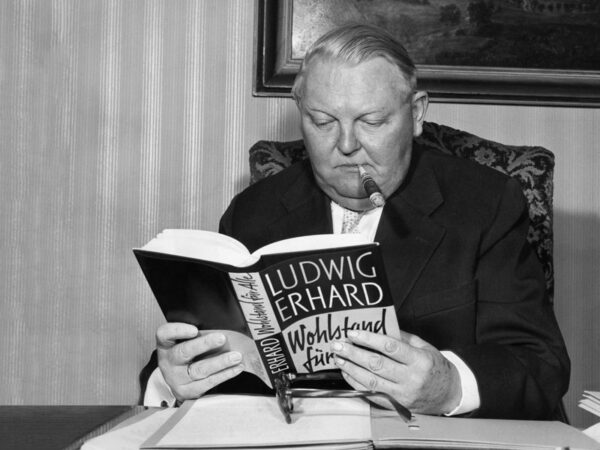
Holtfrerich offers three primary explanations for why Erhard, rather than Tenenbaum, received—and continues to receive—popular credit for the currency reform. Firstly, Tenenbaum was remarkably self-effacing, a trait that even his biographer finds difficult to fully comprehend. When confronted with the reality of Erhard appropriating credit for his work, Tenenbaum is reported to have casually remarked, "Who cares who gets the credit?" Secondly, in stark contrast to Tenenbaum, Erhard was relentless in his self-promotion. This distinction between academics and politicians is, perhaps predictably, tempting to highlight. Erhard also demonstrated a remarkable adaptability, skillfully adjusting his policy positions to align with prevailing political currents. Prior to and during the war, he had advocated for strong state intervention in the economy. However, with the advent of the Marshall Plan, he transformed into a vocal proponent of sound money, private enterprise, and market competition. Thirdly, post-war West Germany was in desperate need of a positive national identity, given the atrocities committed during the Third Reich and the profound guilt associated with that history. The nation yearned for strong leadership, even for heroes. The narrative of a home-grown currency reform, spearheaded by a German figure, perfectly fulfilled this psychological and political need. Modern Germany stands as a testament to the legacy of the post-war Wirtschaftswunder: a prosperous, democratic nation deeply integrated into the European framework. However, such achievements are never permanently assured. To preserve the economic gains accumulated over the post-war decades, Germany requires another significant economic overhaul, guided by political leaders capable of meeting the challenges of a new era.