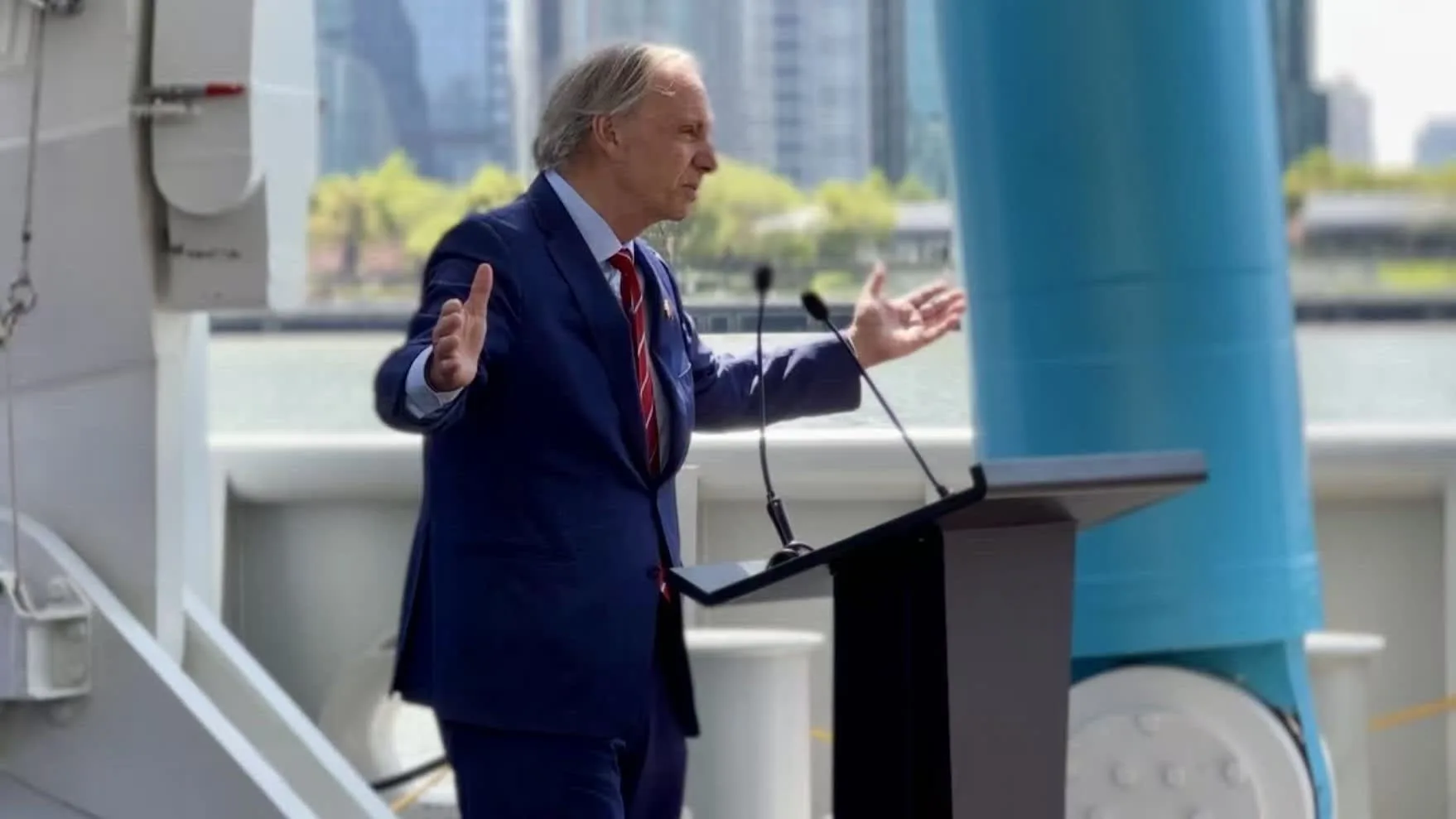
The architectural foundations of the global economy are bracing for a transformative moment as United States President Donald Trump prepares for a high-stakes diplomatic mission to Beijing on May 14 and 15. This summit, which marks a critical pivot point in the bilateral relationship between the world’s two largest economies, is expected to transcend traditional diplomatic platitudes, focusing instead on the granular mechanics of trade and the increasingly complex movement of global capital. Ray Dalio, the influential founder of Bridgewater Associates and a long-time observer of Sino-American relations, has signaled that this meeting could serve as a vital cooling mechanism for a relationship that has recently been strained by military friction and economic protectionism.
Speaking from Shanghai, Dalio emphasized that while trade remains the traditional pillar of these discussions, the focus is rapidly shifting toward capital flows—the lifeblood of international investment and corporate expansion. As the United States and China navigate a period characterized by "de-risking" and strategic autonomy, the ability for capital to move across borders remains a primary concern for institutional investors. The upcoming dialogue between President Trump and President Xi Jinping is not merely about balancing a ledger of goods; it is about establishing a predictable framework for the trillions of dollars in equity, debt, and foreign direct investment that link Wall Street to the financial hubs of Shanghai and Shenzhen.
The timing of this summit is particularly poignant, coming on the heels of significant geopolitical volatility. Originally scheduled for late March, the meeting was postponed as Washington’s attention was diverted by the outbreak of hostilities in the Middle East. The conflict, often referred to as the Iran war, has cast a long shadow over global markets, disrupting energy supplies and injecting a fresh dose of uncertainty into an already fragile international order. Dalio noted that this lack of direct, high-level contact between Washington and Beijing has historically been the "biggest source" of bilateral tension. By re-engaging in person, the two leaders have the opportunity to replace speculative hostility with a form of "strategic empathy," a concept Dalio believes is essential for avoiding a catastrophic escalation of conflict.

Market performance reflects the anxiety of this transitional era. Despite a general recovery in the major U.S. indices over the past twelve months, the S&P 500 remains down more than 3% since the start of the year. This sluggishness is attributed not only to the direct costs of the Iran conflict but also to the broader "geopolitical risk premium" that investors must now bake into their valuations. When the world’s two superpowers are at odds, the cost of capital rises, and the appetite for long-term infrastructure and technology projects wanes. The summit in Beijing is therefore viewed by the financial community as a potential "circuit breaker" that could restore confidence in the stability of the global supply chain.
Central to the economic negotiations will be the status of tariffs and export controls. During their last significant encounter in South Korea, the two presidents managed to secure a one-year reprieve on several punitive tariffs, a move that provided a temporary sigh of relief for manufacturers and retailers alike. Simultaneously, Beijing agreed to delay the implementation of stringent export controls on rare earth elements—materials that are indispensable for the production of everything from electric vehicle batteries to advanced military hardware. However, these temporary truces are nearing their expiration dates. The May summit will likely determine whether these reprieves become permanent fixtures of a new trade deal or if the world will see a return to the tit-for-tat economic warfare that characterized the previous decade.
Dalio’s perspective is shaped by a historical lens that views the current era as a period of profound "world order" transition. In recent analyses, he has compared the present landscape of military confrontations and economic sanctions to the lead-up to previous global conflicts. He suggests that we are currently in a "world war of sorts," albeit one that is fought through cyber-attacks, currency manipulation, and proxy conflicts as much as through conventional military means. In this context, the Trump-Xi meeting is a rare opportunity to manage this transition peacefully. Dalio argues that the two leaders must discuss how to accommodate a shifting balance of power without triggering the "Thucydides Trap"—the historical tendency toward war when a rising power threatens to displace an existing hegemon.
Beyond the hard-nosed negotiations of trade and security, there is a growing emphasis on "soft diplomacy" and shared existential threats. Dalio’s presence in Shanghai was partly to celebrate the conclusion of an eight-day ocean exploration voyage organized by OceanX, his non-profit initiative dedicated to marine stewardship. The mission, which included students from both the U.S. and China, served as a symbolic reminder that there are arenas where cooperation is not only possible but necessary. Climate change and ocean health have emerged as the "neutral ground" of 21st-century diplomacy. Even as the two nations compete for dominance in artificial intelligence and semiconductor manufacturing, they remain bound by the shared biological and environmental systems of the planet.

The importance of the Beijing summit is magnified by the fact that it may be the first of four scheduled meetings between Trump and Xi this year. This frequency of contact suggests a mutual recognition that the relationship is too complex to be managed through sporadic communiqués or mid-level bureaucratic channels. The "Chinese-American relationship and the oceans," as Dalio remarked, are the two most critical variables for the well-being of humanity. If the two leaders can find common ground in Beijing, it could pave the way for a more synchronized approach to global challenges, including the stabilization of energy markets in the wake of the Iran ceasefire and the management of global debt levels.
For investors, the stakes could not be higher. The "decoupling" of the world’s two largest economies would necessitate a massive and costly reorganization of global production. Currently, China remains a vital node in the supply chains of American giants like Apple and Tesla, while U.S. capital continues to seek growth opportunities in China’s burgeoning middle class. Any movement toward a more integrated capital market—or conversely, any move toward more aggressive capital controls—will dictate the flow of wealth for the next generation. Dalio’s call for empathy is not merely a moral plea; it is a pragmatic recognition that in a highly interconnected financial system, the "ruin of my rival" often leads to the "ruin of myself."
As the world looks toward the mid-May summit, the focus remains on the tangible outcomes. Will there be a formalization of the rare earth agreement? Will the U.S. offer concessions on technology exports in exchange for greater access to Chinese financial markets? While the "news of the day" often focuses on the latest ceasefire or diplomatic slight, the underlying structural shifts in trade and capital flows will be the true legacy of the Trump-Xi era. Ray Dalio’s optimism, tempered by a realistic assessment of historical cycles, suggests that while the path forward is fraught with risk, the potential for a "grand bargain" remains the most compelling hope for global economic stability.
The coming weeks will be characterized by intense preparatory work by treasury officials and trade representatives from both sides. The goal is to create a framework that allows for "competition within a set of rules," preventing the current cold-war-style tensions from boiling over into a full-scale economic decoupling. As Dalio noted, the world order is changing, and the leaders of the two most powerful nations on earth now face the daunting task of negotiating the terms of that change. Whether they can do so with the "empathy" and foresight required will determine the trajectory of the global economy for decades to come.