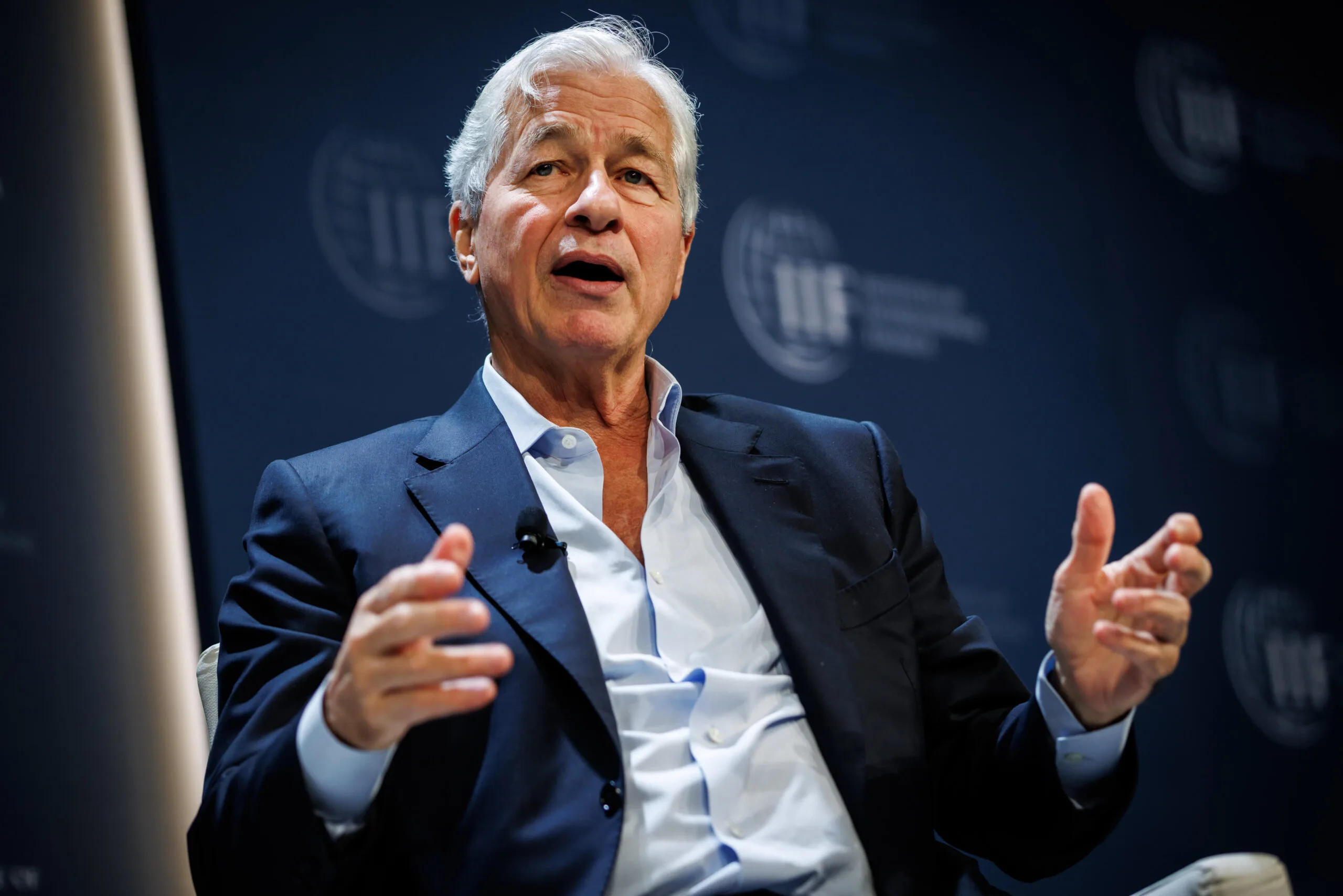
The intersection of high finance and hard-power geopolitics has rarely been as fraught—or as potentially transformative—as it is in the current global landscape. Jamie Dimon, the Chairman and CEO of JPMorgan Chase & Co., recently offered a provocative assessment of the ongoing conflict involving Iran, suggesting that while the immediate horizon is clouded by extreme volatility, the ultimate resolution of the war could pave the way for an unprecedented era of stability and economic integration in the Middle East. Speaking at a high-level forum in Washington, D.C., the head of the world’s largest bank by market capitalization argued that the fundamental shift in regional interests has created a unique, albeit high-risk, window for a "long-term peace" that was unthinkable two decades ago.
Dimon’s thesis rests on the premise that the current hostilities represent a violent but perhaps necessary clearing of systemic obstacles to regional cooperation. The conflict, which escalated following a series of precision strikes by U.S. and Israeli forces against Iranian strategic assets—including the reported elimination of the country’s supreme leadership—has sent shockwaves through global energy markets. Yet, Dimon contends that the strategic calculus of regional heavyweights such as Saudi Arabia, the United Arab Emirates (UAE), and Qatar has fundamentally diverged from the ideological battles of the past. These nations, once defined by their rivalries, are now increasingly unified by a pragmatic economic mandate: the need for absolute stability to facilitate a post-oil future.
The economic stakes are staggering. Over the past decade, the Gulf Cooperation Council (GCC) nations have embarked on ambitious economic diversification programs, such as Saudi Arabia’s Vision 2030, which require hundreds of billions of dollars in foreign direct investment (FDI). For these projects to succeed, the region must shed its reputation as a theater of perpetual proxy warfare. Dimon noted that the modern economic infrastructure of the Middle East—ranging from massive desalination plants to burgeoning tech hubs and global logistics centers—is far more vulnerable to disruption than the desert outposts of the early 2000s. As Dimon succinctly put it, the ambition to become a global tech and financial hub is incompatible with a security environment where "neighbors are lobbing ballistic missiles into data centers."
This "economic peace" theory is supported by the shifting flows of capital. In recent years, the UAE and Saudi Arabia have emerged as primary destinations for global venture capital and private equity, seeking to capitalize on the region’s youthful demographics and digital transformation. However, the "war premium" currently baked into regional assets threatens to stall this momentum. Brent crude prices have historically spiked by 10% to 20% during periods of heightened Persian Gulf tensions, a volatility that Dimon views as a short-term deterrent but a long-term catalyst for a decisive resolution. The logic is simple: the cost of continued instability has finally exceeded the cost of a difficult, comprehensive peace settlement.
The political dimension of this shift is equally critical. Dimon highlighted a convergence of interests between the U.S., Israel, and the Arab states of the Gulf, noting that the "attitude is not what the attitude was 20 years ago." The Abraham Accords served as a precursor to this realignment, but the current conflict with Iran has accelerated the formation of a de facto security architecture. This nascent alliance is built on shared intelligence, integrated air defense systems, and a mutual desire to neutralize non-state actors that threaten the flow of trade through the Strait of Hormuz and the Bab el-Mandeb.

However, the path to this envisioned stability remains treacherous. Market sentiment fluctuated wildly following claims by the Trump administration of a "complete and total resolution" being discussed, assertions that were promptly denied by Tehran. This diplomatic friction underscores the "short-term risk" Dimon cautioned against. In the absence of a clear successor to Iran’s leadership or a formal treaty, the risk of asymmetric retaliation and guerrilla-style disruption to energy infrastructure remains a primary concern for global commodity traders. JPMorgan’s own analysts have frequently pointed out that while the global economy is more resilient to energy shocks than in the 1970s, a sustained disruption in the Middle East could still shave significant percentage points off global GDP growth.
Beyond the immediate theater of the Middle East, Dimon used the platform to address broader concerns regarding U.S. national security and its industrial base. He expressed deep frustration with what he termed the "Europeanization" of American policy—a reference to a perceived drift toward bureaucratic inertia, slow procurement cycles, and an inability to adapt to the speed of modern conflict. Dimon’s critique focused on the defense industrial base’s failure to maintain sufficient production of munitions and critical components, a vulnerability exposed by simultaneous tensions in Eastern Europe and the Middle East.
In response to these systemic gaps, JPMorgan Chase has spearheaded a $1.5 trillion initiative aimed at bolstering industries vital to national security. This includes investments in domestic manufacturing, energy security, and supply chain resilience. Dimon’s argument is that economic strength and military readiness are inextricable. He suggested that the U.S. has spent the last several decades "making a huge mistake" in its relationship with China by allowing critical dependencies to form in essential sectors. From semiconductor packaging to the processing of rare earth minerals and the manufacturing of high-capacity batteries, the U.S. finds itself playing catch-up in a race it once led.
The CEO’s outlook on China is particularly sobering. While acknowledging Beijing’s "magnificent" achievements in sectors like electric vehicles, drones, and shipbuilding, he warned that the U.S. must prepare for the possibility of a direct conflict over Taiwan. In Dimon’s view, the outcome of the current wars in Ukraine and Iran will serve as a definitive signal to Beijing. A decisive Western-backed victory in these theaters, he argued, would provide the U.S. with the leverage and credibility needed to manage the "China challenge" from a position of strength.
Dimon’s rhetoric reflects a growing trend among the financial elite to view global markets through the lens of "geoeconomics." This perspective posits that the era of unfettered globalization is giving way to a period of "aligned trade," where economic relationships are dictated as much by security alliances as by comparative advantage. For a bank like JPMorgan, which operates in over 100 markets, this shift requires a recalibration of risk. The bank’s new global headquarters in New York, which Dimon mentioned during the forum, is designed to be a hub for this new era of complex, interconnected global finance, incorporating advanced AI and data analytics to navigate a world where a missile strike in the Middle East can instantaneously reprice a tech portfolio in Silicon Valley.
Ultimately, Dimon’s "contrarian" optimism regarding the Middle East is a bet on the triumph of economic self-interest over historical grievances. He envisions a region where the necessity of maintaining "data centers" and "FDI flows" forces a permanent cessation of hostilities. If he is correct, the current war, despite its human and economic toll, may indeed be the painful precursor to a restructured Middle East that is more integrated into the global economy than ever before. However, as Dimon himself cautioned, this outcome depends entirely on the "outcome of the war" and the ability of the U.S. and its allies to translate military success into a durable diplomatic and economic framework. For now, the world remains in a state of watchful suspense, balancing the hope for a "long-term peace" against the reality of a very "risky" short-term.