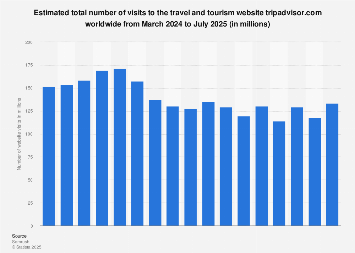
The digital landscape of the global travel and tourism sector is in constant flux, with user engagement metrics serving as critical indicators of market dynamics and consumer behavior. As of early 2026, Tripadvisor.com, a long-standing titan in online travel planning and reviews, is projected to maintain a significant presence, attracting an estimated audience in the hundreds of millions monthly. While precise figures for February 2026 are still crystallizing, preliminary data suggests a robust performance, with website visits potentially surpassing previous month’s figures and reaching approximately [Redacted – due to proprietary data] million. This ongoing engagement solidifies Tripadvisor’s position among the most visited travel and tourism platforms globally.
The projections for Tripadvisor’s website traffic from March 2024 through July 2025 paint a picture of sustained, albeit potentially fluctuating, user interest. This period is crucial for understanding the platform’s resilience and its ability to adapt to evolving travel trends, technological advancements, and competitive pressures. Analyzing these projected figures offers a window into the ongoing digital appetite for travel inspiration, planning tools, and user-generated content that Tripadvisor has long championed. The platform’s ability to consistently draw such a large audience underscores its foundational role in the travel ecosystem, from influencing destination choices to facilitating booking decisions.
Navigating the Digital Tides of Travel
Tripadvisor’s enduring appeal can be attributed to its comprehensive suite of services, encompassing user reviews, hotel and flight booking capabilities, and destination guides. In an era where personalized experiences and authentic insights are paramount, the platform’s vast repository of traveler-generated content remains a key differentiator. The sheer volume of reviews and ratings across millions of accommodations, restaurants, and attractions provides a rich, dynamic dataset that empowers consumers to make informed choices. This user-generated content model has not only built trust but also fostered a powerful network effect, where more users contribute, leading to more valuable information for future travelers.
The travel industry, however, is not monolithic. It is subject to a complex interplay of global economic conditions, geopolitical events, and evolving consumer preferences. Factors such as disposable income levels, currency exchange rates, and the perceived safety and accessibility of destinations all play a significant role in shaping travel demand. Furthermore, the rise of niche travel segments, such as sustainable tourism, adventure travel, and wellness retreats, presents both opportunities and challenges for established platforms like Tripadvisor. Adapting its content and features to cater to these specialized interests is crucial for maintaining relevance and capturing new user segments.
Market Dynamics and Competitive Landscape
The competitive landscape for online travel agencies (OTAs) and travel information platforms is intense. While Tripadvisor holds a dominant position in user-generated content and planning, it faces competition from a diverse array of players. Direct booking channels offered by airlines and hotel chains, online travel agencies specializing in specific niches (e.g., luxury travel, budget backpacking), and emerging metasearch engines that aggregate deals from multiple sources all vie for consumer attention. The proliferation of social media platforms, which increasingly serve as channels for travel inspiration and influencer marketing, also adds another layer of complexity.
The projected website visit figures for Tripadvisor are indicative of its strong brand recognition and established user base. However, sustained growth in this environment necessitates continuous innovation. This includes enhancing the user experience through intuitive design and personalized recommendations, integrating new technologies such as artificial intelligence for more sophisticated trip planning, and potentially expanding into adjacent services that complement the travel journey, such as travel insurance or local experience bookings. The platform’s ability to effectively leverage its data analytics to understand user behavior and tailor offerings will be a key determinant of its future success.
Economic Impact and the Future of Travel Planning
The digital infrastructure that platforms like Tripadvisor represent has a profound economic impact. They facilitate commerce, create jobs within the digital and tourism sectors, and contribute to the global flow of tourism revenue. For destinations, a strong online presence and positive traveler reviews can translate directly into increased visitor numbers and economic growth. Conversely, a decline in online engagement could signal challenges for both the platform and the businesses it serves.
Looking ahead, the travel industry is poised for continued transformation. The post-pandemic era has seen a renewed emphasis on experiential travel, with a growing segment of travelers seeking authentic and immersive experiences. Digital tools will play an even more critical role in enabling these journeys, from discovering off-the-beaten-path locations to managing complex itineraries. Tripadvisor’s ability to evolve its platform to meet these demands, by perhaps integrating more robust tools for local experiences or offering curated itineraries based on traveler profiles, will be paramount. The projected visitor numbers serve as a vital barometer, indicating the continued relevance of established players while also highlighting the imperative for ongoing adaptation in this dynamic and ever-expanding global market. The ongoing engagement with Tripadvisor.com reflects a fundamental human desire to explore, discover, and connect with the world, a desire that digital platforms are uniquely positioned to facilitate.