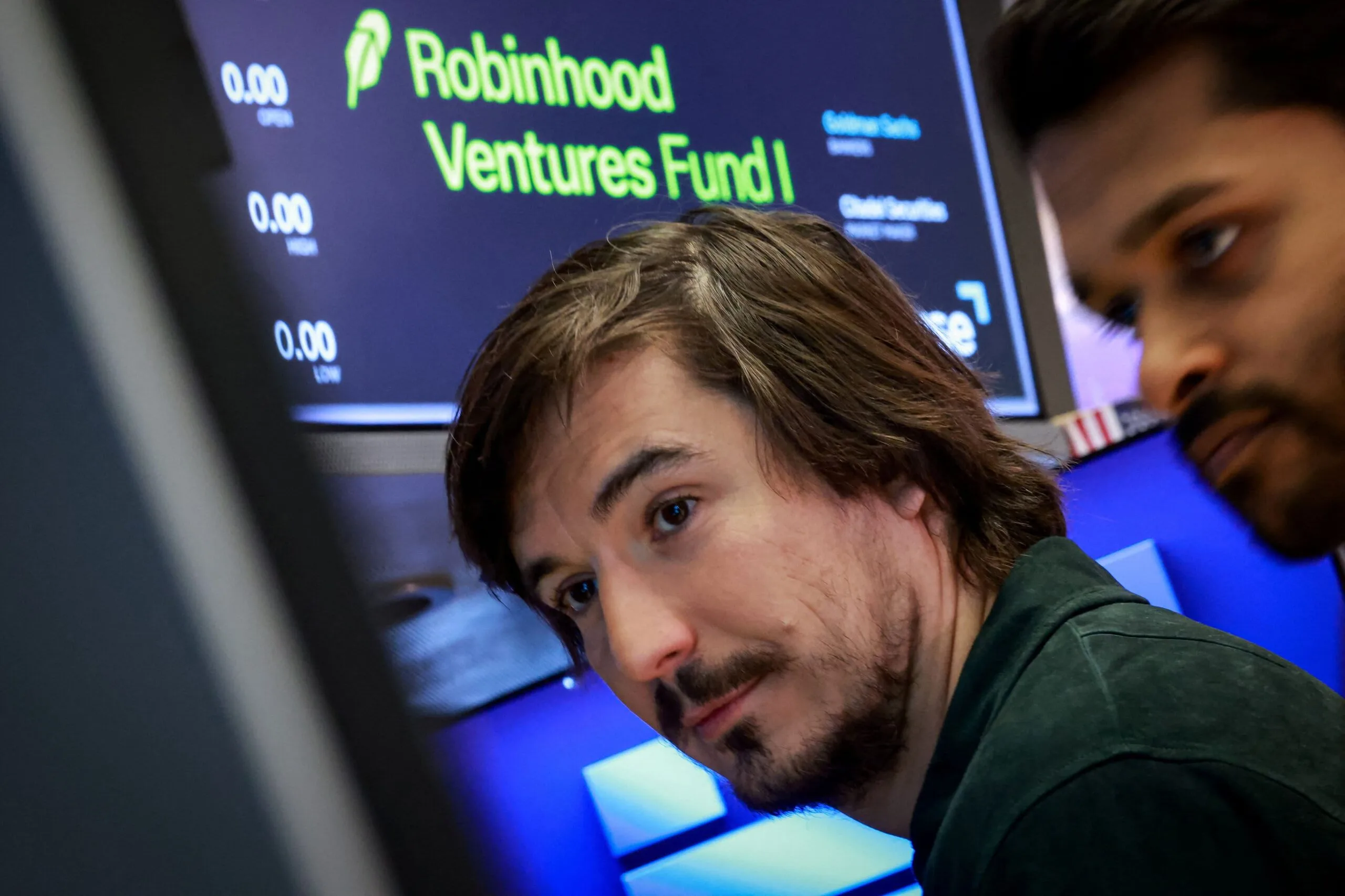
The ambition to bridge the widening gap between elite institutional capital and the everyday retail investor faced a harsh reality check on Friday as Robinhood Markets launched its inaugural venture fund on the New York Stock Exchange. Trading under the ticker RVI, the Robinhood Ventures Fund I experienced a tumultuous first day of public trading, closing down 11% from its initial offering price. The decline underscores a complex intersection of retail enthusiasm, institutional skepticism, and a volatile macroeconomic backdrop that continues to weigh heavily on high-growth, speculative assets.
Priced initially at $25 per share, the fund opened at $22 and faced immediate selling pressure, bottoming out at $21 before stabilizing slightly to close at that mark. The double-digit slide on day one serves as a stark reminder of the risks inherent in "democratizing" asset classes that have historically been the exclusive playground of pension funds, sovereign wealth funds, and ultra-high-net-worth individuals. While Robinhood’s leadership framed the launch as a revolutionary moment for financial inclusivity, the market’s response suggested that investors may be wary of the valuations assigned to private "unicorns" during a period of geopolitical instability and shifting monetary policy.
The Vision of Open-Access Private Equity
The launch of RVI represents the latest evolution in Robinhood’s broader strategy to diversify its revenue streams and deepen its relationship with its core user base. For years, the firm has positioned itself as a disruptor of the traditional financial establishment, first by eliminating trading commissions and later by introducing 24-hour trading and retirement accounts. With the Venture Fund I, CEO Vlad Tenev is targeting what many consider the final frontier of retail finance: the private markets.
In recent years, the lifecycle of a successful startup has changed dramatically. Companies are staying private longer, often reaching valuations in the tens or even hundreds of billions of dollars before ever considering an initial public offering (IPO). This shift has meant that the "hyper-growth" phase of a company’s life—where the most significant wealth creation occurs—is often completed by the time the general public can buy shares. Tenev’s stated mission is to "blow the hinges off" these closed doors, allowing retail participants to capture the upside of companies like the London-based fintech giant Revolut or the data-and-AI powerhouse Databricks.
By packaging these private holdings into a closed-end fund structure, Robinhood allows investors to trade shares of the fund on a public exchange just as they would a traditional stock. This provides a level of liquidity that is virtually non-existent in the traditional venture capital world, where capital is typically locked up for seven to ten years. However, as Friday’s trading proved, liquidity can be a double-edged sword; when sentiment turns negative, the ability to exit quickly can lead to rapid price erosion.
A Portfolio of Private Giants
The allure of the Robinhood Ventures Fund I lies in its underlying portfolio, which includes some of the most highly anticipated names in the tech and finance sectors. Among its top holdings are Revolut, which was recently valued at approximately $450 billion in secondary market discussions, and Databricks, the data analytics firm currently positioned at the center of the global artificial intelligence boom.
For the average investor, gaining exposure to such companies has historically required "accredited investor" status—a regulatory threshold requiring a high net worth or a consistent high income. By bypassing these requirements through a publicly traded fund structure, Robinhood is effectively offering a proxy for a diversified venture capital portfolio.
However, analysts have raised questions regarding the transparency and valuation of these private assets. Unlike public companies, which must provide quarterly audited financial statements, private firms operate with a degree of opacity. The 11% drop in RVI’s share price on its first day may reflect a "valuation gap"—a discrepancy between what the fund believes the underlying assets are worth and what the public market is willing to pay for them in a high-interest-rate environment.
Macroeconomic Headwinds and Geopolitical Friction
The timing of the fund’s debut could hardly have been more challenging. Global markets have been on edge as geopolitical tensions in the Middle East, specifically the escalating conflict between the U.S. and Iran, have sparked a flight to safety. Such environments are notoriously hostile to venture capital and growth-oriented investments, as traders pivot away from "risk-on" assets in favor of gold, treasuries, and defensive sectors.
The broader U.S. stock indices were already reeling from a week of volatility when RVI hit the tape. Investors are currently recalibrating their expectations for the Federal Reserve’s interest rate path, with many fearing that persistent inflation and global instability will keep rates "higher for longer." For a venture fund whose value is derived from future cash flows and high-growth projections, high interest rates are a significant headwind, as they increase the discount rate applied to those future earnings and squeeze the margins of the tech companies within the portfolio.
The Mechanics of the Closed-End Fund Trap
Financial historians and market analysts often point to the "closed-end fund discount" as a perennial risk for retail investors. Unlike an Open-End Mutual Fund or an Exchange Traded Fund (ETF), where the share price is generally pegged to the Net Asset Value (NAV) of the underlying holdings, a closed-end fund like RVI can trade at a significant premium or discount to its NAV based purely on supply and demand.
The 11% decline on the first day suggests that RVI is already trading at a steep discount to the $25 per share valuation set by the fund’s managers. This phenomenon often occurs when the market lacks confidence in the manager’s ability to pick winners or when the market believes the private valuations provided by the companies themselves are inflated. In the case of RVI, the market seems to be signaling that it wants a "margin of safety" before committing capital to a basket of private tech firms that have yet to prove their mettle in a public environment.
Furthermore, the costs associated with managing a venture fund—including management fees and the expenses of conducting due diligence on private entities—can eat into returns. While Robinhood has marketed the fund as a tool for the "democratization" of finance, the reality of the public markets is that price discovery is often ruthless.
Global Comparisons and the Future of Retail Venture Capital
Robinhood is not alone in its quest to bring private equity to the masses. Firms like Apollo Global Management, Blackstone, and KKR have all launched products aimed at the "wealth" segment, though many of these are structured as interval funds or non-traded REITs with limited liquidity. In Europe, the "European Long-Term Investment Fund" (ELTIF) framework has similarly sought to channel retail capital into infrastructure and private enterprise.
What sets Robinhood’s approach apart is its integration into a mobile-first, high-frequency trading platform. This creates a unique dynamic where long-term venture assets are being held by a demographic known for shorter-term trading horizons. If the fund continues to experience high volatility, it may test the resolve of the very investors Robinhood is trying to empower.
Despite the rocky start, the long-term viability of RVI will depend on the exit events of its portfolio companies. If Revolut or Databricks eventually goes public at valuations significantly higher than their current private marks, the fund’s NAV will rise, potentially erasing the initial losses for those who held through the volatility.
Navigating the New Frontier
The debut of the Robinhood Ventures Fund I serves as a case study in the complexities of modern market structure. On one hand, it represents a genuine attempt to level the playing field, providing access to wealth-building opportunities that were previously the domain of the 1%. On the other, it exposes retail investors to the brutal realities of institutional price discovery and the inherent risks of the venture capital asset class.
As the fund moves into its second week of trading, the focus will shift from the initial hype of the launch to the fundamental performance of its underlying assets. For Robinhood, the success of RVI is a critical component of its evolution from a "meme stock" brokerage to a comprehensive financial services powerhouse. However, the 11% first-day drop is a sobering reminder that in the world of high-stakes venture capital, the "hinges" of the door may be off, but the room inside remains as unpredictable as ever. Investors will now be watching closely to see if this dip represents a unique buying opportunity or a cautionary tale about the perils of entering the private markets at a time of global uncertainty.