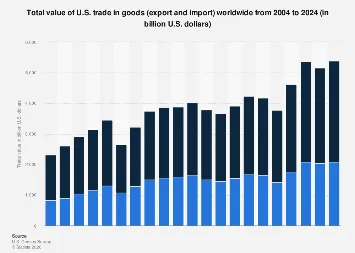
In 2024, the United States engaged in a monumental flow of goods across its borders, with the total value of its international trade reaching an estimated $5.4 trillion. This figure underscores the critical role of global commerce in the nation’s economic vitality, reflecting a complex interplay of imports and exports that shapes domestic industries and consumer markets. The data for the current year indicates that the U.S. brought in approximately $3.3 trillion worth of goods from its international trading partners, while simultaneously sending out goods valued at around $2.1 trillion. This substantial disparity between imports and exports points to a persistent trade deficit, a long-standing feature of the U.S. economic narrative.
The intricacies of international trade involve the movement of goods into and out of a nation. Imports, in the context of U.S. trade, encompass all merchandise brought into the country. This definition extends beyond goods manufactured exclusively in foreign lands; it also includes items of U.S. origin that may have undergone processing or refinement abroad before re-entering the domestic market. Conversely, exports represent goods that are sold to other countries, originating from U.S. soil. This category also encompasses foreign commodities that, after being imported into the U.S., are subjected to further processing, value addition, or manufacturing before being re-exported. This dynamic definition highlights the globalized nature of supply chains and the multifaceted contributions of various economies to the final products that circulate worldwide.
Analyzing the flow of goods reveals a significant reliance on international markets for consumer and industrial products. The $3.3 trillion in imports suggests a robust demand for a wide array of goods, from raw materials essential for manufacturing to finished consumer products that populate retail shelves. This influx of foreign goods contributes to price competition, offers consumers a broader selection, and provides U.S. businesses with access to specialized components and technologies that may not be readily available domestically. However, it also raises questions about the impact on domestic production and employment in sectors that face intense international competition.
On the export side, the $2.1 trillion represents the value generated by U.S. industries and agriculture reaching global consumers. These exports are vital for supporting American jobs, driving innovation, and enhancing the country’s balance of payments. The diversity of U.S. exports, ranging from agricultural products and manufactured goods to advanced technology and services, showcases the country’s competitive strengths in various global sectors. The ability of U.S. businesses to successfully compete in international markets is a key indicator of their efficiency, quality, and technological prowess.
The persistent trade deficit, with imports significantly outpacing exports, is a complex economic phenomenon with far-reaching implications. While a trade deficit is not inherently detrimental and can reflect strong domestic demand and investment, a sustained and widening deficit can signal underlying economic vulnerabilities. It can lead to an accumulation of foreign debt, potentially exert downward pressure on the domestic currency, and may indicate that certain domestic industries are struggling to compete internationally. Policymakers often grapple with strategies to address this imbalance, focusing on measures to boost exports, encourage domestic production, and ensure fair trade practices.
Examining the principal trading partners provides crucial insights into the geographic distribution of U.S. trade flows. In 2023, Mexico emerged as the foremost source of goods imported into the United States, with the value of these imports approximating $475.6 billion. This substantial figure reflects the deep economic integration between the two North American neighbors, facilitated by geographical proximity and trade agreements. Canada and Mexico also ranked prominently as major exporters of goods to the U.S., solidifying the North American trading bloc’s significance.
Conversely, when considering the destinations for U.S. exports, Canada stood out in 2023 as the leading market, absorbing over $350 billion worth of American trade goods. This highlights the strong demand for U.S. products in its northern neighbor. Mexico and China also featured prominently on the list of countries importing U.S. goods, underscoring their importance as key markets for American industries. The trade relationships with these nations are critical for the performance of numerous U.S. sectors, influencing investment decisions, employment levels, and overall economic growth.
The dynamics of trade with Mexico and Canada are particularly noteworthy. Their proximity offers logistical advantages, reducing transportation costs and lead times. Furthermore, trade agreements like the United States-Mexico-Canada Agreement (USMCA) aim to facilitate seamless trade flows and create a predictable regulatory environment for businesses operating within North America. This regional integration is a cornerstone of the U.S. trade strategy, fostering economic interdependence and mutual prosperity.
China’s role as both a major importer of U.S. goods and a significant source of imports for the U.S. presents a more complex picture. Despite ongoing trade tensions and geopolitical considerations, China remains a crucial market for American agricultural products, manufactured goods, and increasingly, services. Simultaneously, China is a primary supplier of a vast array of consumer electronics, apparel, and industrial components to the U.S. The intricate and often contentious trade relationship with China has significant implications for global supply chains, international trade rules, and economic policy decisions in both countries and around the world.
The sheer scale of the U.S. trade volume, totaling $5.4 trillion in 2024, positions the United States as a pivotal player in the global economy. Its import and export activities influence commodity prices, manufacturing output, and consumer spending patterns worldwide. The U.S. consumer market, with its high purchasing power, acts as a powerful engine for global demand, while U.S. industries, driven by innovation and scale, contribute significantly to the global supply of goods and services.
Economic analyses of the trade deficit often consider its impact on national savings and investment. A persistent deficit implies that the U.S. is consuming more than it produces, necessitating borrowing from foreign sources to finance this consumption. While foreign investment can fuel domestic capital formation and economic growth, excessive reliance on foreign capital can create vulnerabilities. Understanding these macroeconomic linkages is crucial for formulating effective trade and economic policies.
Moreover, the composition of trade is as important as its value. The U.S. trade balance in goods versus services often tells different stories. While the U.S. typically runs a deficit in goods trade, it often enjoys a surplus in services trade, encompassing areas like financial services, technology, and intellectual property. This highlights the growing importance of the services sector in the U.S. economy and its global competitiveness.
Looking ahead, the trajectory of U.S. trade will be shaped by a confluence of factors, including global economic growth, geopolitical stability, technological advancements, and evolving trade policies. The ongoing digital transformation, the shift towards sustainable energy, and the reshoring or nearshoring of production capabilities are all likely to influence the patterns and composition of U.S. international trade in the coming years. The ability of the U.S. to adapt to these changes, foster innovation, and maintain competitive industries will be critical in navigating the complexities of the $5.4 trillion global trade landscape and ensuring its continued economic prosperity. The $5.4 trillion figure is not merely a number; it represents a dynamic network of economic relationships that are fundamental to the well-being of the United States and its partners across the globe.