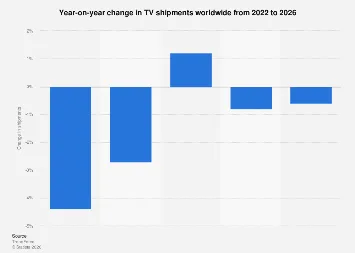
The global television market is projected to experience a period of sustained, albeit moderate, growth in the coming years, with shipments anticipated to expand through 2026. This forecast, derived from comprehensive market analysis, indicates a dynamic landscape shaped by the relentless pace of technological innovation, evolving consumer demands, and the strategic maneuvers of major manufacturers. While the era of explosive unit sales growth seen in prior decades may have plateaued, the industry is entering a new phase characterized by higher average selling prices (ASPs) and a focus on premium features, which will underpin its overall economic trajectory.
Several key factors are contributing to this projected expansion. The continued proliferation of smart TV functionalities, offering seamless integration with streaming services, online content, and other connected devices, remains a primary driver. Consumers are increasingly seeking an all-encompassing entertainment hub within their living rooms, and manufacturers are responding by embedding sophisticated operating systems, voice control capabilities, and advanced connectivity options as standard features. This technological sophistication not only enhances the user experience but also justifies higher price points for newer models, contributing to revenue growth even if unit volumes see more subdued increases.
Furthermore, the ongoing development and refinement of display technologies are playing a crucial role. While OLED and QLED panels have become increasingly accessible, pushing the boundaries of visual fidelity with superior contrast ratios, color accuracy, and brightness, advancements in Mini-LED and Micro-LED technologies are promising even more immersive and energy-efficient viewing experiences. These premium technologies, initially confined to the high-end segment, are gradually trickling down to more mainstream offerings, creating upgrade cycles and attracting consumers willing to invest in cutting-edge visual performance. The demand for larger screen sizes, a trend that has been accelerating for years, also continues to support revenue growth, as these larger displays command higher prices.
Emerging markets present a significant growth frontier. As disposable incomes rise in regions across Asia, Africa, and Latin America, a burgeoning middle class is increasingly adopting television sets as a primary source of entertainment and information. While these markets may initially gravitate towards more budget-friendly models, the long-term trend points towards an increasing demand for smart functionalities and better display quality as consumers become more familiar with global entertainment trends and aspire to higher-quality home entertainment setups. This demographic shift offers substantial volume potential, albeit with pricing pressures that manufacturers will need to navigate carefully.
However, the television market is not without its challenges. The global supply chain, while stabilizing after recent disruptions, continues to be a factor that can influence production costs and product availability. Geopolitical tensions and trade policies can also introduce volatility, impacting the cost of components and finished goods. Moreover, the increasing fragmentation of content delivery – with a multitude of streaming services and a rise in over-the-top (OTT) platforms – means that consumers are discerning about where they allocate their entertainment budgets. While this fuels the demand for smart TVs, it also intensifies competition among content providers, indirectly influencing hardware purchasing decisions.
The competitive landscape remains intense, dominated by a few global giants and a host of regional players. Korean manufacturers like Samsung and LG continue to lead in innovation and market share, particularly in the premium segments, leveraging their strong brand recognition and advanced R&D capabilities. Chinese manufacturers, such as TCL and Hisense, have made significant inroads by offering compelling value propositions, combining competitive pricing with increasingly sophisticated features, and are rapidly expanding their global presence. Japanese brands, while perhaps less dominant than in previous eras, still hold sway with their focus on picture quality and reliability. The strategic decisions of these players regarding product development, pricing, and market penetration will be critical in shaping the overall market trajectory.
Analyzing the economic impact, the television industry is a significant contributor to global manufacturing output and employment. The production of televisions involves complex supply chains, from semiconductor fabrication and component manufacturing to assembly and logistics. A healthy and growing television market translates into sustained demand for these upstream industries, supporting jobs and economic activity across multiple sectors. Furthermore, the widespread adoption of smart TVs fosters the growth of the digital content and software industries, creating a symbiotic relationship that drives innovation and economic diversification.
Looking ahead, the forecast for modest growth through 2026 suggests a mature market that is evolving rather than experiencing explosive expansion. The focus will likely remain on technological differentiation, with manufacturers striving to offer unique selling propositions that justify premium pricing. Sustainability and energy efficiency are also emerging as important considerations for consumers and manufacturers alike, potentially influencing product design and material sourcing in the coming years. The ability of the industry to navigate these evolving consumer preferences and technological landscapes will determine its success in achieving sustained, profitable growth in the years to come. The television, once a mere passive display device, has transformed into an intelligent gateway to a universe of digital content, and its continued evolution promises to keep it at the heart of the connected home.