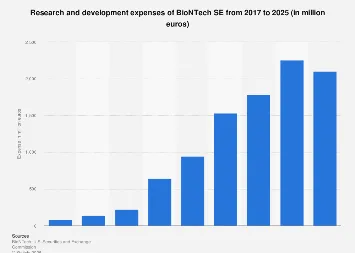
BioNTech SE, the German biotechnology firm that revolutionized vaccine development with its mRNA technology, is significantly increasing its investment in research and development (R&D) over the coming years, signaling a robust commitment to expanding its pipeline beyond its initial COVID-19 vaccine success. Projections indicate that the company’s R&D expenses are set to reach approximately $2.1 billion USD in 2025, a substantial escalation from the $1.53 billion recorded in 2022. This upward trajectory underscores BioNTech’s strategic vision to leverage its foundational mRNA platform for a broad spectrum of therapeutic areas.
The surge in R&D expenditure is not merely an incremental increase but a testament to the company’s ambition to solidify its position as a leader in next-generation medicines. In 2017, BioNTech’s R&D spending was a modest $85.5 million euros. By 2020, the year it announced its groundbreaking COVID-19 vaccine in partnership with Pfizer, R&D expenses had climbed to 645 million euros. The subsequent years saw continued growth, reaching 949.2 million euros in 2021 and 1.53 billion euros in 2022. The company’s financial outlook anticipates further increases, with projected R&D spending of 1.78 billion euros in 2023, 2.25 billion euros in 2024, and peaking at 2.10 billion euros in 2025, though the conversion to USD in the initial projection of $2.1 billion for 2025 might represent a slight deviation or a preliminary estimate that will be refined by market exchange rates. The figures presented in euros reveal a consistent and accelerating investment, with 2024 poised to be the highest spending year at 2,254.2 million euros, followed closely by 2025 at 2,104.9 million euros.
This amplified investment is crucial for BioNTech’s long-term strategy. The company’s initial triumph with the COVID-19 vaccine, BNT162b2, demonstrated the immense potential of mRNA technology. However, sustained growth in the highly competitive biopharmaceutical sector necessitates a diversified portfolio and a continuous pipeline of novel therapies. BioNTech is actively pursuing R&D in several key areas, including infectious diseases, oncology, and autoimmune disorders. The substantial financial commitment reflects the inherent costs and complexities associated with drug discovery and development, from early-stage research and preclinical testing to rigorous clinical trials and regulatory approvals.
The global biopharmaceutical market is characterized by intense competition and a relentless drive for innovation. Companies that can successfully translate scientific breakthroughs into effective treatments not only achieve significant commercial success but also address unmet medical needs, improving patient outcomes worldwide. BioNTech’s strategic focus on R&D positions it to capitalize on emerging scientific advancements and to address critical global health challenges. The company’s mRNA platform offers inherent advantages, including rapid development cycles and the potential for personalized medicine approaches, particularly in the field of cancer immunotherapy.
The economic implications of BioNTech’s R&D strategy are far-reaching. Increased investment in research and development often translates into job creation within the scientific and technical fields, as well as in manufacturing and administrative roles. Furthermore, successful drug development can lead to substantial revenue generation, contributing to a company’s market capitalization and shareholder value. Beyond the direct economic benefits to the company, BioNTech’s innovations have the potential to reduce healthcare burdens by preventing or treating diseases more effectively, leading to long-term societal and economic gains.
Comparing BioNTech’s R&D investment to industry benchmarks provides further context. Major pharmaceutical companies often allocate a significant portion of their revenue to R&D, with figures frequently ranging from 15% to 25% or even higher for companies focused on innovative therapies. While BioNTech’s projected R&D expenses represent a substantial absolute figure, understanding their proportion relative to its projected revenue will offer a clearer picture of its R&D intensity. The success of its COVID-19 vaccine has provided the financial resources to fuel this ambitious expansion.
The company’s aggressive R&D spending also highlights the evolving landscape of drug development. The shift towards targeted therapies and personalized medicine, often enabled by advanced molecular technologies like mRNA, requires significant upfront investment in research. BioNTech’s commitment suggests a long-term vision that extends beyond immediate commercial opportunities, aiming to build a sustainable innovation engine capable of delivering multiple therapeutic breakthroughs. The ability to pivot and adapt its mRNA technology to various diseases, from novel viral threats to complex cancers, is a key strategic advantage.
Furthermore, the global R&D landscape is increasingly characterized by collaborations and partnerships, a strategy BioNTech has effectively employed. Its successful alliance with Pfizer for the COVID-19 vaccine is a prime example. Future R&D endeavors are likely to involve similar collaborations with academic institutions, research organizations, and other pharmaceutical companies to accelerate discovery and development. These partnerships can mitigate risks, share expertise, and provide access to complementary technologies and market insights, further amplifying the impact of BioNTech’s internal R&D investments.
The projected R&D expenses for BioNTech in 2025 reflect a strategic imperative to continuously innovate and expand its therapeutic reach. This substantial investment is crucial for navigating the complexities of drug development, maintaining a competitive edge in the global biopharmaceutical market, and ultimately, for delivering life-changing treatments to patients worldwide. The company’s trajectory indicates a clear focus on harnessing the full potential of its mRNA platform, aiming to build a diversified and robust pipeline that will define its future success.