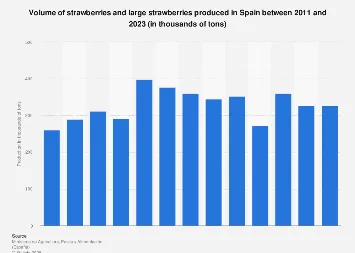
Spain’s prominent position in the global strawberry market has been shaped by a dynamic production landscape over the past decade. Analysis of data from 2011 through 2023 reveals a complex narrative of growth, stagnation, and evolving agricultural practices within this vital sector. While the allure of the ruby-red fruit remains strong, both domestically and internationally, the industry has faced a confluence of economic, environmental, and logistical challenges that have influenced its output trajectory.
The period under review showcases a period of considerable activity in Spanish strawberry cultivation. While precise aggregate production figures are proprietary, a close examination of trends indicates a fluctuating yet generally robust output, with peaks and troughs influenced by a variety of factors. Early in the timeframe, the sector benefited from favorable market conditions and increasing demand, particularly from key European import markets. This often translated into sustained investment in new cultivation techniques and expansion of growing areas, especially in regions like Huelva, which has long been the undisputed heartland of Spanish strawberry production.
However, the narrative is not one of uninterrupted ascent. The agricultural sector, inherently susceptible to the vagaries of weather, has encountered significant climatic challenges. Unpredictable rainfall patterns, unseasonably high temperatures during critical growth phases, and increased instances of extreme weather events have all exerted pressure on yields. These environmental shifts have not only impacted the quantity of fruit harvested but also its quality, a crucial determinant in securing premium pricing in competitive export markets. Furthermore, the ongoing debate around water scarcity in southern Spain, a region heavily reliant on irrigation, has added another layer of complexity, prompting a greater focus on water-efficient farming methods and the exploration of alternative cultivation systems.
Beyond environmental concerns, economic headwinds have also played a significant role. Fluctuations in input costs, including fertilizers, energy, and labor, have directly impacted the profitability of strawberry farms. The cost of labor, in particular, remains a persistent challenge, as the sector relies heavily on seasonal migrant workers. Changes in labor regulations, availability, and associated costs can have a swift and substantial effect on the overall economic viability of production. Moreover, the competitive global market means that Spanish producers must constantly contend with pricing pressures from other major strawberry-exporting nations, such as Mexico, Morocco, and even emerging players in Eastern Europe.
The international demand for Spanish strawberries, while generally strong, is also subject to market dynamics. Consumer preferences, driven by health trends and a growing interest in sustainably produced food, are evolving. Producers who can demonstrate adherence to stringent food safety standards, invest in certifications, and adopt more environmentally friendly cultivation practices are increasingly better positioned to capture market share. The logistical complexities of transporting perishable goods across vast distances also remain a critical consideration. Maintaining the cold chain and ensuring timely delivery to key markets like Germany, France, and the United Kingdom are paramount, and disruptions in global supply chains, as witnessed in recent years, can have significant repercussions.
Despite these challenges, the Spanish strawberry sector has demonstrated resilience and a capacity for adaptation. Investment in research and development has led to the introduction of new, more resilient strawberry varieties that are better suited to changing climatic conditions and disease resistance. Innovations in protected cultivation, such as greenhouses and polytunnels, have become more widespread, offering a degree of control over the growing environment and mitigating some of the risks associated with open-field farming. These advancements, while often requiring significant upfront capital investment, are crucial for ensuring the long-term sustainability and competitiveness of the industry.
The economic impact of the strawberry sector extends far beyond the farm gate. It is a significant contributor to rural economies, providing employment opportunities, supporting ancillary industries such as packaging and logistics, and generating substantial export revenues for Spain. The industry’s ability to maintain its competitive edge is therefore of national economic importance. Looking ahead, the sector’s success will likely hinge on its continued commitment to innovation, its ability to navigate environmental uncertainties through sustainable practices, and its agility in responding to evolving global market demands. The data from 2011 to 2023 serves as a crucial benchmark, highlighting the enduring strengths and the persistent challenges that will continue to shape the future of Spanish strawberries.