The Chinese government has signaled a strategic recalibration of its military ambitions, announcing a planned 7% increase in national defense spending for the current fiscal year. This figure, revealed in a comprehensive budget report by the Ministry of Finance during the opening of the National People’s Congress (NPC), represents the slowest pace of growth in Beijing’s military expenditure since 2021. While the marginal deceleration from the 7.2% annual increases seen over the previous three years suggests a degree of fiscal pragmatism, the move underscores a persistent commitment to transforming the People’s Liberation Army (PLA) into a world-class fighting force capable of projecting power far beyond its borders.
This budgetary disclosure arrives at a precarious moment for global stability. With the Middle East embroiled in escalating conflict and the Indo-Pacific region grappling with sustained tensions over the status of Taiwan and territorial disputes in the South China Sea, China’s fiscal priorities serve as a barometer for its long-term strategic intentions. The 7% uptick, though lower than previous years, occurs against a backdrop of broader economic headwinds within the domestic Chinese economy, including a cooling property sector and fluctuating consumer confidence, forcing Beijing to balance the "guns versus butter" dilemma with increasing precision.
Despite the slight cooling in the rate of growth, the sheer scale of China’s military investment remains a focal point for international economists and defense analysts. Last year’s proposed defense budget stood at 1.78 trillion yuan (approximately $245 billion). A 7% increase would push this figure toward the 1.9 trillion yuan mark, solidifying China’s position as the world’s second-largest military spender. However, the official figures provided by Beijing are frequently the subject of intense scrutiny by Western intelligence agencies and independent think tanks, who argue that the "headline" number fails to capture the full extent of China’s military-related outlays.
The United States Department of Defense, in its 2025 annual report to Congress, estimated that China’s actual military-related spending in 2024 ranged between $304 billion and $377 billion. This discrepancy—suggesting that actual spending may be 32% to 63% higher than the officially stated $231 billion for that year—stems from the exclusion of several "off-budget" items. These typically include research and development costs for advanced weaponry, the procurement of foreign hardware, and the funding of the People’s Armed Police, a paramilitary force responsible for internal security and maritime law enforcement. When these factors are accounted for, China’s military shadow looms much larger over the global economic landscape.
A central pillar of this year’s military strategy, as outlined in the government’s work report, is the pursuit of "high-quality" modernization. This phrase reflects a shift away from mere numerical expansion toward the integration of advanced technologies, such as artificial intelligence, cyber capabilities, and sophisticated aerospace engineering. The report highlighted the commissioning of the Fujian, China’s first domestically designed and built aircraft carrier featuring electromagnetic catapults, as a symbol of this technological leap. The Fujian, which joined the fleet in late 2025, represents a significant upgrade over its predecessors, allowing the PLA Navy to launch heavier aircraft with greater fuel and weapons loads, thereby extending its operational reach into the "Second Island Chain."
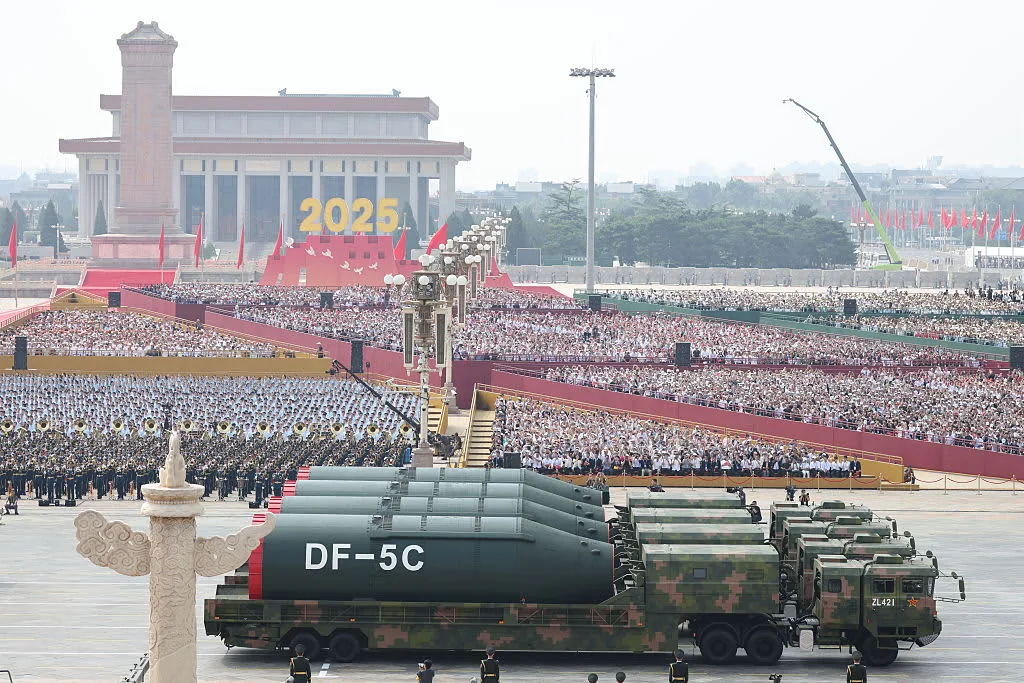
The modernization drive was also visible during a massive military parade held in September, which showcased the DongFeng-5C (DF-5C) liquid-fueled intercontinental strategic nuclear missiles. These assets, capable of striking targets globally, underscore Beijing’s focus on maintaining a credible nuclear deterrent while simultaneously building out its conventional "Anti-Access/Area Denial" (A2/AD) capabilities. For global markets, these developments indicate that China is prioritizing the protection of its maritime trade routes—the lifeblood of its export-oriented economy—and securing its energy supply lines that stretch across the Indian Ocean to the Middle East.
Geopolitically, the budget announcement reinforces Beijing’s uncompromising stance on regional sovereignty. The government work report explicitly stated that China would "resolutely fight against separatist forces aimed at ‘Taiwan independence’ and oppose external interference." This rhetoric, coupled with consistent military spending growth, signals to both Washington and Taipei that Beijing remains committed to its long-term goal of national reunification, by force if necessary. The economic implications of a conflict in the Taiwan Strait would be catastrophic, with some estimates suggesting a global GDP contraction of up to 10% due to the disruption of semiconductor supply chains and international shipping lanes.
From a regional perspective, China’s military spending is fundamentally altering the balance of power in Asia. According to data from the International Institute for Strategic Studies (IISS), Beijing accounted for nearly 44% of total defense spending in Asia in 2025, a significant rise from the 39% recorded in 2017. This dominance has sparked a regional arms race, with neighboring powers such as Japan, Australia, and India substantially increasing their own defense outlays. Japan, in particular, has embarked on its largest military buildup since World War II, citing the "unprecedented strategic challenge" posed by China’s rapid modernization and assertive maritime activities.
When compared globally, the United States remains the undisputed leader in military expenditure, with a fiscal year 2025 budget request of approximately $849.77 billion. Actual U.S. spending, according to non-profit data from USAFacts, reached an estimated $919.2 billion, representing about 13% of the total federal budget. While the U.S. maintains a significant lead in total dollar terms, analysts point out that China benefits from lower labor costs and a highly integrated civil-military industrial complex, allowing Beijing to achieve more "bang for its buck" in terms of hardware procurement and infrastructure development.
The 7% growth rate also reflects the internal economic pressures facing the Chinese Communist Party. As the government targets a GDP growth rate of around 5%, allocating a significant portion of the budget to the military requires careful management of public debt and social spending. Economists note that while defense spending can stimulate certain high-tech sectors of the economy, it also diverts resources away from addressing demographic challenges, such as an aging population and a shrinking workforce. The decision to moderate the growth rate to 7% may be a concession to these economic realities, ensuring that military expansion does not come at the cost of domestic social stability.
Furthermore, the "high-quality" modernization mentioned in the report suggests an emphasis on indigenous innovation. By reducing reliance on foreign technology and fostering a domestic defense-industrial base, China aims to insulate its military supply chains from Western sanctions. This strategy of "dual-use" technology development—where advancements in the commercial sector, such as 6G telecommunications and quantum computing, are integrated into military applications—is a cornerstone of Beijing’s long-term economic and security planning.
As the eight-day National People’s Congress continues, the international community will be watching closely for further details on how these funds will be allocated. The shift to a 7% increase may be interpreted by some as a sign of relative restraint, but in the context of China’s massive economic base, it represents a formidable and consistent investment in power projection. In an era defined by great power competition, Beijing’s latest budget confirms that while the pace of growth may fluctuate, the trajectory toward a modernized, technologically superior military remains unchanged. The global economic and security order is being reshaped not just by the weapons China displays in its parades, but by the calculated, persistent flow of capital into its defense apparatus.